1,530 mm Cast-Resin Double Vanity - Storm Blue, Flat-Pack
A 60-inch double vanity with a seamless resin top and a board carcass you can actually document: three cartons, 0.44 m3, 148 sets on a 40HQ.
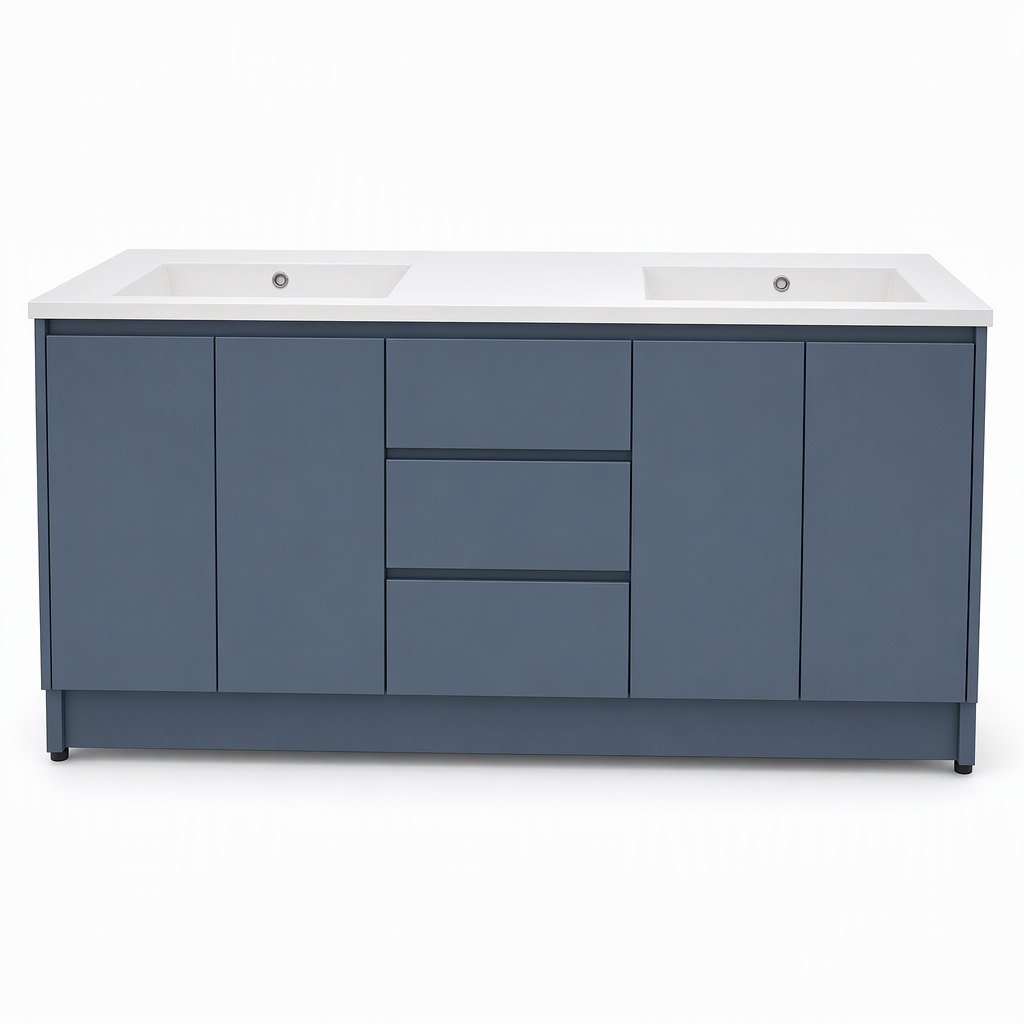
A US turn schedule does not buy a 60-inch double vanity because it photographs well. It buys a unit that survives a tenant, a mop bucket and a maintenance call, and that arrives with paperwork an importer can hand to a broker without rewriting it. RB1530 is built on that order of priorities. The top is one cast-resin casting with two 420 mm bowls, so there is no grout line to fail and no seam to silicone in year three. Every panel in the carcass is TSCA Title VI certified particleboard at the 0.09 ppm limit, labelled at the carton as the rule requires. Three cartons, 0.44 m3, 148 sets to a 40HQ. Storm blue super-matte fronts at 5 gloss.
- ModelFAME-RB-153SB (RB1530 series)
- Overall size1,530 W x 560 D x 850 H mm carcass (60 x 22 x 33.5 in), 870 mm with top, 58.5 kg net
- LayoutThree bays: 540 mm two-door sink base, 450 mm three-drawer bank, 540 mm two-door sink base; 100 mm toe kick on four adjustable legs
- Top / basinOne-piece cast-resin top 1,540 x 570 x 20 mm rim, two integrated bowls 420 x 320 x 130 mm, matte white gel coat, overflow drilled to a 32 mm waste
- Carcass18 mm particleboard certified to TSCA Title VI (0.09 ppm) and CARB Phase 2, melamine faced both sides, 5 mm HDF back panel in a groove, sealed back edges
- FinishStorm blue super-matte melamine at 5 gloss units; fronts and carcass matched; alternative finishes to the same profile from 60 sets per colour
Trade inquiry only — this is a B2B catalog with no online checkout. Our team replies within 24 hours.
Full Specification
- ModelFAME-RB-153SB (RB1530 series)
- Overall size1,530 W x 560 D x 850 H mm carcass (60 x 22 x 33.5 in), 870 mm with top, 58.5 kg net
- LayoutThree bays: 540 mm two-door sink base, 450 mm three-drawer bank, 540 mm two-door sink base; 100 mm toe kick on four adjustable legs
- Top / basinOne-piece cast-resin top 1,540 x 570 x 20 mm rim, two integrated bowls 420 x 320 x 130 mm, matte white gel coat, overflow drilled to a 32 mm waste
- Carcass18 mm particleboard certified to TSCA Title VI (0.09 ppm) and CARB Phase 2, melamine faced both sides, 5 mm HDF back panel in a groove, sealed back edges
- FinishStorm blue super-matte melamine at 5 gloss units; fronts and carcass matched; alternative finishes to the same profile from 60 sets per colour
- Fronts / doors4 slab doors at 18 mm with a 2 mm shadow gap, no handle drilling, push-latch standard, 128 mm pull optional
- Hinges8 concealed soft-close hinges at 110 degrees, clip-on, 3-way adjustment, 50,000-cycle rated
- Drawers3 drawers on 30 kg concealed full-extension soft-close runners, 16 mm boxes, 8 mm bases, 450 mm bank
- Packaging3 cartons per set: flat-pack carcass, cast-resin top in a moulded EPS cradle, hardware box inside carton 1; 5-layer corrugated, 15 mm foam corners, assembly drawing and care sheet
- Volume / weight0.44 m3 per set, 62 kg gross (58.5 kg net), 141 kg per m3; largest carton 1,600 x 520 x 260 mm
- Loading / MOQ148 sets per 40HQ at 66 m3 usable, 62 sets per 20GP; MOQ 20 sets per model, 3 finishes mixable from 60; 30-35 days after deposit and finish approval
- ComplianceTSCA Title VI finished-goods label on every carton; statement of compliance on the invoice and packing list; CARB Phase 2 panel certificates available on request
- Port / termsFOB Ningbo or Shanghai; CIF Los Angeles, Long Beach, Savannah and Houston quoted on request, with THC and ISF filing shown separately
Why Buyers Choose This Model
- 1,530 W x 560 D x 850 H mm (60 x 22 x 33.5 in), three bays: a 540 mm sink base left, a 450 mm three-drawer bank centre and a 540 mm sink base right, with a 100 mm toe kick on adjustable legs
- One-piece cast-resin top at 1,540 x 570 mm with two integrated bowls of 420 x 320 x 130 mm, matte white gel coat, non-porous and sandable, so a chip is repaired on site instead of a top being replaced
- 18 mm particleboard certified to TSCA Title VI at the 0.09 ppm limit and to CARB Phase 2, melamine faced on both faces, 1 mm ABS hot-melt on every exposed edge, sealed back edges
- Storm blue super-matte melamine at 5 gloss units on 18 mm slab fronts, one finish across fronts and carcass, so a replacement door in year four does not arrive in a different sheen
- 8 concealed soft-close hinges at 110 degrees with 3-way adjustment, and a three-drawer bank on 30 kg full-extension soft-close runners with 16 mm boxes and 8 mm bases
- Cam and dowel assembly with pre-inserted nylon dowels and 32 mm system holes: roughly 25 minutes per unit with a cordless drill, a number 2 square bit and a 4 mm hex key, and no panel cut on site
- Three cartons at 0.44 m3 and 62 kg gross, which is 148 sets per 40HQ on 66 m3 usable and 300 sets per 45HQ pallet-free load, filling on cube at about 9.2 t against a payload above 26 t
- Finished goods carry the fabricator name, the month and year of production and the TSCA Title VI compliance statement on the carton label, so the container clears without a relabel job at the warehouse
Specification Questions Buyers Ask
Why a cast-resin top instead of a ceramic or stone top on a 60-inch unit?
What exactly does the TSCA Title VI label on the carton have to say?
How is 148 sets per 40HQ calculated, and does a mixed container change it?
What should be in the first container beyond the cabinets?
Can the same carcass be ordered with a different top or a different finish?
Building a Basins Program?
Send your target market, sizes and quantities — we reply within 24 hours with a tailored quotation.