1000mm Mist White Melamine Vanity with a Ceramic Top-Basin
0.229 m3 for one metre of run, against roughly 0.28 m3 for a 900 plus two 500s: the width that removes a filler also removes a carton
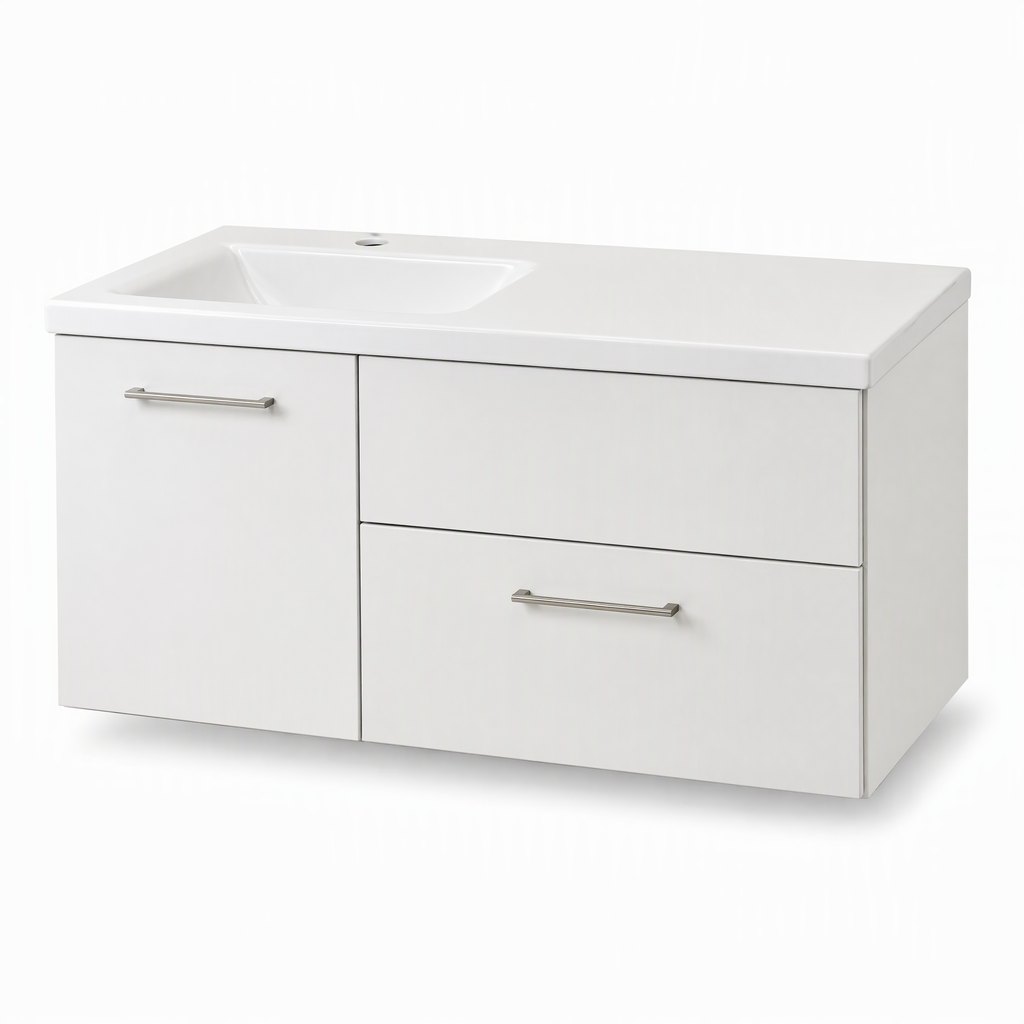
A 1000 mm vanity usually exists to close a gap that a 900 mm unit leaves, and that gap gets closed with an infill panel, a second carcass or a silicone bead. This is one carcass at 1000 mm, so the filler leaves the order and a joint leaves the wall. The body is 18 mm EN 312 P3 board in E1, melamine faced both sides over a 5 mm HDF back, the specification that survives a tenant rather than a showroom. The top is a one-piece ceramic casting at 20 mm with the bowl molded in, not cut and bonded. Three cartons at 0.229 m3 and 58 kg, about 295 sets to a 40HQ.
- ModelFAME-MM-1000MW
- Nominal size1000 x 460 x 520 mm (39.4 x 18.1 x 20.5 in), W x D x H, wall-hung; the 460 mm depth and 520 mm height are the same carcass family as the 600 and 900 mm units, so only the width changes on the cutting list
- Carcass18 mm EN 312 P3 particleboard, E1 emission class, melamine faced both sides, ABS edge 1 mm on exposed edges; 5 mm HDF back rebated into the side panels
- Fronts18 mm MFC slab doors and drawer fronts, mist white matte at 4 to 6 gloss units, 1 mm ABS laser edge on four sides, 3 mm reveal, factory jig-drilled for a 128 mm handle; 1000 mm as one 400 mm door and a 600 mm two-drawer bank
- Top and basinOne-piece ceramic top 20 mm, vitreous china fired at 1,280 C, glazed bowl 500 x 350 x 125 mm molded into the casting; white, with a 20 mm upstand available on request
- Drilling2 x 35 mm tap holes on 200 mm centers; 32 mm waste aperture with a 60 mm overflow slot, cut and glazed in the plant; three-hole sets drilled to your centers on request
Trade inquiry only — this is a B2B catalog with no online checkout. Our team replies within 24 hours.
Full Specification
- ModelFAME-MM-1000MW
- Nominal size1000 x 460 x 520 mm (39.4 x 18.1 x 20.5 in), W x D x H, wall-hung; the 460 mm depth and 520 mm height are the same carcass family as the 600 and 900 mm units, so only the width changes on the cutting list
- Carcass18 mm EN 312 P3 particleboard, E1 emission class, melamine faced both sides, ABS edge 1 mm on exposed edges; 5 mm HDF back rebated into the side panels
- Fronts18 mm MFC slab doors and drawer fronts, mist white matte at 4 to 6 gloss units, 1 mm ABS laser edge on four sides, 3 mm reveal, factory jig-drilled for a 128 mm handle; 1000 mm as one 400 mm door and a 600 mm two-drawer bank
- Top and basinOne-piece ceramic top 20 mm, vitreous china fired at 1,280 C, glazed bowl 500 x 350 x 125 mm molded into the casting; white, with a 20 mm upstand available on request
- Drilling2 x 35 mm tap holes on 200 mm centers; 32 mm waste aperture with a 60 mm overflow slot, cut and glazed in the plant; three-hole sets drilled to your centers on request
- Hinges and drawersDTC 110 degree clip-on hinges, 3D cam adjustment, 40,000 cycles; DTC 30 kg soft-close tandem runners, 50,000 cycles, on a 16 mm drawer base
- HandleBrushed nickel aluminum bar, 128 mm centers, 10 mm projection; other centers and finishes quoted against the door drilling
- Hanging systemSteel rail across the full 1000 mm with 2 x M8 through-bolts, levelling cams and an EPDM wall gasket; fixing schedule for masonry, stud wall and plasterboard on steel frame
- Weight58 kg gross packed; about 46 kg installed dry, about 52 kg with water and contents, which is the figure the wall sees
- PackingThree cartons: carcass 1,040 x 520 x 150 mm at 0.081 m3 and 26 kg; fronts and hardware 1,010 x 480 x 120 mm at 0.058 m3 and 9 kg; ceramic top 1,060 x 500 x 170 mm at 0.090 m3 and 23 kg
- Loading quantity0.229 m3 per set: about 295 sets per 40HQ at 68 m3 usable, about 120 sets per 20GP
- MOQ20 pcs per model per finish
- Lead time25-30 days after deposit and finish confirmation
- Loading portNingbo / Shanghai, FOB
Why Buyers Choose This Model
- 1000 x 460 x 520 mm as a single carcass: one metre of run at 0.229 m3 in three cartons, against roughly 0.28 m3 for a 900 mm unit plus two 500 mm fillers, so a filler panel, a second back panel and a second rail leave the bill of materials
- 18 mm EN 312 P3 particleboard in E1, melamine faced on both faces and edged on all four sides before assembly, on a 5 mm HDF back that is rebated rather than stapled, so a wet mop and a leaking trap meet a panel with a sealed edge instead of an open chipboard core
- Mist white matte melamine at 4 to 6 gloss units on doors and end panels from the same press run and the same decor batch, so a 1 m run shows no color step between a door and the visible end panel
- One-piece ceramic top at 20 mm, vitreous china fired at 1,280 C, with a 500 x 350 x 125 mm bowl molded into the casting rather than bonded under it, so there is no joint line at the rim for soap scum to collect in
- Two 35 mm tap holes on 200 mm centers as standard, with a 32 mm waste aperture and a 60 mm overflow slot drilled and glazed in the plant, so a plumber is not cutting glaze on site and voiding the warranty
- One 400 mm door on DTC 110 degree clip-on hinges rated 40,000 cycles with 3D cam adjustment, plus a 600 mm two-drawer bank on DTC 30 kg soft-close runners at 50,000 cycles, which puts storage where a 1000 mm unit actually needs it
- Brushed nickel aluminum bar handle at 128 mm centers, jig-drilled in the factory, with the drilling centers published on the drawing so a replacement front from stock fits without a template
- Three cartons at 0.229 m3 and 58 kg gross: carcass 1,040 x 520 x 150 mm at 26 kg, fronts 1,010 x 480 x 120 mm at 9 kg, ceramic top 1,060 x 500 x 170 mm at 23 kg, all three on a 1,200 x 800 pallet
Specification Questions Buyers Ask
Is a 1000 mm carcass cheaper per metre than a 900 plus an infill?
What does E1 mean on the paperwork, and will a buyer ask for more?
The top is ceramic: what breaks first in transit and how is it packed?
Can the same carcass be supplied with a resin top or a solid-surface top?
What is the realistic lead time and what delays it?
Building a Bathroom Cabinets Program?
Send your target market, sizes and quantities — we reply within 24 hours with a tailored quotation.