1,050 mm MFC Wall-Hung Vanity - Pigeon Grey, Two Door
A wall-hung 1,050 mm unit that leaves the floor clear: two cartons at 0.21 m3, 18 mm MFC throughout, a one-piece china top, and 310 sets to a 40HQ.
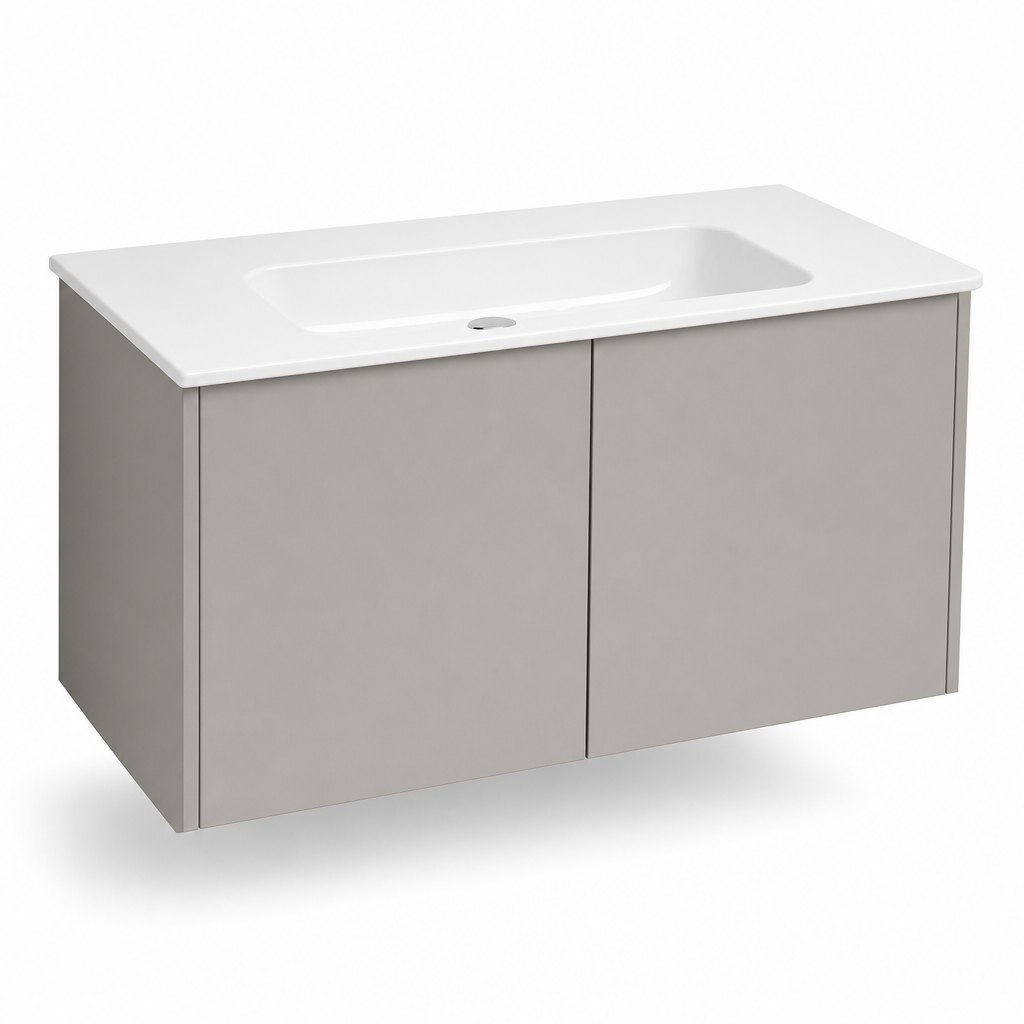
A UK bathroom is usually decided by the floor plan, not by the door style. A 2.4 by 1.8 metre room cannot take a full-height unit and a shower, so the vanity goes on the wall and the floor stays open for cleaning and for standing. MFC1050 is built around that constraint. The carcass is 18 mm melamine-faced chipboard on a 460 mm depth so it clears a 500 mm door swing, the top is one vitreous china casting with the bowl moulded in, and the whole thing leaves the factory as two cartons weighing 46 kg. No stone template, no fabricator visit, no silicone line to fail in year three.
- ModelFAME-MFC-105PG (MFC1050 series)
- Overall size1,050 W x 460 D x 520 H mm including the 20 mm top; 44 kg net, 46 kg gross
- LayoutTwo door wall-hung unit, one adjustable shelf, 480 mm clear internal depth, no plinth and no toe kick
- Top / basinOne-piece vitreous china top 1,060 x 470 x 20 mm, integrated bowl 500 x 330 x 130 mm, 32 mm waste, no overflow slot, gloss white glaze
- Carcass18 mm MFC (melamine-faced chipboard), melamine faced both faces, 8 mm HDF back panel in a groove, sealed back edges
- FinishPigeon grey super-matte melamine at 6 gloss units; fronts and carcass matched; alternative melamine colours on the same board from 60 sets per colour
Trade inquiry only — this is a B2B catalog with no online checkout. Our team replies within 24 hours.
Full Specification
- ModelFAME-MFC-105PG (MFC1050 series)
- Overall size1,050 W x 460 D x 520 H mm including the 20 mm top; 44 kg net, 46 kg gross
- LayoutTwo door wall-hung unit, one adjustable shelf, 480 mm clear internal depth, no plinth and no toe kick
- Top / basinOne-piece vitreous china top 1,060 x 470 x 20 mm, integrated bowl 500 x 330 x 130 mm, 32 mm waste, no overflow slot, gloss white glaze
- Carcass18 mm MFC (melamine-faced chipboard), melamine faced both faces, 8 mm HDF back panel in a groove, sealed back edges
- FinishPigeon grey super-matte melamine at 6 gloss units; fronts and carcass matched; alternative melamine colours on the same board from 60 sets per colour
- Fronts / doorsTwo 18 mm slab doors at 525 mm with a 2 mm shadow gap, push-latch standard, 128 mm bar pull or 16 mm knob optional
- HingesTwo 110 degree concealed soft-close hinges per door, clip-on, 3-way adjustment, 50,000-cycle rated
- Wall fixingTwo galvanised steel hanger plates on 400 mm centres with cam levelling; 8 x 60 mm frame fixings and a paper drilling template supplied
- Packaging2 cartons per set: flat-pack carcass and doors in carton 1, china top in a moulded EPS cradle and a 5-layer case in carton 2; hardware bag, assembly drawing and care sheet inside carton 1
- Volume / weight0.21 m3 per set (carcass carton 1,150 x 520 x 130 mm, top carton 1,120 x 520 x 220 mm), 46 kg gross, 219 kg per m3
- Loading / MOQ310 sets per 40HQ at 66 m3 usable, 155 sets per 20GP; MOQ 20 sets per model, colours mixable from 60; 30-35 days after deposit and finish approval
- ComplianceCarcass board supplied with the panel mill's EN 717-1 emission class and FSC or PEFC chain-of-custody reference on request; UKTR due diligence pack issued per shipment
- Port / termsFOB Ningbo or Shanghai; CIF Felixstowe, Southampton and London Gateway quoted on request, with THC, CDS entry and PVA handling shown separately
Why Buyers Choose This Model
- 1,050 W x 460 D x 520 H mm carcass, two 525 mm doors with one adjustable shelf behind, 480 mm clear internal depth for a 400 mm trap and a 32 mm waste
- One-piece vitreous china top at 1,060 x 470 x 20 mm with an integrated bowl of 500 x 330 x 130 mm, a 32 mm waste outlet and no overflow slot to stain
- 18 mm MFC carcass and 18 mm fronts, melamine faced on both faces, 1 mm ABS hot-melt edge on every exposed edge and an 8 mm HDF back panel set in a groove
- Pigeon grey super-matte melamine at 6 gloss units, fronts and carcass from the same board batch so a replacement door in year four does not arrive a shade lighter
- Two galvanised steel hanger plates on 400 mm centres with a cam levelling adjustment, plus 8 x 60 mm frame fixings and a drilling template in the hardware bag
- Two 110 degree concealed soft-close hinges per door with 3-way adjustment and clip-on mounting, rated to 50,000 cycles, so the door realigns after a removal without a new hinge
- Two cartons at 0.21 m3 and 46 kg gross, which is 310 sets per 40HQ and 155 sets per 20GP, filling on cube at about 14.3 t against a payload above 26 t
- Cam and dowel assembly with pre-inserted nylon dowels: about 18 minutes per unit with a cordless drill, a number 2 square bit and a 4 mm hex key, and no panel cut on site
Specification Questions Buyers Ask
What has to be tested before a wall-hung unit can be sold in the UK?
Is MFC acceptable in a bathroom, or does it have to be painted or solid timber?
Why a china top rather than a resin or stone top?
How is 0.21 m3 and 310 sets per 40HQ arrived at?
Can the same carcass be built at 1,200 mm or in a different finish?
Building a Bathroom Cabinets Program?
Send your target market, sizes and quantities — we reply within 24 hours with a tailored quotation.