KC88 Quarry Grey Flat-Pack Kitchen - Eighteen Units, 4.2 m Base Run
Quoted as one pack of eighteen units on the Australian 560 mm carcass, with the benchtop left out because the stonemason supplies it.
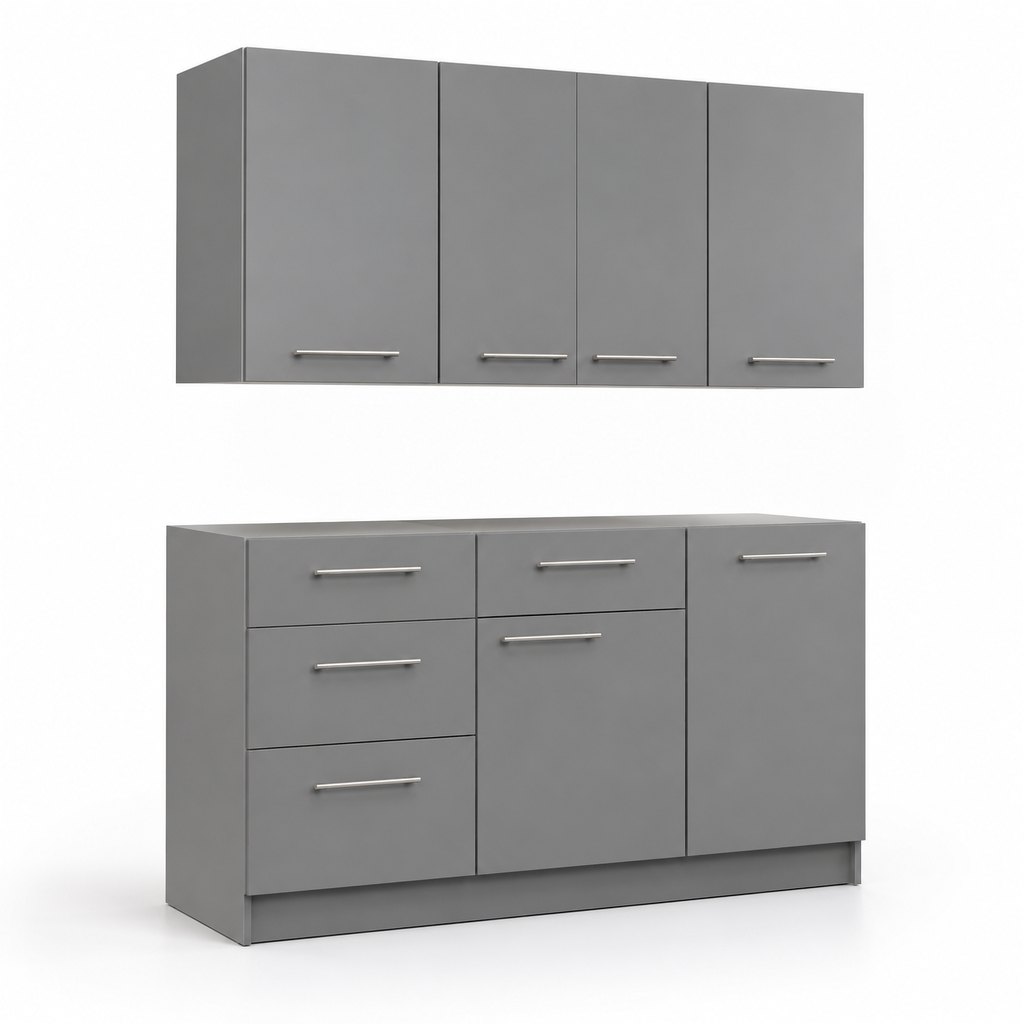
A flat-pack kitchen quoted as a bag of boxes makes the builder price the layout twice, once on the plan and again on the packing list. KC88 is quoted on the run: seven 600 mm base units at 4.2 m, two 450 mm returns, five 600 mm and two 450 mm wall units, and two 600 mm tall units - eighteen units in fourteen cartons. The carcass is 16 mm E0 HMR board to AS/NZS 1859.1 with a 6 mm rebated back, 560 mm deep so a 600 mm benchtop overhangs 20 mm, and the fronts are quarry grey super-matte melamine at 4 gloss units. 0.72 m3 and 182 kg per pack, 86 packs per 40HQ.
- ModelFAME-KC-88QG (KC88 series)
- Configuration18 units: 7 x 600 base (2 three-drawer, 3 drawerline, 1 sink, 1 cooktop), 2 x 450 base, 5 x 600 wall, 2 x 450 wall, 2 x 600 tall
- Overall sizeBase 870 mm high (720 carcass + 150 adjustable kickboard, recessed 60 mm) x 560 mm deep; wall 720 x 300 mm; tall 2,100 x 560 mm
- Run length4.2 m of 600 mm base plus two 450 mm returns; 3.0 m of 600 mm wall plus two 450 mm wall units
- Carcass16 mm E0 HMR MFC to AS/NZS 1859.1, melamine faced both sides
- Back panel6 mm HMR MFC, rebated into the carcass, not a nailed hardboard sheet
Trade inquiry only — this is a B2B catalog with no online checkout. Our team replies within 24 hours.
Full Specification
- ModelFAME-KC-88QG (KC88 series)
- Configuration18 units: 7 x 600 base (2 three-drawer, 3 drawerline, 1 sink, 1 cooktop), 2 x 450 base, 5 x 600 wall, 2 x 450 wall, 2 x 600 tall
- Overall sizeBase 870 mm high (720 carcass + 150 adjustable kickboard, recessed 60 mm) x 560 mm deep; wall 720 x 300 mm; tall 2,100 x 560 mm
- Run length4.2 m of 600 mm base plus two 450 mm returns; 3.0 m of 600 mm wall plus two 450 mm wall units
- Carcass16 mm E0 HMR MFC to AS/NZS 1859.1, melamine faced both sides
- Back panel6 mm HMR MFC, rebated into the carcass, not a nailed hardboard sheet
- Fronts18 mm E0 board, quarry grey super-matte melamine at 4 gloss units, slab, 1 mm ABS edging on all four edges with a PUR glue line
- HingesHettich Sensys 110 degree soft close, clip-on, 3-way adjustment, EN 15570 tested
- DrawersConcealed soft-close runners, 25 kg rated, full extension, 15 mm drawer box bottoms
- AssemblyCam and dowel, cams pre-fitted, dowels pre-inserted, hinge plates pre-drilled; about 10 minutes per base unit
- WorktopNot included - 600 mm stone, laminate or compact supplied by the local fabricator, fixed with brackets or adhesive per that supplier's method
- Packaging14 flat cartons per pack, average 780 x 620 x 150 mm, 5-layer corrugated with EPS corner blocks, fronts interleaved
- Volume / weight0.72 m3 per pack, 182 kg gross; base carton 26 kg, wall carton 15 kg average
- Loading86 packs (1,548 units) per 40HQ at 62 m3 usable, 34 packs per 20GP
- MOQ / lead time / port20 packs per model, 3 decors mixable from 60 packs; 30-35 days after deposit and decor approval; FOB Ningbo or Shanghai, CIF Sydney, Melbourne and Brisbane on request
Why Buyers Choose This Model
- Eighteen units in one pack code: 7 x 600 mm base across a 4.2 m run (2 three-drawer, 3 drawerline, 1 sink base, 1 cooktop base), 2 x 450 mm base returns, 5 x 600 mm and 2 x 450 mm wall units, 2 x 600 mm tall units
- 870 mm overall base height from a 720 mm carcass and a 150 mm adjustable kickboard recessed 60 mm, so the pack lands on a standard Australian plan without site-cut plinth
- 560 mm carcass depth rather than 570 mm: a 600 mm benchtop overhangs 20 mm at the front edge and sits flush to the wall line, which is the detail an Australian installer checks first
- 16 mm E0 HMR carcass to AS/NZS 1859.1 with a 6 mm rebated back panel, so a unit pushed against brick veneer or a slightly out-of-square wall keeps its square instead of bowing
- Quarry grey super-matte melamine at 4 gloss units on 18 mm slab fronts, 1 mm ABS edging on all four edges with a PUR glue line, no handle holes drilled
- Hettich Sensys 110 degree soft-close hinges with 3-way adjustment, plus 25 kg concealed soft-close runners on the three-drawer and drawerline bases
- Cam-and-dowel assembly with cams pre-fitted and hinge plates pre-drilled: about 10 minutes per base unit, no glue, no site drilling beyond the fixing rail
- Benchtop left out of the pack and 14 cartons at 0.72 m3 / 182 kg: 86 packs, 1,548 units, per 40HQ at 62 m3 usable, 34 packs per 20GP
Specification Questions Buyers Ask
Why 560 mm carcass depth instead of the 570 mm used on European packs?
Why is the benchtop not in the pack?
Is flat-pack accepted on Australian residential projects?
Does a 16 mm HMR carcass hold up in an Australian kitchen?
What timber packaging documents does the container need?
Building a Kitchen Cabinets Program?
Send your target market, sizes and quantities — we reply within 24 hours with a tailored quotation.