Latte Beige Compact Kitchen - 2.4 m One-Wall Run
A seven-module one-wall kitchen for compact units, shipped as eight cartons: 18 mm E1 HMR carcass, latte beige slab fronts, and hardware a fitter assembles in an afternoon without a second site visit.
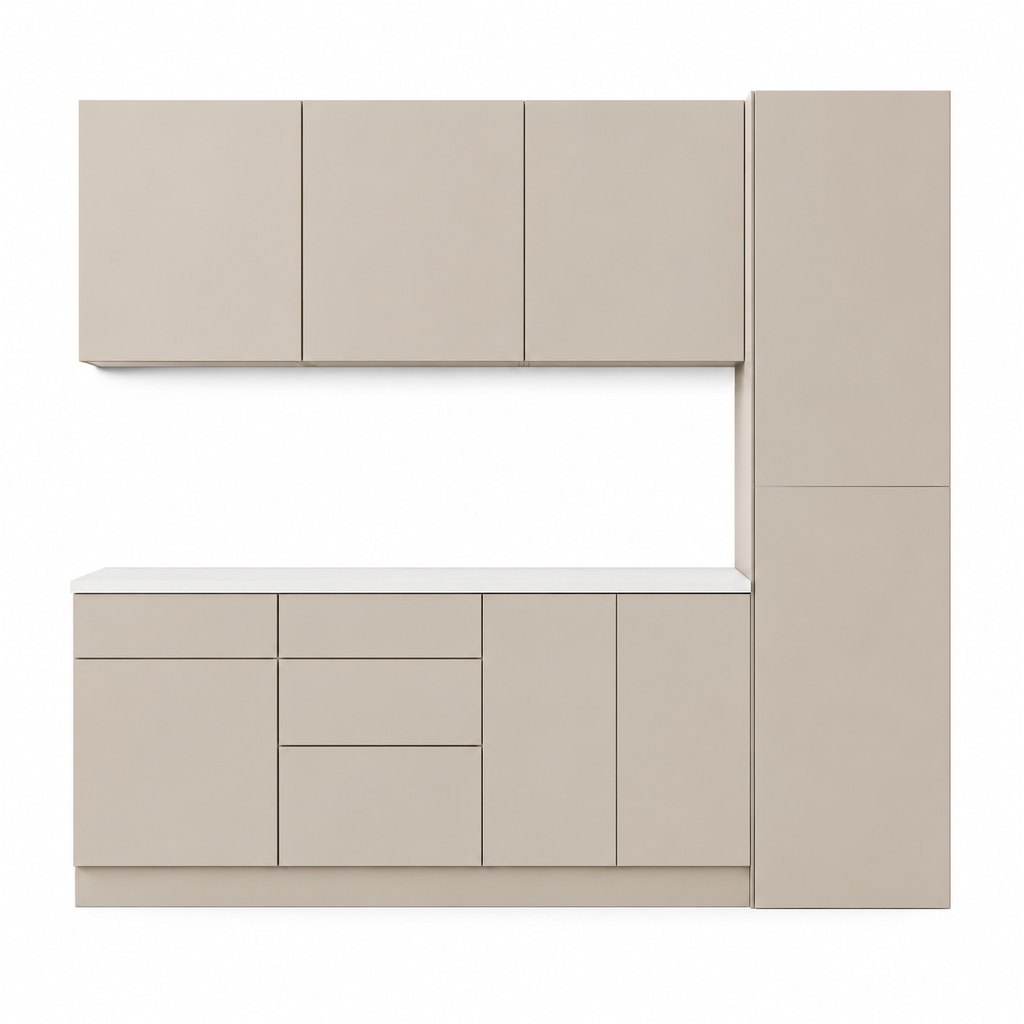
Compact apartments do not buy a 3 m kitchen, and trimming a 3 m run on site is how a program ends up with damaged doors and a fitter charging for a cut. KC75 is a 2,400 mm one-wall run: three 600 mm bases, three 600 mm wall units, one 600 mm tall larder, two 50 mm scribe fillers and a plinth to match. Carcass and fronts are 18 mm E1 moisture-resistant board with 1 mm ABS on every exposed edge, latte beige super-matte at 4 gloss units, cam and dowel with 32 mm system holes. It leaves the factory as eight cartons at 0.62 m3 and 96 kg, and 108 runs fit a 40HQ.
- ModelFAME-KC-75LT (KC75 series)
- Run size2,400 mm finished: 3 x 600 base, 3 x 600 wall, 1 x 600 tall larder, 2 x 50 scribe filler, 2,400 mm plinth
- Carcass18 mm E1 moisture-resistant board to EN 717-2, melamine faced both sides, sealed back edge
- Fronts / finish18 mm E1 board, latte beige super-matte melamine at 4 gloss units, slab, 3 mm shadow gap
- Edging1 mm ABS on all exposed edges, hot-melt glued, trimmed and radiused; PVC-free on request
- JoineryCam and dowel with pre-inserted nylon dowels, 32 mm system holes at 32 mm pitch, 5 mm HDF back panel in a groove
Trade inquiry only — this is a B2B catalog with no online checkout. Our team replies within 24 hours.
Full Specification
- ModelFAME-KC-75LT (KC75 series)
- Run size2,400 mm finished: 3 x 600 base, 3 x 600 wall, 1 x 600 tall larder, 2 x 50 scribe filler, 2,400 mm plinth
- Carcass18 mm E1 moisture-resistant board to EN 717-2, melamine faced both sides, sealed back edge
- Fronts / finish18 mm E1 board, latte beige super-matte melamine at 4 gloss units, slab, 3 mm shadow gap
- Edging1 mm ABS on all exposed edges, hot-melt glued, trimmed and radiused; PVC-free on request
- JoineryCam and dowel with pre-inserted nylon dowels, 32 mm system holes at 32 mm pitch, 5 mm HDF back panel in a groove
- HingesHettich Sensys 110 degree soft close, clip-on, 3-way adjustment, 50,000-cycle rated
- Drawers25 kg concealed runners, soft close, full extension; 600 mm three-drawer bank with 16 mm drawer boxes
- Module sizesBase 600 W x 550 D x 720 H; wall 600 W x 320 D x 720 H; tall 600 W x 550 D x 2,000 H; adjustable feet 100-150 mm
- Sink unit600 mm base with two doors and a dummy front, undrilled top rail so the tap position follows the local countertop cut
- WorktopNot included; 28 mm laminate and 38 mm compact tops quoted separately against the same run
- Packaging8 cartons per run, 5-layer corrugated, 15 mm foam corners, hardware in a labelled box inside carton 1, assembly drawing included
- Volume / weight0.62 m3 per run, 96 kg gross (91 kg net); largest carton 2,050 x 620 x 120 mm, 155 kg per m3
- Loading / MOQ108 runs per 40HQ at 68 m3 usable, 44 runs per 20GP; MOQ 20 sets per model per finish - one 2,400 mm run per set, equal to the 20 pcs per model MOQ; 3 finishes mixable from 60 sets; 30-35 days after deposit and finish approval
- Port / termsFOB Ningbo or Shanghai; CIF Santos and Paranagua quoted on request, with AFRMM shown separately on the freight line
Why Buyers Choose This Model
- 2,400 mm finished run: 3 x 600 base, 3 x 600 wall, 1 x 600 tall larder, 2 x 50 scribe filler, 2,400 mm plinth - a one-wall kitchen that reaches both end walls without an on-site cut
- 18 mm E1 moisture-resistant board (EN 717-2) with melamine on both faces, sealed back edge and 1 mm ABS on every exposed edge - the specification that survives a kitchen at 80 percent RH
- Latte beige super-matte melamine at 4 gloss units, slab fronts with a 3 mm shadow gap - a matte surface that hides fingerprints in a small kitchen where every door gets touched daily
- Cam and dowel joinery with pre-inserted nylon dowels and 32 mm system holes at 32 mm pitch, so a fitter drills nothing on site and a replacement door still aligns two years later
- Hettich Sensys 110 degree soft-close hinges with 3-way adjustment and 25 kg full-extension soft-close runners on the drawer bank, both rated 50,000 cycles
- 8 cartons per run, 0.62 m3 and 96 kg gross - 155 kg per m3, so a 40HQ fills on cube at 108 runs and 10.4 t, comfortably inside the payload limit
- 108 runs per 40HQ at 68 m3 usable and 44 per 20GP, with no solid wood anywhere in the pack, so no ISPM 15 mark and no fumigation queue on the Brazilian side
- Tall larder drilled for four shelves at 32 mm pitch and supplied with three, so the buyer can add a shelf height without a new door drilling pattern
Specification Questions Buyers Ask
Why 2.4 m instead of the usual 3 m run?
What is actually different about a moisture-resistant board?
Do the modules need to be drilled on site for hinges and shelves?
How does the container arithmetic work with a vanity program?
What should ship as spare parts on a first order?
Building a Kitchen Cabinets Program?
Send your target market, sizes and quantities — we reply within 24 hours with a tailored quotation.