900mm Honeycomb Aluminum Vanity in Agate Gray with a Ceramic Top
Two 0.8 mm skins on a hexagonal core — a cabinet that cannot swell, at 18 kg a piece
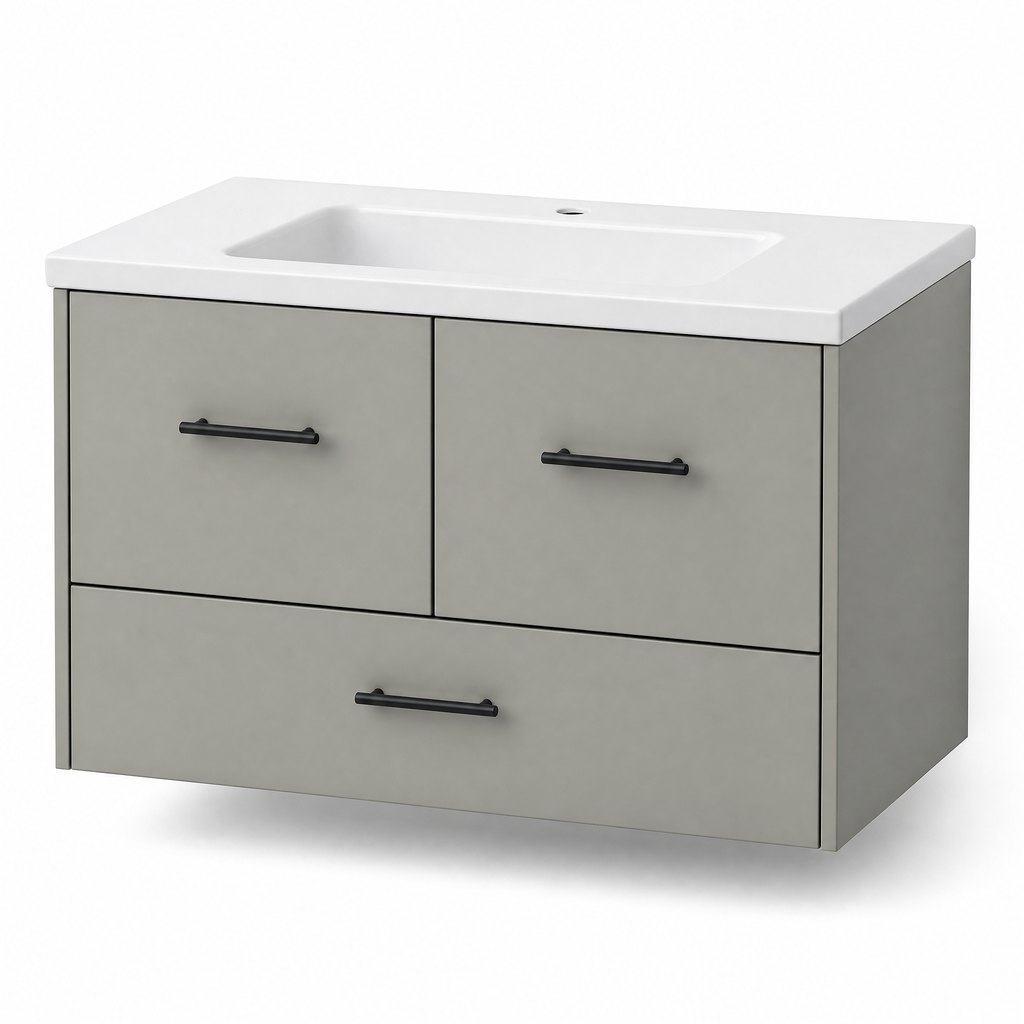
This is the wet-room variant of the range: a 900 mm wall-hung vanity built on a 12 mm aluminum honeycomb panel — two 0.8 mm skins bonded to a hexagonal core — rather than on a board that has to be sealed against water. Doors, carcass and drawer front are the same panel, powder-coated agate gray inside and out, so a waste that drips for a year reaches coated aluminum and not swollen chipboard. The top is a one-piece vitreous china basin, and the unit hangs on a 30 × 30 mm aluminum sub-frame fixed into the studs. No timber content, no formaldehyde class to declare, about 18 kg per piece.
- ModelFAME-AL-900HC
- Nominal size900 × 460 × 520 mm (35.4 × 18.1 × 20.5 in), W × D × H, wall-hung
- Carcass12 mm aluminum honeycomb panel, 0.8 mm skins, hexagonal core, PET-lined interior
- Front finishMatte agate gray powder coat (RAL 7038), 60–80 microns, flat slab doors
- Basin topOne-piece vitreous china, 900 × 465 mm, overflow, single 35 mm tap hole
- Doors and drawersTwo soft-close doors, one full-extension drawer, 2 mm door gap
Trade inquiry only — this is a B2B catalog with no online checkout. Our team replies within 24 hours.
Full Specification
- ModelFAME-AL-900HC
- Nominal size900 × 460 × 520 mm (35.4 × 18.1 × 20.5 in), W × D × H, wall-hung
- Carcass12 mm aluminum honeycomb panel, 0.8 mm skins, hexagonal core, PET-lined interior
- Front finishMatte agate gray powder coat (RAL 7038), 60–80 microns, flat slab doors
- Basin topOne-piece vitreous china, 900 × 465 mm, overflow, single 35 mm tap hole
- Doors and drawersTwo soft-close doors, one full-extension drawer, 2 mm door gap
- HardwareDTC soft-close hinges, ball-bearing runners, 30 × 30 mm aluminum hanging sub-frame
- Mirror option900 × 700 mm plain mirror or LED mirror cabinet, quoted as a separate line
- Water exposurePanel skins and core are non-absorbent; no thickness swell and no edge sealing routine on site
- PackingFlat-pack nine-panel kit at 0.09 m3 per carton; 0.19 m3 assembled
- Loading quantityAbout 750 pcs per 40HQ flat-packed, about 350 pcs assembled
- MOQ20 pcs per model per finish
- Lead time25–30 days after deposit and finish confirmation
- Loading portNingbo / Shanghai
- Trade termsFOB, CIF or DDP on request; mixed container with kitchen cabinets allowed
Why Buyers Choose This Model
- 900 mm wide, 460 mm deep and 520 mm high, wall-hung on a 30 × 30 mm aluminum sub-frame that carries the load into the studs instead of into plasterboard
- Carcass, doors and drawer front are 12 mm aluminum honeycomb panel — two 0.8 mm skins on a hexagonal core — so the cabinet is fully waterproof and weighs about 18 kg against about 32 kg for the same vanity in MDF
- Powder coat at 60–80 microns, cured at 200 °C, applied to the inside of the carcass as well, so a leaking waste never reaches bare metal
- One-piece vitreous china top at 900 × 465 mm with an overflow and a single 35 mm tap hole; the same drilling pattern accepts a cast resin top without a tooling change
- DTC soft-close hinges and full-extension ball-bearing runners, cycled to 50,000 movements, with hinge plates riveted into an aluminum insert rather than screwed into a honeycomb void
- Flat-pack ships as a nine-panel kit in one carton at 0.09 m3, which puts about 750 pcs into a 40HQ against about 350 assembled at 0.19 m3
- No wood-based panel anywhere in the article, so there is no E1 class to declare and no timber content in the product itself — only the pallet, if one is used, falls under ISPM 15
- Every panel is cut and punched on one CNC program, holding door gaps at 2 mm and hinge cups at 22.5 mm from the door edge across a 200-piece run
Specification Questions Buyers Ask
Does the cabinet need WaterMark or WELS certification to be sold in Australia?
Is an aluminum cabinet rigid enough, or does it drum and flex?
How does landed cost compare with an HMR board vanity of the same size?
Can the ceramic top be swapped for resin, or the width changed?
What lead time applies, and can it ship with a flat-pack kitchen?
Building a Bathroom Cabinets Program?
Send your target market, sizes and quantities — we reply within 24 hours with a tailored quotation.