900mm Wall-Hung Vanity with a One-Piece Vitreous China Basin Top in Dove Grey
Two cartons, 0.139 m3, about 480 sets to a 40HQ — a fired china top costed by the cubic meter, not by the showroom
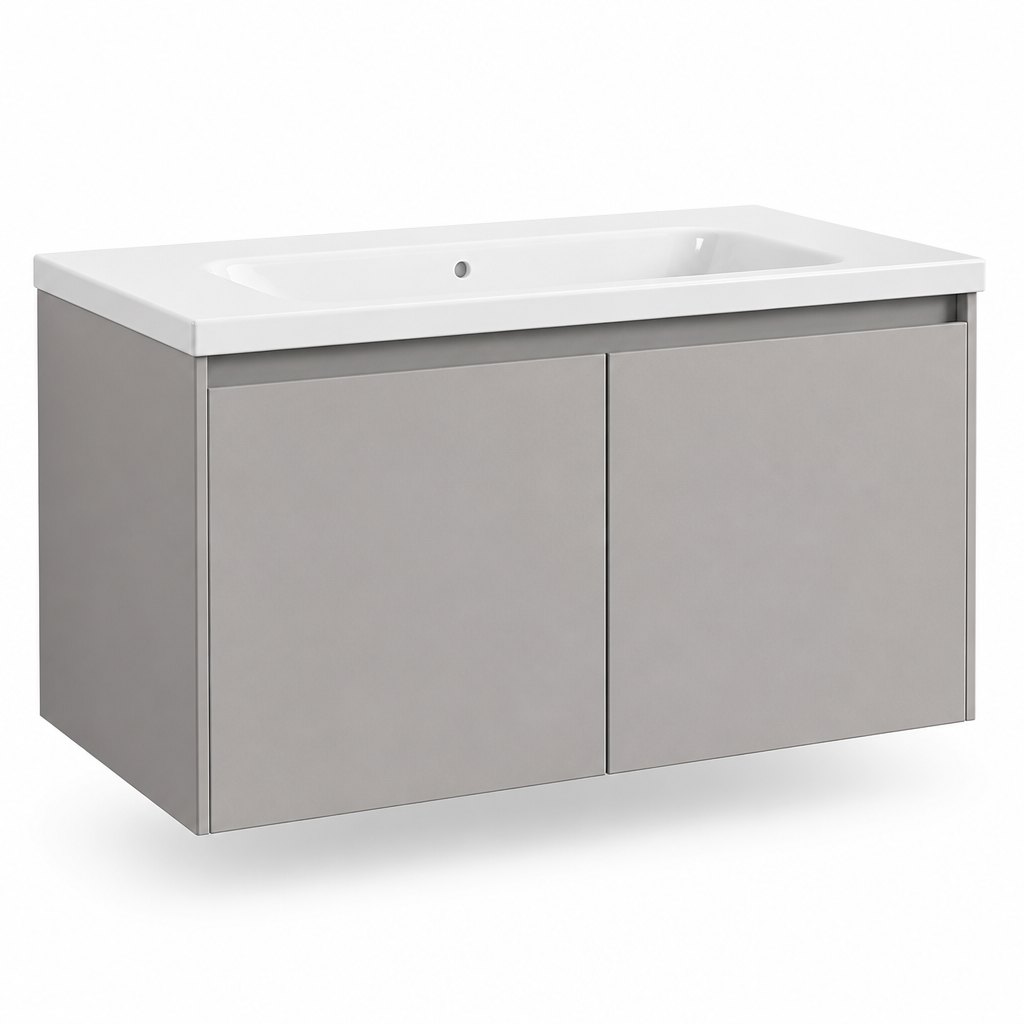
The case for this unit is a joint that does not exist. The deck and the bowl are one vitreous china casting, fired and glazed as a single piece, so the seam where water stands on a wood top and the silicone bead turns black is not there to maintain. The carcass is 18 mm EN 312 P3 board in dove grey super-matte melamine, edge banded on four sides, hung on a steel rail with two through-bolts. Two cartons at 0.139 m3 and 32 kg gross, about 480 sets to a 40HQ — the number a merchant actually buys on.
- ModelFAME-CB-900DG
- Nominal size900 x 460 x 520 mm (35.4 x 18.1 x 20.5 in), W x D x H, wall-hung
- Carcass18 mm EN 312 P3 melamine-faced board, E1 emission class, 5 mm HDF back panel
- Fronts18 mm MFC slab, dove grey super-matte, 0.6 gloss, 1 mm ABS laser edge, integrated 45 degree finger pull
- Top-basinOne-piece vitreous china top-basin, 22 mm deck, 26 mm apron, fully glazed including the underside, white
- Bowl480 x 330 x 125 mm, 11.5 L to overflow, molded slotted overflow, 45 mm waste
Trade inquiry only — this is a B2B catalog with no online checkout. Our team replies within 24 hours.
Full Specification
- ModelFAME-CB-900DG
- Nominal size900 x 460 x 520 mm (35.4 x 18.1 x 20.5 in), W x D x H, wall-hung
- Carcass18 mm EN 312 P3 melamine-faced board, E1 emission class, 5 mm HDF back panel
- Fronts18 mm MFC slab, dove grey super-matte, 0.6 gloss, 1 mm ABS laser edge, integrated 45 degree finger pull
- Top-basinOne-piece vitreous china top-basin, 22 mm deck, 26 mm apron, fully glazed including the underside, white
- Bowl480 x 330 x 125 mm, 11.5 L to overflow, molded slotted overflow, 45 mm waste
- Tap drillingOne 35 mm tap hole as standard; no hole, or two holes on 180 mm centers, on request
- Doors2 doors on DTC 110 degree clip-on hinges, 3D cam adjustment, 40,000 cycles
- Hanging systemSteel rail, 2 x M8 through-bolts, 100 kg static load, levelling cams, EPDM wall gasket
- PackingTwo cartons: carcass panels 0.048 m3 / 17 kg, china top 0.091 m3 / 15 kg
- Carton sizeLargest carton 950 x 500 x 190 mm; fits a 1,200 x 800 pallet and a 48 x 40 in GMA pallet
- Loading quantityAbout 480 sets per 40HQ, about 200 sets per 20GP
- MOQ20 pcs per model per finish
- Lead time25-30 days after deposit and finish confirmation
- Loading portNingbo / Shanghai, FOB
Why Buyers Choose This Model
- 900 x 460 x 520 mm carcass on a steel hanging rail with two M8 through-bolts rated to 100 kg static, so the unit goes onto finished tile without a pattress or blocking out
- 18 mm EN 312 P3 board rated for load-bearing use in humid conditions in E1 emission class, 1 mm ABS edge on all four sides, so a weeping trap is a mop job and not a delamination claim
- One-piece vitreous china top-basin fired at about 1,200 C, 22 mm deck and 26 mm apron, glazed over the full face and the underside, so there is no cut edge for a fitter to seal on site
- Bowl 480 x 330 x 125 mm with 11.5 L to overflow, a molded slotted overflow and a 45 mm waste, drilled for one 35 mm tap hole as standard
- Two DTC 110 degree clip-on hinges with 3D cam adjustment, rated to 40,000 cycles, so a door that drops in year three is a screwdriver job rather than a warranty call
- Dove grey super-matte at about 0.6 gloss units, a decorative paper pressed into the melamine rather than a lacquer film on top of it, so a scratch reads as a lighter grey line and not a white edge
- Two cartons at 0.139 m3 and 32 kg gross with the china cradled in molded EPS — about 480 sets per 40HQ against roughly 300 for a single-carton unit at 0.22 m3
- Flat-pack carcass on cam and dowel, 18 minutes per unit with numbered panels and a template in the carton, so a distributor stocks panels and builds against confirmed orders
Specification Questions Buyers Ask
Is a fired china top safe to hang on a wall-hung carcass, or does it force a floor-standing unit?
What does E1 actually measure, and is it still the class a UK specifier names?
Can the china top be drilled for two separate taps instead of a mixer?
How much does the two-carton split actually save on freight?
What is the process if a china top arrives broken?
Building a Basins Program?
Send your target market, sizes and quantities — we reply within 24 hours with a tailored quotation.