1,500 mm Aluminum Double Vanity - Saltbush, Twin Bowl
A twin-bowl wall-hung unit with an aluminum carcass instead of board: 38 kg gross in two cartons, 0.30 m3, 218 sets to a 40HQ, and nothing that swells when a shower runs all winter.
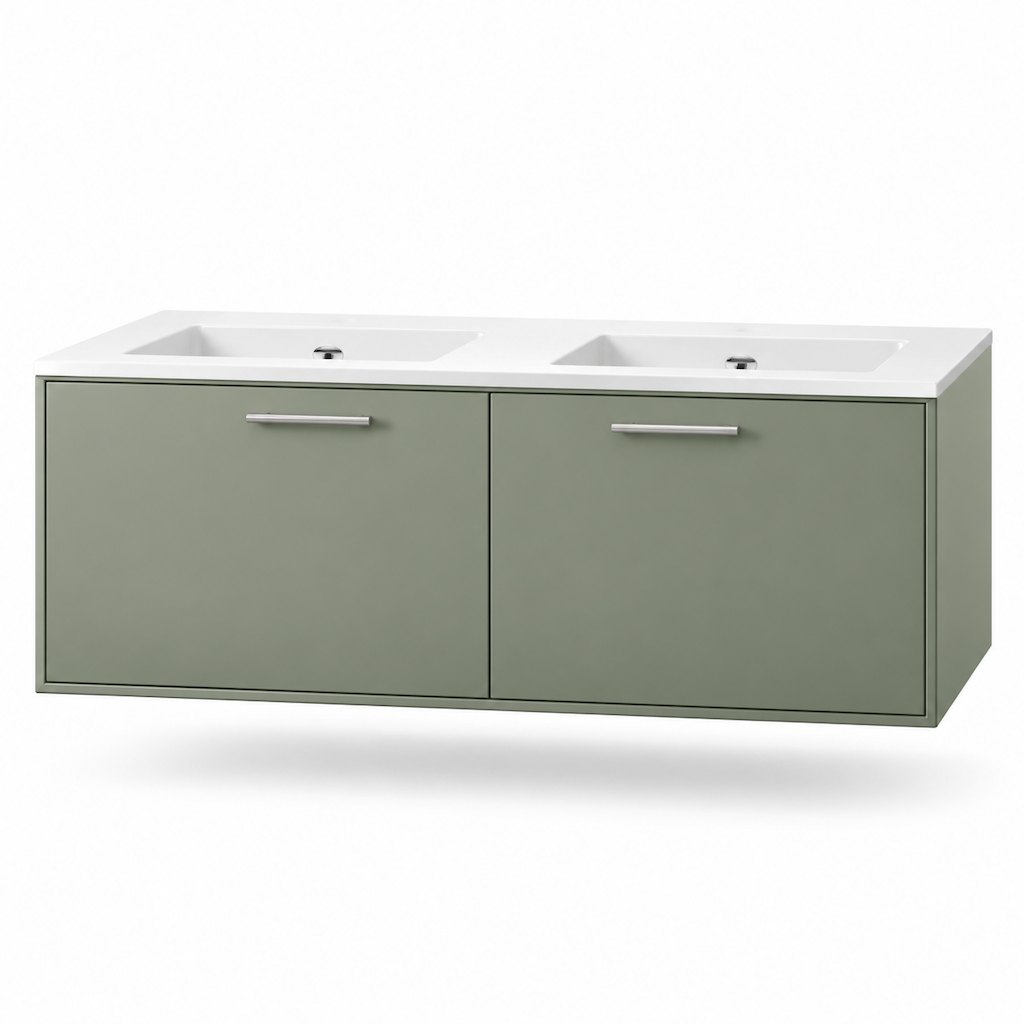
An Australian bathroom program on the coast is a moisture problem before it is a design problem. Board carcasses are fine in a dry room, but a wall-hung unit in a beachside apartment takes humid air on the back panel every day of its life. AL1500 is built to remove that failure path. The carcass is a 1.2 mm 6063-T5 aluminum extrusion frame with 12 mm honeycomb composite infill panels, powder coated inside and out in saltbush, and it carries a one-piece twin-bowl vitreous china top. It leaves the factory as two cartons at 38 kg, because aluminum carries the load that 18 mm board needs mass to carry.
- ModelFAME-AL-150SB (AL1500 series)
- Overall size1,500 W x 460 D x 470 H mm including the 20 mm china top; 34 kg net, 38 kg gross
- LayoutWall-hung twin-bowl unit, two 740 mm door compartments, one adjustable shelf per side, 455 mm clear internal depth, no plinth
- Top / basinsOne-piece vitreous china top 1,510 x 465 x 20 mm, two bowls 500 x 330 x 130 mm, twin 32 mm wastes, no overflow slot, gloss white glaze
- Carcass1.2 mm 6063-T5 aluminum extrusion frame with die-cast corner blocks and M6 stainless machine screws; 12 mm aluminum honeycomb composite infill panels, 0.8 mm skins
- FinishSaltbush matte powder coat at 5 gloss units inside and out, close to RAL 7033; 6-stage pretreatment; 1,000-hour neutral salt spray to ASTM B117; other RAL colors from 40 sets
Trade inquiry only — this is a B2B catalog with no online checkout. Our team replies within 24 hours.
Full Specification
- ModelFAME-AL-150SB (AL1500 series)
- Overall size1,500 W x 460 D x 470 H mm including the 20 mm china top; 34 kg net, 38 kg gross
- LayoutWall-hung twin-bowl unit, two 740 mm door compartments, one adjustable shelf per side, 455 mm clear internal depth, no plinth
- Top / basinsOne-piece vitreous china top 1,510 x 465 x 20 mm, two bowls 500 x 330 x 130 mm, twin 32 mm wastes, no overflow slot, gloss white glaze
- Carcass1.2 mm 6063-T5 aluminum extrusion frame with die-cast corner blocks and M6 stainless machine screws; 12 mm aluminum honeycomb composite infill panels, 0.8 mm skins
- FinishSaltbush matte powder coat at 5 gloss units inside and out, close to RAL 7033; 6-stage pretreatment; 1,000-hour neutral salt spray to ASTM B117; other RAL colors from 40 sets
- DoorsTwo 12 mm honeycomb composite doors at 740 mm with a 2 mm shadow gap, aluminum edge band, push-latch standard, 128 mm bar pull or 16 mm knob optional
- HingesTwo 110 degree concealed soft-close hinges per door, clip-on, 3-way adjustment, 50,000-cycle rated, stainless mounting plates with isolation washers
- Wall fixingTwo galvanized steel hanger plates on 600 mm centres with cam levelling; 8 x 60 mm frame fixings and a paper drilling template supplied
- Packaging2 cartons per set: flat aluminum carcass and doors in carton 1 with a hardware bag and assembly drawing, china top in a moulded EPS cradle and 5-layer case in carton 2
- Volume / weight0.30 m3 per set (carcass carton 1,560 x 520 x 150 mm, top carton 1,530 x 500 x 230 mm), 38 kg gross, 127 kg per m3
- Loading / MOQ218 sets per 40HQ at 66 m3 usable, 108 sets per 20GP; MOQ 20 sets per model, colors mixable from 40; 30-35 days after deposit and finish approval
- ComplianceAlloy and temper certificate to ASTM B221 / EN 573-3 per heat; powder coat adhesion to AS 1580 methods on request; wood packaging ISPM 15 marked where a pallet is used
- Port / termsFOB Ningbo or Shanghai; CIF Sydney, Melbourne, Brisbane and Fremantle quoted on request, with biosecurity, THC and delivery shown as separate lines
Why Buyers Choose This Model
- 1,500 W x 460 D x 470 H mm overall, two 740 mm door compartments with one adjustable shelf each and 455 mm clear internal depth for a 40 mm trap and two 32 mm wastes
- One-piece vitreous china top at 1,510 x 465 x 20 mm with two integrated bowls of 500 x 330 x 130 mm, twin 32 mm outlets and no overflow slot to stain
- 1.2 mm 6063-T5 aluminum extrusion frame, mitred and joined with die-cast corner blocks on M6 stainless machine screws, so a carcass stays square without a cam
- 12 mm aluminum honeycomb composite side, back and door panels with 0.8 mm skins, which is what stops the drumming an empty aluminum box makes under a running tap
- Saltbush matte powder coat at 5 gloss units, applied after a 6-stage pretreatment, with a 1,000-hour neutral salt spray result to ASTM B117 and no undercut at the scribe
- Two 110 degree concealed soft-close hinges per door, clip-on with 3-way adjustment and a 50,000-cycle rating, mounted on stainless plates with isolation washers against the aluminum
- Two galvanized steel hanger plates on 600 mm centres with cam levelling, 8 x 60 mm frame fixings and a paper drilling template in the hardware bag
- Two cartons at 0.30 m3 and 38 kg gross: 218 sets per 40HQ and 108 per 20GP, filling on cube at about 8.3 t against a payload above 26 t, so weight never binds
Specification Questions Buyers Ask
Is an aluminum vanity actually specified for coastal apartments, or is it a gimmick?
Does the carcass need to be earthed or isolated from the plumbing?
What has to be in the BMSB file for a November shipment from China?
How does 0.30 m3 and 218 sets per 40HQ come out?
Can the same frame run at 1,200 mm, or as a single bowl?
Building a Bathroom Cabinets Program?
Send your target market, sizes and quantities — we reply within 24 hours with a tailored quotation.