1200mm Wall-Hung Aluminum Vanity with Two Molded Bowls in Fir Green
One carcass for 1.2 meters of run: 0.280 m3 against 0.32 m3 for two 600 mm units, and no joint in the middle for a mop to find
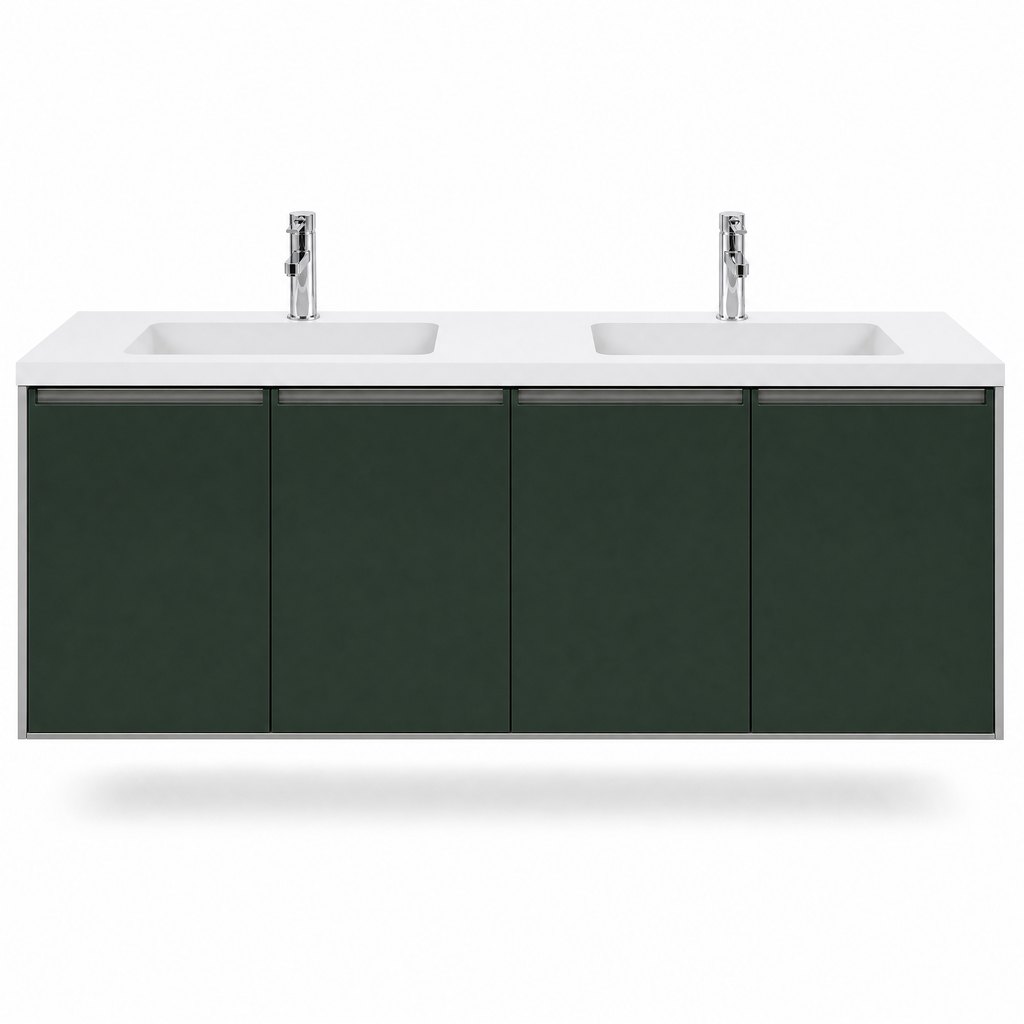
A 1200 mm vanity in Australia is normally two 600 mm cabinets bolted together, which means two carcasses, two back panels, two hanging rails and a joint down the middle that collects water. This is one carcass. The panels are 18 mm aluminum honeycomb, a 0.8 mm skin over a 4 mm core, so a trap that weeps for a week has nothing to swell. The top is a single 20 mm solid-surface casting with both bowls molded into it, matte white and sandable, which is what makes it survive a tenant rather than a showroom. Three cartons at 0.280 m3 and 63 kg, about 240 sets to a 40HQ.
- ModelFAME-AL-1200FG
- Nominal size1200 x 460 x 520 mm (47.2 x 18.1 x 20.5 in), W x D x H, wall-hung; the 460 mm depth and 520 mm height are the same carcass family as the 900 mm unit, so only the width changes on the cutting list
- Carcass18 mm honeycomb aluminum panel, 0.8 mm 3003 aluminum skin both faces, 4 mm core, anodized aluminum frame, no board content, fully waterproof
- Fronts18 mm honeycomb aluminum, fir green RAL 6009 powder coat, 60 to 80 micron film, matte at 4 to 6 gloss units, 2 mm anodized aluminum edge
- Top20 mm solid surface (modified acrylic), matte white through the thickness, two molded bowls 480 x 330 x 120 mm, 20 mm upstand on request
- Tap and waste drilling2 x 35 mm tap holes on 600 mm centers; 2 x 32 mm waste apertures for 1 1/4 in Australian basin wastes; three-hole sets drilled to your centers on request
Trade inquiry only — this is a B2B catalog with no online checkout. Our team replies within 24 hours.
Full Specification
- ModelFAME-AL-1200FG
- Nominal size1200 x 460 x 520 mm (47.2 x 18.1 x 20.5 in), W x D x H, wall-hung; the 460 mm depth and 520 mm height are the same carcass family as the 900 mm unit, so only the width changes on the cutting list
- Carcass18 mm honeycomb aluminum panel, 0.8 mm 3003 aluminum skin both faces, 4 mm core, anodized aluminum frame, no board content, fully waterproof
- Fronts18 mm honeycomb aluminum, fir green RAL 6009 powder coat, 60 to 80 micron film, matte at 4 to 6 gloss units, 2 mm anodized aluminum edge
- Top20 mm solid surface (modified acrylic), matte white through the thickness, two molded bowls 480 x 330 x 120 mm, 20 mm upstand on request
- Tap and waste drilling2 x 35 mm tap holes on 600 mm centers; 2 x 32 mm waste apertures for 1 1/4 in Australian basin wastes; three-hole sets drilled to your centers on request
- Doors and drawers4 doors on DTC 110 degree clip-on hinges, 3D cam adjustment, 40,000 cycles; 2 central drawers on DTC 30 kg soft-close runners, 50,000 cycles
- Hanging systemAluminum rail across the full width, 2 x M8 through-bolts, 150 kg static load, levelling cams, EPDM wall gasket; fixing schedule for brick veneer, stud wall and concrete
- WeightAbout 63 kg packed and 50 kg installed dry; about 68 kg with bowls, water and contents, which is the figure the wall sees
- PackingThree cartons: carcass panels 1,240 x 620 x 200 mm at 0.154 m3 and 30 kg; fronts 660 x 480 x 140 mm at 0.044 m3 and 11 kg; molded top 1,260 x 500 x 130 mm at 0.082 m3 and 22 kg
- Carton handling0.280 m3 and 63 kg per set; the top carton is the only one that cannot be stacked above two high, and all three fit a 1,200 x 800 pallet
- Loading quantityAbout 240 sets per 40HQ at 68 m3 usable, about 100 sets per 20GP
- MOQ20 pcs per model per finish
- Lead time25-30 days after deposit and finish confirmation
- Loading portNingbo / Shanghai, FOB
Why Buyers Choose This Model
- 1200 x 460 x 520 mm as a single carcass: 1.2 meters of vanity run at 0.280 m3 in three cartons, against roughly 0.32 m3 for two 600 mm units bolted together, so one joint, one back panel and one rail come out of the plan
- 18 mm honeycomb aluminum panel with a 0.8 mm skin on both faces over a 4 mm core, framed in anodized aluminum, so a leaking waste or a wet trap cannot delaminate a panel that contains no board
- Fir green RAL 6009 powder coat at 60 to 80 microns, cured at 200 C over a chromate-free pre-treatment, matte at 4 to 6 gloss units, sprayed as one batch across doors and end panels so a 1.2 meter run has no color step
- One-piece 20 mm solid-surface top with two bowls molded in at 480 x 330 x 120 mm, matte white through the full thickness, so a chip or a scorch is 400 grit and a polish rather than a new top
- Two 35 mm tap holes on 600 mm centers as standard and two 32 mm waste apertures drilled to suit Australian 1 1/4 in basin wastes, both cut and edge-sealed in the plant, not on site
- Four doors on DTC 110 degree clip-on hinges rated 40,000 cycles with 3D cam adjustment, plus two central soft-close drawers on DTC 30 kg runners, which is storage a double vanity usually throws away
- Aluminum hanging rail with two M8 through-bolts rated 150 kg static, levelling cams and an EPDM wall gasket, plus a written fixing schedule for brick veneer on timber studs at 450 or 600 mm centers
- Three cartons at 0.280 m3 and 63 kg gross: flat panels in one, fronts in the second, the molded top in the third, with the largest carton at 1,260 x 500 x 130 mm on a 1,200 x 800 pallet
Specification Questions Buyers Ask
Why buy one 1200 mm carcass instead of two 600 mm units?
Does an aluminum carcass change anything about wall fixing or corrosion?
What does waterproof actually guarantee on a cabinet like this?
Can this carcass be supplied with one bowl instead of two?
What does this unit need to clear Australian import?
Building a Bathroom Cabinets Program?
Send your target market, sizes and quantities — we reply within 24 hours with a tailored quotation.