3,600 mm RTA Kitchen - Marl Grey, Six Base Modules and a 2,100 mm Larder
Eighteen cartons at 0.72 m3: 90 runs to a 40HQ, a 720 mm carcass, a full-height larder, and a cost per running metre that holds from quotation to delivery.
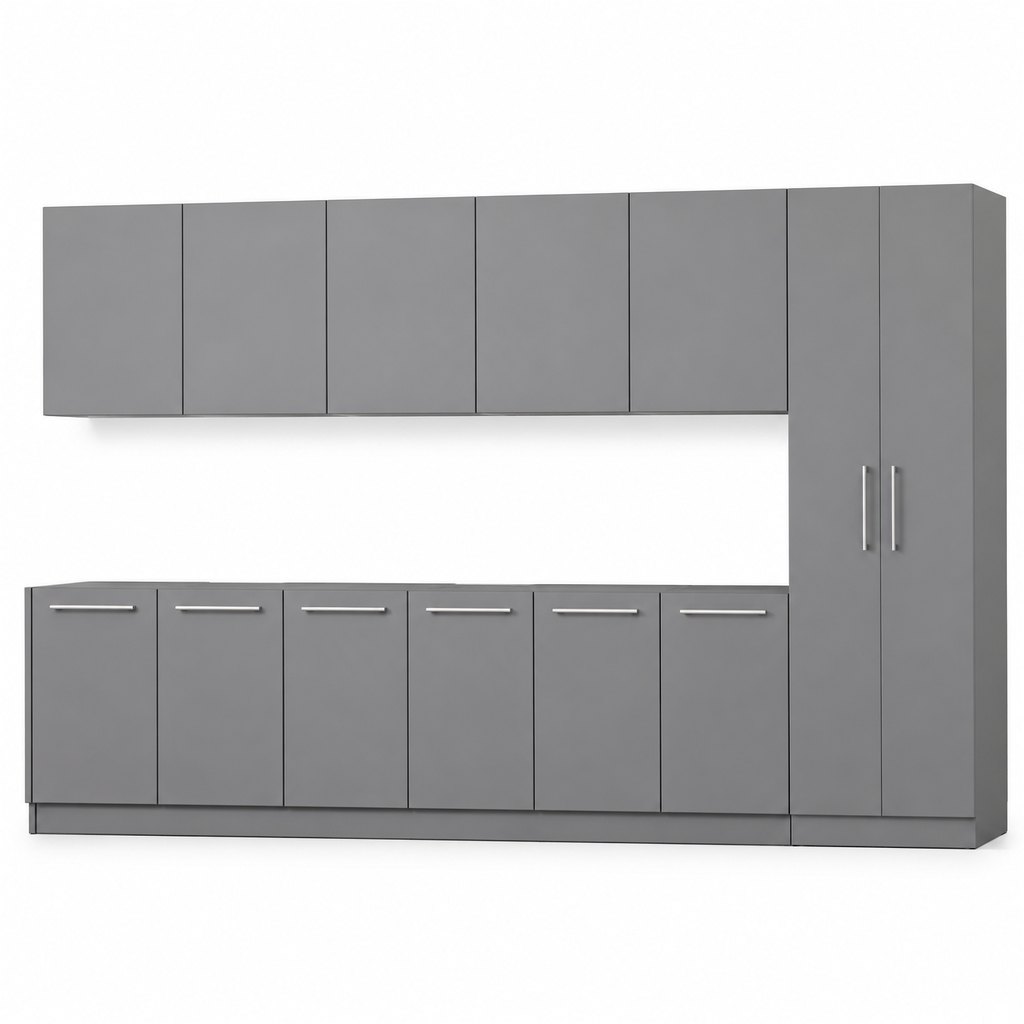
A 3,600 mm run with a tall larder is the configuration German refurbishment and rental programs actually order, because it replaces a kitchen and a separate pantry in one elevation. KC360 is that run in flat pack: six 600 mm base modules, five wall units and a 2,100 mm two-door larder on an 18 mm E1 HMR carcass, packed in 18 cartons at 0.72 m3. That is 90 runs to a 40HQ and 46 to a 20GP, so a first order can mix kitchens with a mirror program and still fill the box. Fronts are 18 mm marl grey super-matte melamine at 4 gloss units, a cool mid-grey with no grain print to batch-match.
- ModelFAME-KC-360MR (KC360 series)
- Run length3,600 mm base and 3,000 mm wall, plus a 600 mm larder; six base modules, five wall units, one tall unit per run
- Base modules600 mm sink base (2 doors), 600 mm four-drawer bank, 600 mm hob base (2 doors plus 150 mm top drawer), 600 mm pull-out waste base, two 600 mm door bases
- Wall modules600 mm wide x 720 mm high x 320 mm deep, five per run, one adjustable 18 mm shelf each
- Tall unit600 mm wide x 2,100 mm high x 560 mm deep, two full-height doors, three adjustable 18 mm shelves and one fixed mid shelf
- Carcass18 mm E1 HMR MFC at 560 mm base depth, 5 mm grooved back panel, 2 mm ABS edge on exposed edges
Trade inquiry only — this is a B2B catalog with no online checkout. Our team replies within 24 hours.
Full Specification
- ModelFAME-KC-360MR (KC360 series)
- Run length3,600 mm base and 3,000 mm wall, plus a 600 mm larder; six base modules, five wall units, one tall unit per run
- Base modules600 mm sink base (2 doors), 600 mm four-drawer bank, 600 mm hob base (2 doors plus 150 mm top drawer), 600 mm pull-out waste base, two 600 mm door bases
- Wall modules600 mm wide x 720 mm high x 320 mm deep, five per run, one adjustable 18 mm shelf each
- Tall unit600 mm wide x 2,100 mm high x 560 mm deep, two full-height doors, three adjustable 18 mm shelves and one fixed mid shelf
- Carcass18 mm E1 HMR MFC at 560 mm base depth, 5 mm grooved back panel, 2 mm ABS edge on exposed edges
- Heights720 mm carcass on a 150 mm adjustable plinth; with a 30 mm worktop the finished surface sits at 900 mm, wall units top out at 2,100 mm
- Fronts18 mm marl grey super-matte melamine at 4 gloss units, 2 mm color-matched ABS edge, 2 mm shadow gap, 128 mm brushed stainless bar pull on base and larder
- Finish controlDecor code fixed at order and matched to a physical sample; carcass and fronts from the same decor batch, 14 further decors from 40 runs
- Hardware110 degree soft-close clip-on hinges with 3-way adjustment, 50,000-cycle rated; 30 kg full-extension soft-close runners on 16 mm drawer boxes
- WorktopNot included as standard; a 3,600 x 600 x 30 mm postformed laminate top adds three cartons and about 0.06 m3 per run, compact tops quoted separately
- Packaging18 cartons per run: 6 base carcass, 5 wall carcass, 1 larder carcass, 2 fronts, 1 hardware and plinth, 2 shelf packs, 1 spares; cartons carry material codes for the importer's packaging registration
- Volume and loading0.72 m3 per run, 138 kg gross (131 kg net), longest carton 2,180 mm; 90 runs per 40HQ and 46 per 20GP, 12.4 t gross, so the box cubes out before it weighs out
- MOQ and lead timeMOQ 20 runs per model, decors mixable from 40 runs; 30-35 days after deposit and finish approval
- Compliance and portBoard to E1 (EN 717-2, GB 18580), EN 14749 strength and stability on the assembled run; FOB Ningbo or Shanghai, CIF Hamburg and Bremerhaven with THC and inland haulage as separate lines
Why Buyers Choose This Model
- 3,600 mm base run in six 600 mm modules: sink base, four-drawer bank, hob base with a 150 mm top drawer, pull-out waste base and two door bases, all on a 720 mm carcass
- 3,000 mm wall run in five 600 x 720 x 320 mm units with one adjustable 18 mm shelf each, set to clear a 600 mm worktop line and a 500 mm splashback
- 600 x 2,100 x 560 mm two-door larder with three adjustable 18 mm shelves plus a fixed mid shelf, drilled for two shelf heights at the factory
- 18 mm E1 HMR MFC carcass at 560 mm base depth (580 mm to the door face) with 5 mm grooved back panels, so no panel is stapled through
- 18 mm marl grey super-matte melamine slab fronts at 4 gloss units, 2 mm color-matched ABS edge, 2 mm shadow gaps, 128 mm brushed stainless bar pulls
- 110 degree soft-close clip-on hinges rated 50,000 cycles plus 30 kg full-extension soft-close runners on 16 mm drawer boxes with 3D front adjustment
- 18 cartons at 0.72 m3 and 138 kg gross, longest carton 2,180 mm: 90 runs per 40HQ and 46 per 20GP, with carcasses nested and fronts boxed between edge boards
- Flat-pack assembly with a cordless drill and a hex key, about 7 hours for one installer, every hinge cup, runner fixing and cam pre-drilled at the factory
Specification Questions Buyers Ask
What does a running metre cost once the container reaches Hamburg?
Is the larder shipped as one piece, or does it arrive flat?
Does a flat-pack run pass EN 14749, and what changes if it does not?
How does a 3,600 mm run compare with two 1,800 mm runs on freight?
Can one container carry this run, a mirror cabinet and a vanity program?
Building a Kitchen Cabinets Program?
Send your target market, sizes and quantities — we reply within 24 hours with a tailored quotation.