1200mm Pearl Grey Double-Basin Vanity with One Ceramic Casting
Two bowls molded into a single 20 mm casting rather than two basins bonded into a cut deck: one joint line fewer, one leak path fewer, 0.274 m3 for the whole 1200 mm
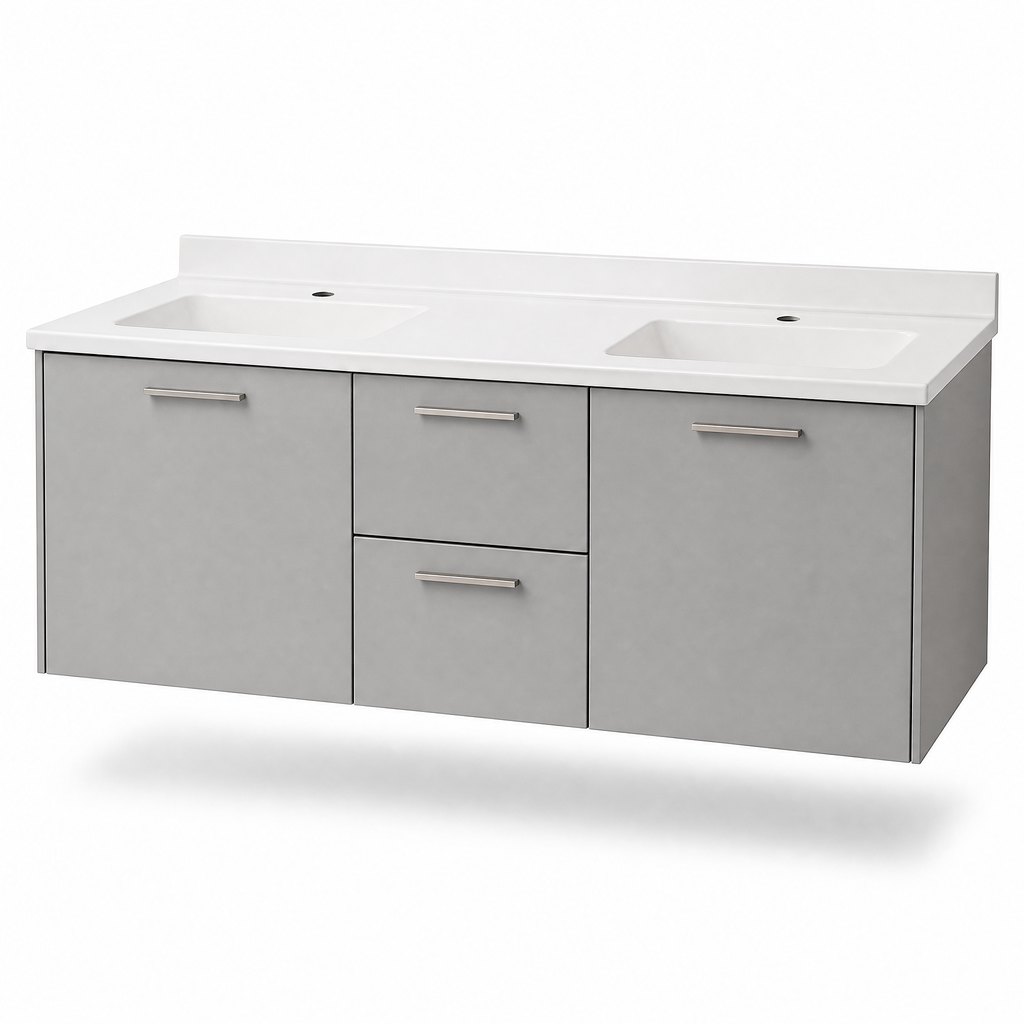
A double vanity is usually a single-door unit with two basins dropped into a slab top, and the two places it fails are the joints where that top was cut. This one is a single ceramic casting 1,260 mm long with both bowls molded into the deck at 20 mm, so the rim, the splash and the bowl are one piece of fired china. The body is 18 mm EN 312 P3 board in E1, melamine faced both sides over a rebated 5 mm HDF back, in pearl grey super-matte. Three cartons at 0.274 m3 and 73 kg, about 245 sets to a 40HQ.
- ModelFAME-CB-1200PG
- Nominal size1200 x 460 x 520 mm (47.2 x 18.1 x 20.5 in), W x D x H, wall-hung; same 460 mm depth and 520 mm height as the 600, 900 and 1000 mm units on the same cutting list
- Carcass18 mm EN 312 P3 particleboard, E1 emission class, melamine faced both sides, 1 mm ABS edge on exposed edges; 5 mm HDF back rebated into the side panels
- Fronts18 mm MFC slab doors and drawer fronts, pearl grey super-matte at 4 to 6 gloss units, 1 mm ABS laser edge on four sides, 3 mm reveal, jig-drilled for a 128 mm handle; 1200 mm as two 600 mm doors over a center drawer bank
- Top and basinsOne-piece ceramic deck 1,260 x 500 mm at 20 mm, vitreous china fired at 1,280 C; two bowls 450 x 330 x 120 mm molded into the casting, white glaze, 40 mm upstand
- Drilling2 x 35 mm tap holes on 200 mm centers; 2 x 32 mm waste apertures with 60 mm overflow slots, cut and glazed in the plant; three-hole sets and non-standard centers drilled to your drawing on request
Trade inquiry only — this is a B2B catalog with no online checkout. Our team replies within 24 hours.
Full Specification
- ModelFAME-CB-1200PG
- Nominal size1200 x 460 x 520 mm (47.2 x 18.1 x 20.5 in), W x D x H, wall-hung; same 460 mm depth and 520 mm height as the 600, 900 and 1000 mm units on the same cutting list
- Carcass18 mm EN 312 P3 particleboard, E1 emission class, melamine faced both sides, 1 mm ABS edge on exposed edges; 5 mm HDF back rebated into the side panels
- Fronts18 mm MFC slab doors and drawer fronts, pearl grey super-matte at 4 to 6 gloss units, 1 mm ABS laser edge on four sides, 3 mm reveal, jig-drilled for a 128 mm handle; 1200 mm as two 600 mm doors over a center drawer bank
- Top and basinsOne-piece ceramic deck 1,260 x 500 mm at 20 mm, vitreous china fired at 1,280 C; two bowls 450 x 330 x 120 mm molded into the casting, white glaze, 40 mm upstand
- Drilling2 x 35 mm tap holes on 200 mm centers; 2 x 32 mm waste apertures with 60 mm overflow slots, cut and glazed in the plant; three-hole sets and non-standard centers drilled to your drawing on request
- Hinges and drawersDTC 110 degree clip-on hinges, 3D cam adjustment, 40,000 cycles; DTC 30 kg soft-close tandem runners, 50,000 cycles, on a 16 mm drawer base
- HandleBrushed nickel aluminum bar, 128 mm centers, 10 mm projection; other centers and finishes quoted against the door drilling
- Hanging systemTwo steel rails across the full 1200 mm with 4 x M8 through-bolts, levelling cams and an EPDM wall gasket; fixing schedule for masonry, stud wall and plasterboard on steel frame
- Weight73 kg gross packed; about 58 kg installed dry, about 66 kg with water and contents, which is the load the two rails see
- PackingThree cartons: carcass 1,240 x 520 x 150 mm at 0.097 m3 and 31 kg; fronts and hardware 1,210 x 480 x 120 mm at 0.070 m3 and 11 kg; ceramic top 1,260 x 500 x 170 mm at 0.107 m3 and 31 kg
- Loading quantity0.274 m3 per set: about 245 sets per 40HQ at a 68 m3 planning figure, about 100 sets per 20GP; the top carton is the cube driver, not the carcass
- MOQ20 pcs per model per finish
- Lead time25-30 days after deposit and finish confirmation; the ceramic deck is fired in batches, so a size change adds a kiln run
- Loading portNingbo / Shanghai, FOB
Why Buyers Choose This Model
- 1200 x 460 x 520 mm wall-hung as one carcass: two 450 x 330 x 120 mm bowls molded into a single 1,260 mm ceramic deck at 20 mm, so there is no cut-out, no silicone joint at the rim and no second bowl to match on site
- 18 mm EN 312 P3 particleboard in E1, melamine faced on both faces and edged on all four sides before assembly, on a 5 mm HDF back that is rebated rather than stapled, because the joint under a double bowl is where a leaking trap ends up
- Pearl grey super-matte at 4 to 6 gloss units on doors, drawer fronts and both visible end panels from one press run and one decor batch, so a 1200 mm run does not show a color step at the centre joint
- Vitreous china fired at 1,280 C with both bowls glazed in the casting, a 40 mm upstand across the full 1,260 mm, and two 35 mm tap holes on 200 mm centers drilled and glazed in the plant
- Two 600 mm doors on DTC 110 degree clip-on hinges at 40,000 cycles with 3D cam adjustment, so the pair can be aligned to each other after the wall has been scribed, not before
- DTC 30 kg soft-close tandem runners at 50,000 cycles on a 16 mm drawer base in the center bank, on a unit where the middle of a 1200 mm run is the only place a drawer actually gets used
- Brushed nickel aluminum bar handle at 128 mm centers, jig-drilled in the factory with the drilling centers printed on the drawing, so a replacement front from stock fits without a template
- Three cartons at 0.274 m3 and 73 kg gross: carcass 1,240 x 520 x 150 mm at 31 kg, fronts 1,210 x 480 x 120 mm at 11 kg, ceramic top 1,260 x 500 x 170 mm at 31 kg, all three on a 1,200 x 800 pallet
Specification Questions Buyers Ask
Is one casting for two bowls actually better than two basins in a cut top?
What does P3 mean and what do I have to file for it?
How is a 1,260 mm ceramic deck packed, and what breaks in transit?
Can the same carcass take a resin deck or a single-bowl top?
What lead time is realistic, and what moves it?
Building a Basins Program?
Send your target market, sizes and quantities — we reply within 24 hours with a tailored quotation.