1,000 mm Wall-Hung Vanity - Alabaster Matt, One-Piece Ceramic Top
A 1,000 mm ceramic top arrives as one piece, not as a stone blank waiting for a basin: two cartons at 0.28 m3 and 232 sets to a 40HQ, priced per set for renovators who order by the apartment.
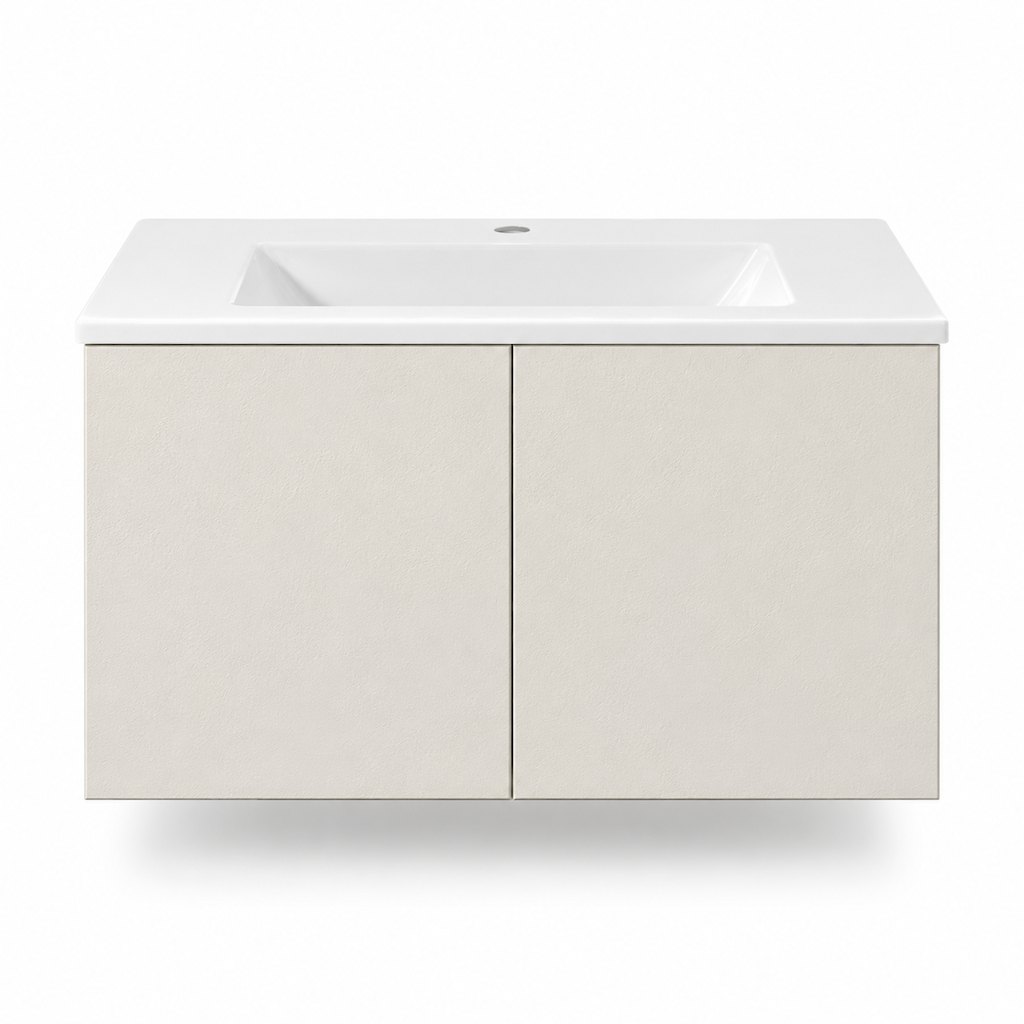
A one-piece ceramic top removes three decisions from a bathroom order at once: the basin, the tap drilling and the joint between the two. CB1050 is a 1,000 mm wall-hung cabinet in alabaster matt melamine carrying that top as a single glazed piece, so nothing on the deck can move, stain at a silicone line or be drilled on site. The cabinet is flat pack, two cartons at 0.28 m3 for the pair, and a 40HQ takes 232 sets against a payload that never binds because the ceramic is the heavy item and the carton is the constraint. It is the unit an Australian renovator can order at 40 apartments without a stone mason in the program.
- ModelFAME-CB-1050AL (CB1050 series)
- Overall size1,000 W x 465 D x 520 H mm, wall-hung; 21.4 kg cabinet net, 46 kg gross with the ceramic top
- Ceramic topOne-piece 1,000 x 465 mm vitreous china top, 20 mm at the rim, integrated bowl 430 x 320 x 110 mm deep, gloss white glaze, single 35 mm tap hole on centre
- Waste and overflow32 mm overflow waste with a slotted brass tailpiece and a chrome or brushed nickel cover; the waste position is marked on the cabinet back panel so the plumber can rough in before the cabinet is hung
- Carcass18 mm melamine-faced chipboard on a moisture-resistant EN 312 P3 core, 15 mm grooved back panel, cam-and-dowel joints, ABS edge on all visible edges
- Fronts18 mm alabaster matt melamine at 6 gloss units, slab profile with no frame, 2 mm colour-matched ABS edge on all four sides
Trade inquiry only — this is a B2B catalog with no online checkout. Our team replies within 24 hours.
Full Specification
- ModelFAME-CB-1050AL (CB1050 series)
- Overall size1,000 W x 465 D x 520 H mm, wall-hung; 21.4 kg cabinet net, 46 kg gross with the ceramic top
- Ceramic topOne-piece 1,000 x 465 mm vitreous china top, 20 mm at the rim, integrated bowl 430 x 320 x 110 mm deep, gloss white glaze, single 35 mm tap hole on centre
- Waste and overflow32 mm overflow waste with a slotted brass tailpiece and a chrome or brushed nickel cover; the waste position is marked on the cabinet back panel so the plumber can rough in before the cabinet is hung
- Carcass18 mm melamine-faced chipboard on a moisture-resistant EN 312 P3 core, 15 mm grooved back panel, cam-and-dowel joints, ABS edge on all visible edges
- Fronts18 mm alabaster matt melamine at 6 gloss units, slab profile with no frame, 2 mm colour-matched ABS edge on all four sides
- DoorsTwo 490 mm doors, 110 degree clip-on soft-close hinges rated 50,000 cycles, 3-way adjustment, 3 mm shadow gap, no face handle
- ShelvingOne adjustable 18 mm shelf on four-position nickel-plated pins plus a fixed bottom panel; 240 mm clear above the shelf, 300 mm below the bowl
- Panel classE1 emission class to EN 717-1 declared on the mill certificate for the 18 mm thickness used; where an Australian specification names AS/NZS 1859, the certificate has to name the class and the test house, not only the board brand
- HardwareNickel-plated steel hinges and pins, stainless steel hanger rail and fixings; no plated steel in the wet zone under the bowl
- MountingStainless steel hanger rail fixed first on the paper template, cabinet dropped on and locked with two screws from inside; six 8 x 60 mm fixings for a masonry wall or a stud wall with plywood backing
- PackagingTwo cartons: cabinet at 0.18 m3 with moulded pulp corner blocks and 3 mm foam on door faces, ceramic top at 0.10 m3 on a pulp cradle with 20 mm corner foam; hardware bag and template taped inside carton A
- Volume and loading0.28 m3 per set in two cartons, 46 kg gross; 232 sets per 40HQ and 116 per 20GP, cubing out at 10.7 t against a payload above 26 t
- MOQ and lead timeMOQ 20 sets per model, 50 sets to open a new decor; 25-30 days after deposit and finish approval, 32-38 days on a first order with a new glazed top
- Compliance and portCabinet tested to BS EN 14749 with the wall fixings named in the report; ceramic top fired to a vitreous body with a lead-free glaze; FOB Ningbo, CIF Sydney, Melbourne and Brisbane with THC, quarantine entry and documentation shown as separate lines
Why Buyers Choose This Model
- 1,000 W x 465 D x 520 H mm wall-hung cabinet at 21.4 kg net, sized to the 1,000 mm vanity bay in an Australian 1,200 mm bathroom and to a 150 mm floor clearance above a tiled floor
- One-piece 1,000 mm vitreous china top, 20 mm at the rim, with an integrated bowl, a single 35 mm tap hole on centre and a 32 mm overflow waste, so the deck joint is a moulded edge rather than a silicone bead
- 18 mm melamine-faced chipboard on a moisture-resistant EN 312 P3 core, every visible edge banded in 2 mm colour-matched ABS, including the top rail the ceramic bed sits on
- Alabaster matt melamine at 6 gloss units, a warm off-white with a faint yellow undertone and no woodgrain print, so it reads as plaster rather than as a printed timber
- Two 490 mm doors on 110 degree clip-on soft-close hinges rated 50,000 cycles with 3-way adjustment, plus one adjustable 18 mm shelf and a fixed bottom panel
- The ceramic top ships in its own carton on a moulded pulp cradle with 20 mm foam at the corners, because a 1,000 mm glazed piece is the one part of the set that cannot be replaced by a phone call
- Two cartons totalling 0.28 m3 and 46 kg gross: 232 sets per 40HQ and 116 per 20GP, cubing out at 10.7 t so the box is volume-limited by roughly 6 m3
- Supplied with a stainless steel hanger rail, six 8 x 60 mm fixings, a paper template and the waste cut-out marked on the cabinet back, about 25 minutes for one installer including the top
Specification Questions Buyers Ask
Why a one-piece ceramic top instead of a stone or composite top with a separate basin?
Does the ceramic top have to be drilled on site for the tap?
0.28 m3 per set and 232 to a 40HQ: what actually limits the load?
What is assumed about the wall, and what happens on a plasterboard wall?
Can the cabinet be ordered without the ceramic top, and can the decor change later?
Building a Basins Program?
Send your target market, sizes and quantities — we reply within 24 hours with a tailored quotation.