1,300 mm Wall-Hung Aluminum Vanity - Dune Beige Frame, Zero Wood Panel
0.44 m3 a carton and 148 sets to a 40HQ: a 1,300 mm floating vanity whose body is aluminum extrusion and honeycomb, so there is no cut edge to swell and no formaldehyde declaration to file.
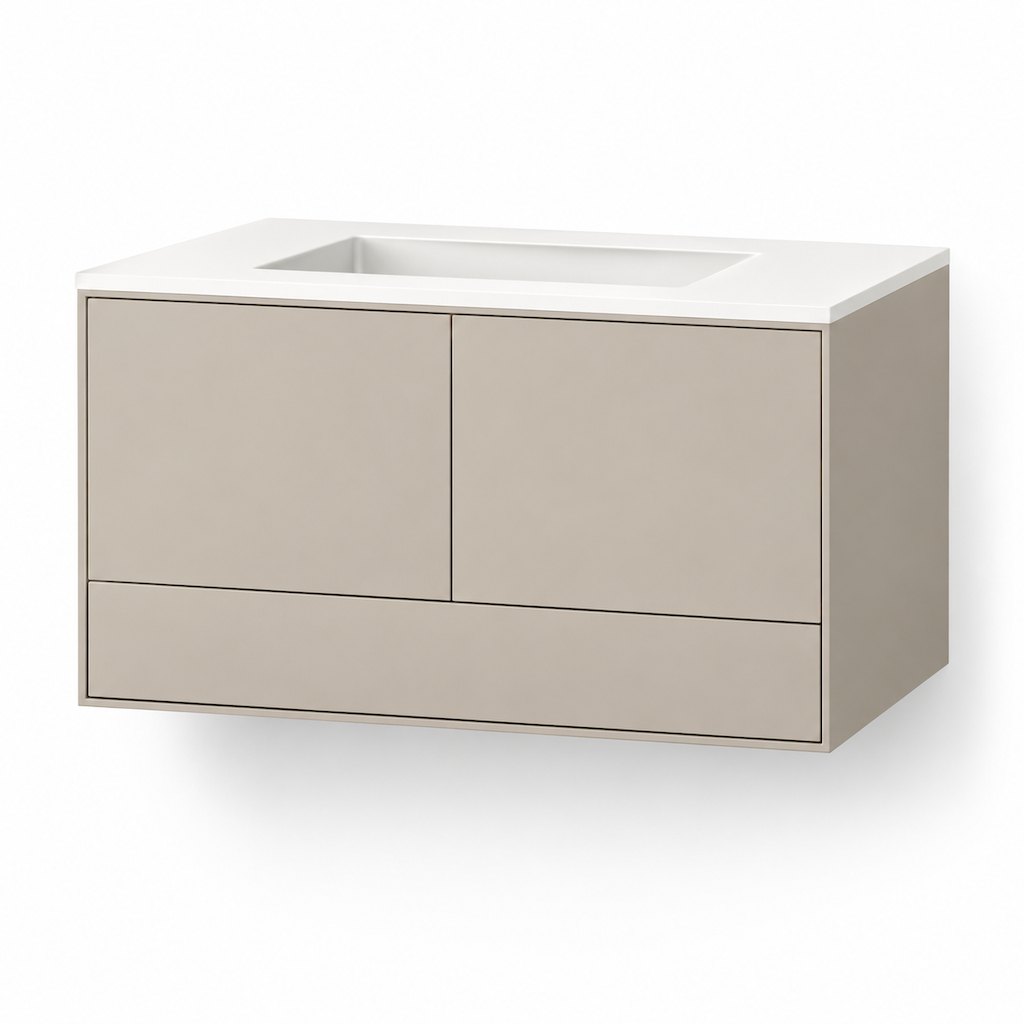
A wall-hung vanity decides whether a US project bathroom reads as spec-grade or builder-grade, and it is also the item that fails first when the carcass is board in a wet room. AL1300 is a 1,300 mm floating cabinet on a 1.2 mm aluminum frame with 18 mm honeycomb composite panels, finished in dune beige matte powder coat. There is no particleboard and no MDF in the body, so nothing swells at a cut edge and the import file carries no formaldehyde declaration for the cabinet itself. It packs at 0.44 m3, so 148 sets fill a 40HQ and cube out under 4 t.
- ModelFAME-AL-1300DU (AL1300 series)
- Overall size1,300 W x 500 D x 480 H mm, wall-hung; 21.4 kg net, 26.5 kg gross
- Frame1.2 mm 6063-T5 aluminum extrusion, mitred with die-cast corner blocks and M6 stainless machine screws; 20 mm visible face profile
- Panels18 mm aluminum honeycomb sandwich panels in doors, shelves and sides; no particleboard, no MDF, no plywood in the body
- FinishDune beige matte powder coat, 70 to 90 micrometer film build, chromate-free pretreatment, 500-hour neutral salt spray to ASTM B117; other RAL tones from 50 sets
- Door layoutTwo 640 mm doors with a 3 mm shadow gap and concealed push catch; left or right opening at no extra cost
Trade inquiry only — this is a B2B catalog with no online checkout. Our team replies within 24 hours.
Full Specification
- ModelFAME-AL-1300DU (AL1300 series)
- Overall size1,300 W x 500 D x 480 H mm, wall-hung; 21.4 kg net, 26.5 kg gross
- Frame1.2 mm 6063-T5 aluminum extrusion, mitred with die-cast corner blocks and M6 stainless machine screws; 20 mm visible face profile
- Panels18 mm aluminum honeycomb sandwich panels in doors, shelves and sides; no particleboard, no MDF, no plywood in the body
- FinishDune beige matte powder coat, 70 to 90 micrometer film build, chromate-free pretreatment, 500-hour neutral salt spray to ASTM B117; other RAL tones from 50 sets
- Door layoutTwo 640 mm doors with a 3 mm shadow gap and concealed push catch; left or right opening at no extra cost
- DrawerOne 560 mm full-extension soft-close drawer, 30 kg rated, 16 mm aluminum box, removable cutlery tray, 3D front adjustment
- ShelvingTwo adjustable 18 mm honeycomb shelves on four-position aluminum pins plus one fixed mid shelf; 340 mm clear under the fixed shelf
- Hardware110 degree clip-on soft-close hinges, 50,000-cycle rated, 3-way adjustment; stainless steel fixings throughout, no plated steel in the wet zone
- Basin and topCabinet supplied on its own, or as a set with a ceramic basin and solid surface top; where a US project specifies cUPC, the basin model number is confirmed against the listing before the order is confirmed
- MountingOne 1,200 mm galvanized steel wall rail with level notch, six 8 x 80 mm fixings and a backing template; a wood-stud or block wall is assumed, cavity anchors quoted separately
- PackagingOne carton, 20 mm EPS corner blocks, 3 mm foam wrap on door faces, five-ply outer, hardware bag and template taped inside the carton
- Volume and loading0.44 m3 per set, 26.5 kg gross, carton 1,380 x 580 x 550 mm; 148 sets per 40HQ and 75 per 20GP, 3.9 t gross in a 40HQ so the box cubes out before it weighs out
- MOQ and lead timeMOQ 20 sets per model, other RAL tones from 50 sets; 25-30 days after deposit and finish approval, 30-35 days for a first order with a custom color
- Compliance and portCabinet tested to EN 14749 strength and stability; no wood-based panel so no formaldehyde class declaration applies to the body; FOB Ningbo or Shanghai, CIF Los Angeles and Houston quoted with THC and documentation as separate lines
Why Buyers Choose This Model
- 1,300 W x 500 D x 480 H mm wall-hung body at 21.4 kg net, with a 1,200 mm clear span under the cabinet for floor cleaning and wheelchair toe clearance
- 1.2 mm 6063-T5 aluminum extrusion frame, mitred with die-cast corner blocks, carrying 18 mm aluminum honeycomb sandwich panels, so the carcass holds zero wood-based board
- Dune beige matte powder coat at 70 to 90 micrometer film build over a chromate-free pretreatment, 500-hour neutral salt spray to ASTM B117, RAL 1019 grey beige family
- Two 640 mm doors on 110 degree clip-on soft-close hinges rated 50,000 cycles, 3-way door adjustment, with a 3 mm shadow gap and no face handle so the front reads as one plane
- One 560 mm full-extension soft-close drawer on 30 kg rated runners, 16 mm aluminum drawer box with a removable cutlery tray, running on a 500 mm deep cabinet
- Two adjustable 18 mm honeycomb shelves on four-position aluminum pins plus one fixed mid shelf, giving 340 mm clear height under the fixed shelf for towel stacks
- One 1,200 mm galvanized steel wall rail with a spirit-level notch, six 8 x 80 mm fixings and a plywood backing template, so one installer levels the unit in about 15 minutes
- 0.44 m3 per set and 26.5 kg gross: 148 sets per 40HQ and 75 per 20GP, so a 40HQ of this model cubes out at 3.9 t and mixes with kitchens without a weight problem
Specification Questions Buyers Ask
Why would a US buyer pay for an aluminum carcass instead of a plywood or MDF box?
148 sets in a 40HQ is a big number. What does that do to the freight per set?
Can the cabinet take a heavier top, such as a stone or solid surface counter?
Does the finish hold up in a commercial bathroom, and what happens if it is damaged?
What is needed on site to hang one unit, and how long does it take?
Building a Bathroom Cabinets Program?
Send your target market, sizes and quantities — we reply within 24 hours with a tailored quotation.