The US Import File Is Decided by Labels and Codes, Not by the Catalog
A US cabinet program is not priced by the FOB line on the invoice, it is priced by four documents nobody photographs: a panel certificate, a carton label, a statement of compliance and a tariff classification. None of them can be produced after the container lands.
20 November 2026 · US market · Fame Industry Co., Ltd.
TSCA Title VI is a panel rule, and melamine sits inside it
The most expensive misunderstanding in this trade is the assumption that a melamine-faced board is a finished decorative material and therefore outside the formaldehyde rule. It is not. The US regulation covers three composite wood products - hardwood plywood, medium-density fiberboard including thin MDF, and particleboard - and it covers finished goods containing them. Melamine- and urea-formaldehyde resins are expressly not treated as no-added-formaldehyde resins, so a melamine-faced particleboard cabinet is squarely inside the rule rather than exempt from it.
The limits themselves are a short list, and they are the same levels California set in its Phase 2 measure, which is why a supplier can satisfy both with one certificate. What matters commercially is that the obligation sits at the panel producer, not at the cabinet factory: the cabinet factory has to buy certified panels and prove it kept the paper. A factory that cannot name its panel mill and its certifier number has not answered the question, however good the sample looks.
- Hardwood plywood: 0.05 ppm
- Medium-density fiberboard: 0.11 ppm
- Thin MDF at 8 mm or less: 0.13 ppm
- Particleboard: 0.09 ppm
- Panels must be certified by a third-party certifier recognised under the program, and the certification is what the label claims
Three labels carry the file, and one of them is on the invoice
Finished goods are not themselves emission-tested, but they must be labelled, and the label has a fixed minimum content: the fabricator's name, the month and year the finished good was produced, and a statement that the finished goods are TSCA Title VI compliant. It has to be in legible English, on every finished good or on every box or bundle containing finished goods, and a barcode or other machine-readable label is expressly not allowed to be the only label. That single rule is why carton artwork is a compliance document and not a design exercise.
The second document is the statement of compliance on an invoice, bill of lading or comparable document, retained for three years by fabricators, importers, distributors and retailers. The third is the import certification itself, made under the customs regulations for chemical substances in articles. Ask for all three before the deposit: on a 148-set container a relabel job at the warehouse costs a week, and a missing statement costs the container.
- Carton label: fabricator name, month and year of production, TSCA Title VI compliance statement, in English
- Invoice or bill of lading: a statement of compliance, retained three years
- Import certification: the positive certification route for articles containing regulated composite wood
- Panel records: certifier number, lot number and the panel mill named on the purchase documents
- De minimis: the 144 square inch labelling exception applies to labelling only, not to the panel standard
HTSUS 9403.60.8081, and what a ruling actually settles
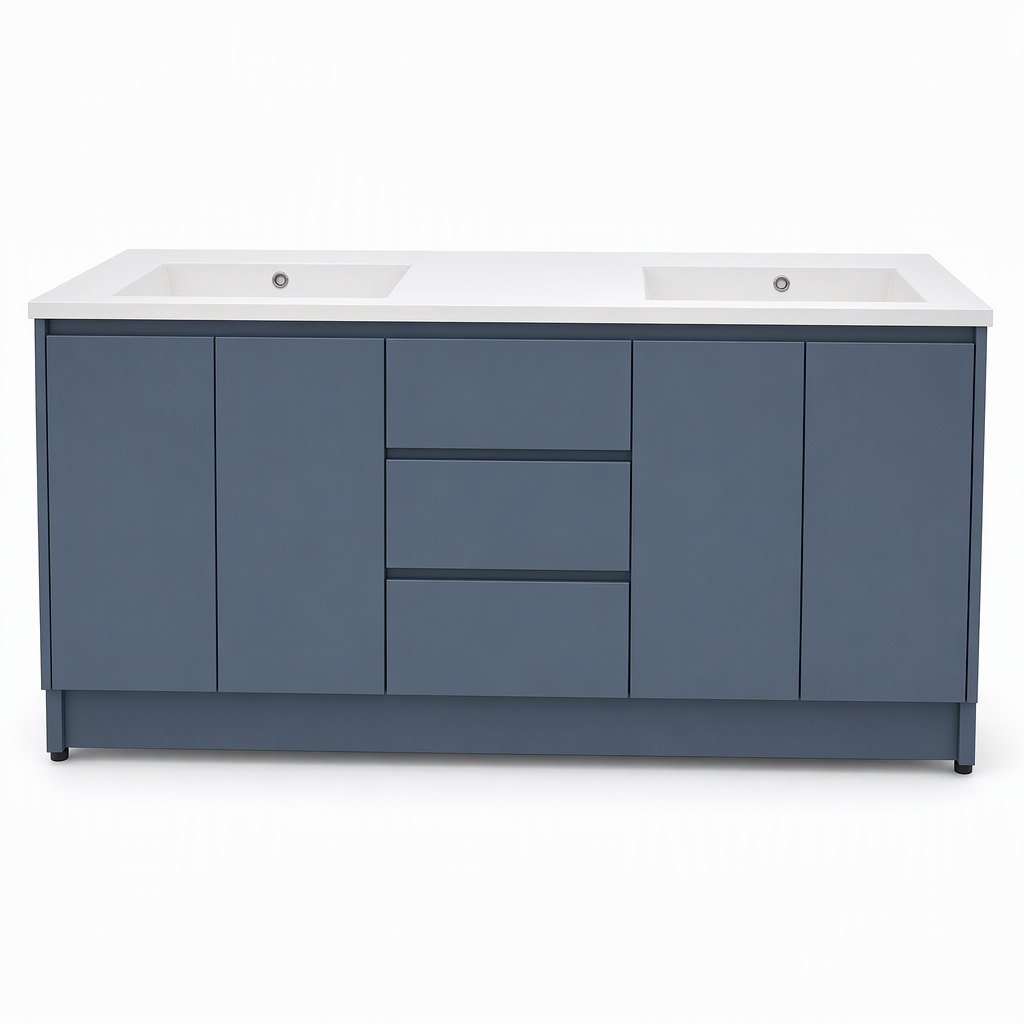
A bathroom vanity is a composite good: a frame, a carcass, a top, a basin. When the metal frame and the wooden drawers each carry real visual appeal and neither clearly imparts essential character, classification falls to the heading that occurs last in numerical order, which is why a published customs ruling on a metal-framed vanity with wooden drawers lands on 9403.60.8081 rather than on the metal furniture heading. The same ruling classifies the wooden drawer sections on their own line and the metal frames on another when they are imported separately and unequally.
Two practical conclusions follow. First, the classification is a function of how the goods are packed and invoiced, so a program that ships frames and boxes separately needs the parts lines quoted as parts, not as furniture. Second, a ruling fixes the heading and the additional Chapter 99 subheading that applied when it issued, but not the rate for ever: Chapter 99 measures are amended by notice, and the number on this month's entry is the number the broker must use this month. Treat a two-year-old ruling as a map, not as a price.
- Assembled wooden bathroom furniture: 9403.60.8081, other wooden furniture, other
- Wooden drawer sections imported separately: 9403.90.7080
- Metal frames imported separately: 9403.90.8041
- The ruling on record confirms a free general rate at heading level and an additional Chapter 99 subheading reported alongside it
- Chapter 99 rates change by notice: confirm the current subheading and rate at the time of entry, not from the quotation
Cube sets the freight line, weight almost never does
A 40-foot high cube holds around 76 cubic metres of geometric volume and about 66 cubic metres of usable volume once the door end, the header and the stacking pattern are taken seriously. A flat-pack vanity at 0.44 cubic metres per set therefore gives 148 sets, and it fills at roughly nine tonnes against a payload above twenty-six. That gap between nine tonnes and twenty-six is the whole economic argument for flat-pack: the container is bought by volume, so the only lever a supplier controls is how much air travels inside the carton.
The lever has a limit, and the limit is the carton, not the cube. Pressing a carcass flat until the carton is 60 mm thick saves volume and loses corners, and the cost of the loss appears in the claim file rather than the freight invoice. The workable target is a carton that is thin enough to load 148 sets and thick enough to survive a parcel network, which is a testable property rather than an opinion.
- 40HQ: 76 cubic metres geometric, about 66 cubic metres usable
- Resin-top double vanity: 0.44 cubic metres per set, 148 sets per 40HQ, 62 kg gross per set
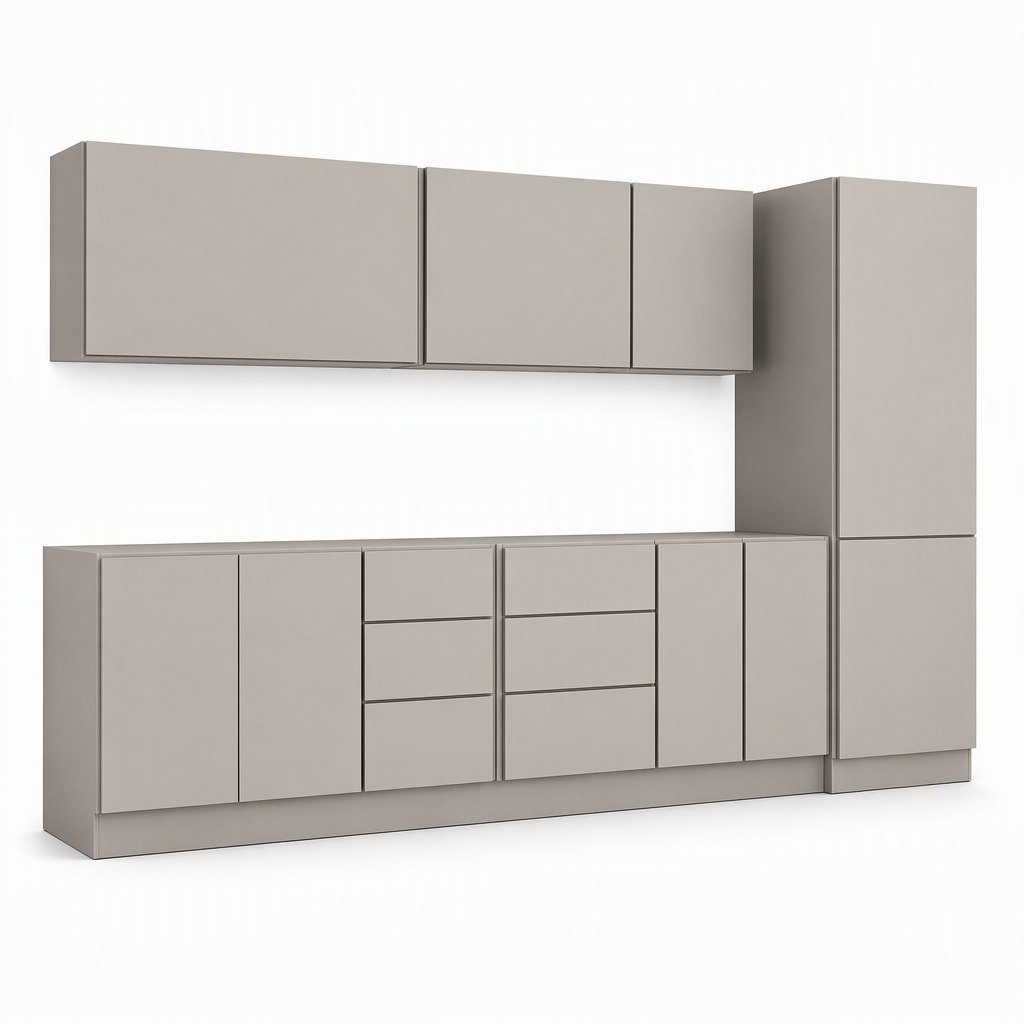
- 10 x 10 RTA kitchen: 1.08 cubic metres per run, 58 runs per 40HQ, 165 kg gross per run
- Density discipline: 141 to 153 kg per cubic metre keeps a container inside weight limits at full cube
- Palletising costs 8 to 10 percent of usable cube and adds the ISPM 15 mark to the pallet, not to the carton
ISTA 3A is the test a flat carton has to pass
A flat-pack carton is a parcel before it is furniture, which is why the relevant test is a parcel-delivery test and not a furniture test. The ISTA 3A sequence covers dropped, thrown and vibrated packages in the weight range a 60-inch vanity or a pantry side panel actually occupies, and it is the sequence that exposes the two failures flat-pack is prone to: corner crush on the long carton and hinge or runner damage when a heavy box lands on an edge.
Designing to it is unglamorous and cheap. Fifteen millimetre foam corners on the four vertical edges, a five-layer board on the long cartons, hardware boxed inside carton one rather than taped to the outside, and the longest panel never used as the structural wall of the carton. Ask a supplier which cartons carry five-layer board and which carry three, because the answer tells you whether the carton was engineered or estimated.
- Test the longest carton first: it fails before the heavy one does
- Five-layer corrugated on panels over 1,500 mm, three-layer on hardware and filler cartons
- 15 mm foam corners on all four vertical edges of every carcass carton
- Hardware inside carton one, never strapped to the outside where a blade opens it
- One drop test report per carton family, retained with the packing list revision
What the October 2026 EPA update changed on paper
In October 2026 the EPA issued a final rule updating the composite wood formaldehyde regulation. It did two things worth knowing at the purchasing desk: it updated six voluntary consensus standards incorporated by reference to their current editions, and it added a small-scale chamber method, ISO 12460-2:2024, to the list of quality-control test methods a producer may use. Neither change moves the 0.09 ppm particleboard limit or the labelling requirement.
The practical consequence is about paperwork currency, not product. A test report citing a superseded edition of an incorporated standard is a report a certifier has to reissue, and a quality-control method is only acceptable if it is one of the methods currently listed. When a supplier sends certificates, check the edition and the method, not just the number: the number has been right for years and the edition is what changed.
- Six incorporated standards updated to current editions
- ISO 12460-2:2024 added as a quality-control test method option
- Emission limits unchanged: 0.05, 0.09, 0.11 and 0.13 ppm by product type
- Labelling content unchanged, including the ban on barcode-only labels
- Ask for the certificate edition and the QC method, not only the certificate number
The eight-line import file
None of this is difficult, and all of it is sequential. A file assembled in the right order takes an afternoon; assembled backwards it takes a container. The sequence starts with the panel certificate, because that decides whether the program is importable at all, and ends with the entry summary, because that is where the code and the statement of compliance are finally read by somebody with authority to stop the goods.
The test of a supplier is not whether they can produce these documents, it is whether they produce them before being asked twice. A cabinet factory that already holds panel certificates, prints the label on the carton and puts the statement on the invoice is a factory that has cleared a US container before.
- Panel certificates naming the mill, product type and certifier number
- Carton artwork carrying fabricator name, month and year, and the compliance statement
- Statement of compliance printed on invoice and packing list, three-year retention
- Import certification prepared for the entry, positive certification route
- Classification per model or per packing configuration, with the current Chapter 99 subheading
- Packing list broken down by carton, so cube per set can be checked against the booking
- One ISTA 3A report per carton family
- Spares pack and care sheet in carton one, so the first container does not generate a service call
Questions Buyers Ask
Does a melamine-faced cabinet need TSCA Title VI certification?
Is 9403.60.8081 the right code for every vanity we import?
How many flat-pack vanities fit a 40HQ, and where does the number go wrong?
What did the October 2026 EPA rule change for an importer?
Want the Numbers for Your Own Program?
Send your model list, sizes and destination port — we reply within 24 hours with FOB pricing, MOQ and lead time.