The UK Entry File Is Decided by Paperwork, Not by the Door
A UK cabinet program is not priced by the FOB line, it is priced by five documents nobody photographs: a timber due diligence pack, a commodity code, an ISPM 15 marked pallet, a storage-unit test report and the carton cube. None of them can be produced after the container lands at Felixstowe.
21 November 2026 · UK market · Fame Industry Co., Ltd.
UKTR puts the obligation on whoever places the goods on the GB market
Since 1 January 2021 the Timber and Timber Products (Placing on the Market) Regulations have applied in Great Britain, replacing the EU Timber Regulation there. The obligation is not attached to the factory and not attached to the freight forwarder: it attaches to the operator, which means the business that first places the timber or timber product on the GB market. In a normal cabinet import, that is the UK importer.
The requirement is a due diligence system, and the regulation is specific about what a system has to contain: access to information on the supplier and the timber, a risk assessment against defined criteria, risk mitigation where the assessment is not negligible, and records kept for five years. A supplier who answers 'FSC certified' has given you a useful risk-mitigation tool but not an automatic pass, because certification is evidence used inside a due diligence system rather than a substitute for one. A shipment covered by a FLEGT licence from a partner country such as Indonesia takes a different route, and the licence is declared at entry.
Two distinctions are worth writing down before the first order. A business that buys finished cabinets from a GB operator and resells them is a trader, not an operator, and its obligation is record-keeping: supplier identity and, where applicable, the buyer. And Northern Ireland is not GB for this purpose, so a shipment entering through Belfast is a different file from the same shipment entering through Liverpool.
- Operator: places timber or timber products on the GB market first, and owes a full due diligence system plus five years of records
- Trader: buys from a GB operator and resells, and owes supplier and buyer records rather than a new due diligence system
- Due diligence system components: information access, risk assessment, risk mitigation where risk is not negligible, record keeping
- FLEGT-licensed imports from a partner country are declared with the licence rather than proven through the general system
- Great Britain means England, Scotland and Wales; Northern Ireland remains under the EU regime
- Practical file item: species, panel mill name, mill certificate number, purchase invoice and a signed due diligence statement per shipment
Two tariff lines, two different duty answers for the same container
Wooden kitchen furniture classifies in heading 9403 40, and the UK tariff carries a 2 percent third country duty on it. Other wooden furniture classifies in 9403 60, and 9403 60 90 carries a zero third country duty. VAT is 20 percent on both, and VAT is a cash-flow question that postponed VAT accounting answers on the return rather than at the border. The duty is the line that changes the landed cost, and it is set by what the goods are, not by what the invoice calls them.
Inside 9403 40 the tariff separates fitted kitchen units from other kitchen furniture, and inside each of those it separates hand-made from other. A flat-packed run of modular units is still a complete article for classification purposes: the General Rules treat an unassembled article as the complete article where it has the essential character of the finished one and is presented together. What changes classification is not flat-packing, it is what the item is designed to do, and how the goods are invoiced and packed when a program ships frames, boxes and tops as separate lines.
The commercial consequence is simple and it is not optional. A container of kitchen units and a container of bathroom vanities are not one line item, even when they travel together, and a broker who is handed a single description will pick one code and apply it to both. Sorting that after entry is a voluntary disclosure, not a correction.
- 9403 40: wooden furniture of a kind used in the kitchen, 2 percent third country duty, 20 percent VAT
- 9403 40 10 fitted kitchen units, 9403 40 90 other kitchen furniture, each split hand-made and other
- 9403 60 90 other wooden furniture, zero third country duty, 20 percent VAT
- 9403 60 10 dining and living room and 9403 60 30 shop furniture are separate lines within the same heading
- Unassembled goods presented together can still be the complete article, so flat-pack does not change the heading
- File item: the code per product line on the invoice, not one code per container
ISPM 15 makes the pallet a border document
Wood packaging material means pallets, crates, boxes, dunnage and any wood used to support or protect a consignment, and GB applies the international standard to it. The two approved treatments are heat treatment, which requires the wood to reach a minimum core temperature of 56 degrees Celsius for at least 30 minutes, and methyl bromide fumigation where that is permitted. Treated material carries the IPPC mark with the country code, the producer's registration and the treatment code, and the mark is applied by a registered producer rather than by the packer.
This matters commercially because of a choice buyers make for the wrong reason. Floor loading into a 40HQ uses no wood packaging at all and gives the full cube. Palletising adds the pallet, the stretch wrap and the ISPM 15 requirement, and it takes 8 to 10 percent of the usable cube back, so the freight line moves up before the container is even booked. The pallet is worth it when the receiver has no dock leveller or when the goods are cross-docked to a site; it is wasted money when the container is unloaded directly into a warehouse.
Processed wood is a different question from solid wood packaging: plywood and OSB cases sit outside the wood packaging standard because they are manufactured, while a solid timber crate or a dunnage batten does not. Getting that wrong is a hold at the port and a re-treatment invoice, and it is checked at the border rather than argued afterwards.
- Heat treatment: minimum 56 degrees Celsius wood core temperature for at least 30 minutes
- Marking: IPPC mark with country code, producer registration and treatment code, applied by a registered producer
- Scope: pallets, crates, boxes, dunnage and any solid wood used to support or protect the load
- Floor loading avoids the pallet, the wrap and the marking requirement entirely, and keeps the full cube
- Palletising costs roughly 8 to 10 percent of usable cube, which is the honest number to put next to the pallet price
- File item: the treatment certificate from the packaging producer, kept with the packing list
BS EN 14749 is the standard a UK buyer will quote back at you
BS EN 14749 is the safety and test-method standard for kitchen and bathroom storage units and domestic storage furniture, and the current published version is the 2016 text with the 2022 amendment. It covers free-standing and wall-hung furniture, which is the part that matters for a bathroom vanity, because a wall-hung unit carries its load through hanger plates into a wall rather than through a plinth onto a floor.
What a buyer should ask for is a test report, not a certificate. The report should name the model tested, the wall-fixing method used, the load applied and the test house. A factory certificate that says the production line is 'EN 14749 compliant' answers nothing, because the compliance belongs to a specific construction and a specific fixing. If the unit you are importing has a different carcass thickness, a different hanger plate spacing or a different door weight, it is a different test.
For a kitchen run the same logic applies to the wall units. A 720 mm high wall unit at 330 mm deep is a different load case from a 900 mm deep pantry, and a report covering one does not cover the other. Where a program mixes both, ask for both.
- Standard: BS EN 14749:2016+A1:2022, kitchen and bathroom storage units and domestic storage furniture
- Scope includes wall-hung units, which is where a vanity's structural risk sits
- Report, not certificate: model, fixing method, applied load, test house and date
- A changed carcass thickness, hanger spacing or door weight is a new test case, not the same one
- File item: the test report PDF, referenced by model in the quotation
Cube is the only freight lever, and the carton is the limit
A 40-foot high cube holds around 76 cubic metres of geometric volume and roughly 66 cubic metres once the door end, the header and the stacking pattern are taken seriously. That number, not the weight, is what a cabinet program is fighting. A wall-hung vanity at 0.21 cubic metres per set gives 310 sets and fills at about 14 tonnes; a three metre RTA kitchen run at 0.62 cubic metres gives 104 runs and fills at roughly 13.7 tonnes. Both are far below a payload above 26 tonnes, which is the whole argument for flat-pack.
The lever has a hard limit, and the limit is the carton rather than the cube. Pressing a carcass flatter saves volume and loses corners, and the cost of that loss lands in the claim file instead of the freight invoice. The workable target is a carton thin enough to load the container and robust enough to survive a parcel network or a builder's van, which is a testable property and not an opinion. Ask for the carton drop test and the board grade, and treat a supplier who cannot name either as a risk rather than a bargain.
- 40HQ: about 76 cubic metres geometric, about 66 cubic metres usable
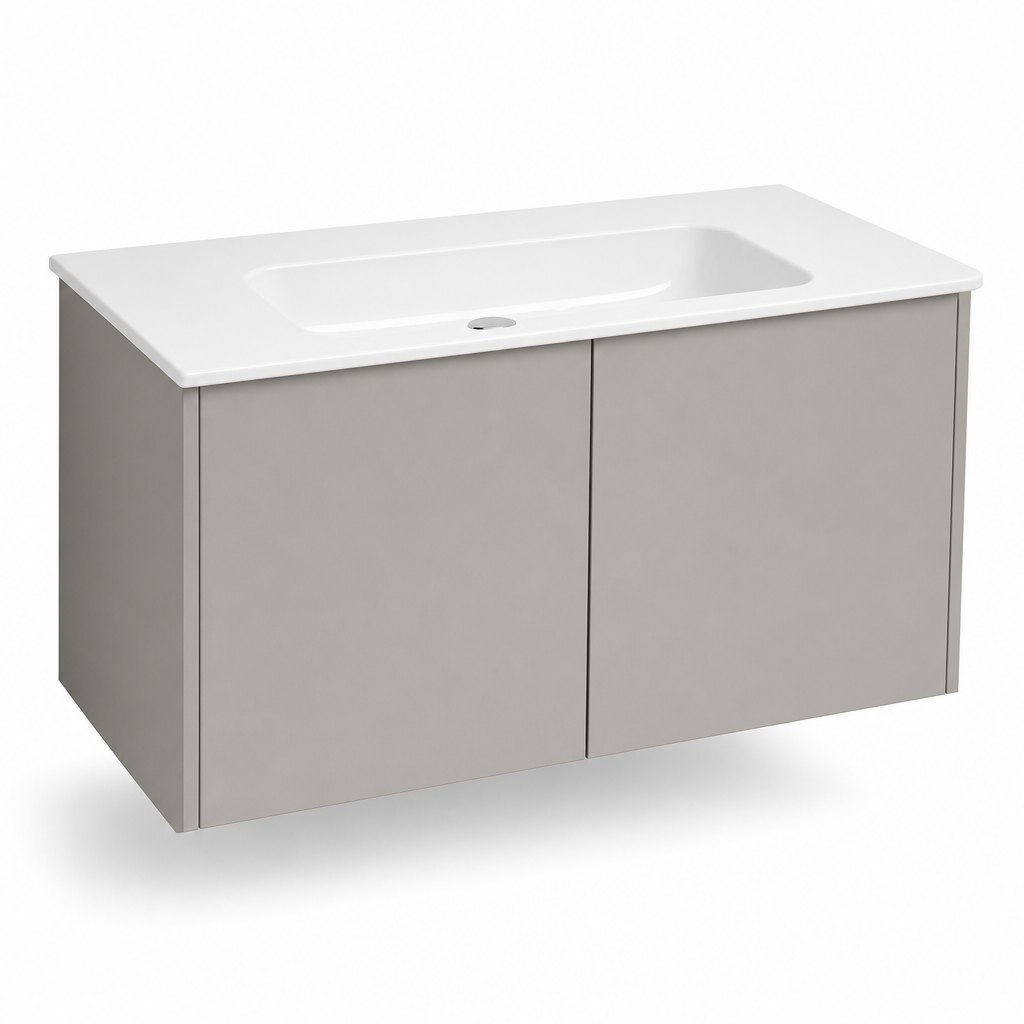
- Wall-hung vanity: 0.21 cubic metres per set, two cartons, 310 sets per 40HQ
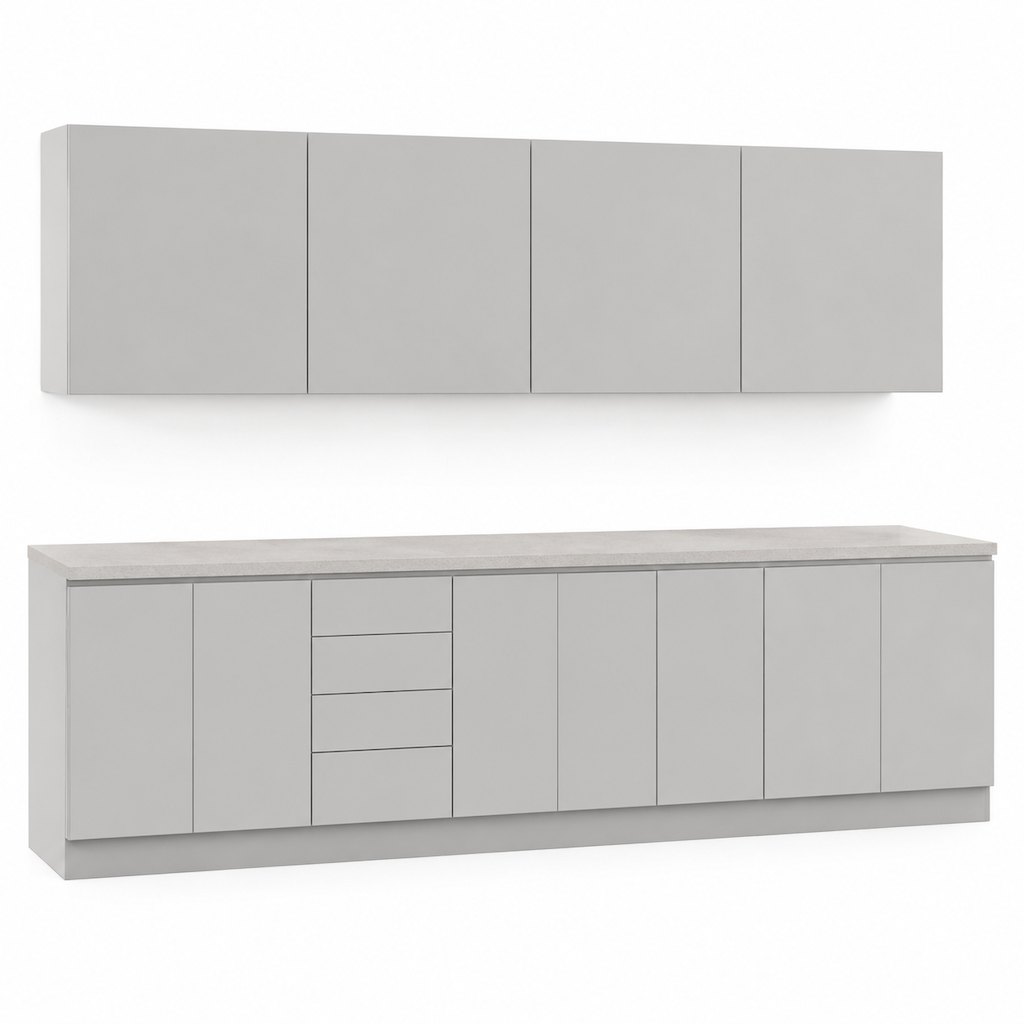
- Three metre RTA kitchen: 0.62 cubic metres per run, 15 cartons, 104 runs per 40HQ
- Both load on cube at around 14 tonnes against a payload above 26 tonnes, so weight never binds
- Palletising costs 8 to 10 percent of usable cube before the pallet itself is priced
- File item: carton dimensions, board grade and drop-test result per model
E1 is a panel class, not a border test
E1 is the emission class a panel mill declares for its board, measured by chamber method under EN 717-1, and it appears on a mill certificate rather than on a customs document. It is a useful purchasing filter and it is not the same thing as the US TSCA Title VI regime, which sets panel limits, requires third-party certification and puts a label on the finished good. A factory that answers a UK question with a US certificate, or the reverse, has not answered the question that was asked.
The practical test of a mill certificate is whether it can be traced. It should name the mill, the board type and thickness, the class, the certifier or test house and a validity date, and it should be reconcilable with the purchase invoice for the board that went into the shipment. A photograph of a sticker is not a certificate, and a certificate for a different thickness is a different product.
- E1: a panel emission class declared by the mill, measured under EN 717-1 chamber method
- TSCA Title VI: a separate US regime with panel limits, third-party certification and a finished-goods label
- Mill certificate should name mill, board type and thickness, class, test house and date
- Reconcile the certificate with the board purchase invoice for that shipment
- File item: mill certificate plus the board invoice line it refers to
What goes in the file before the deposit
The sequence matters more than the list, because most of these documents cannot be created after the fact. The commodity code is settled when the goods are specified, the test report exists only if a sample was tested, and the panel certificate belongs to a board batch that has already been cut. Assembling the file before the deposit is what turns a quotation into a program.
Two operational details are routinely missed. The first is the importer's EORI and enrolment for postponed VAT accounting, which are the importer's tasks and are worth confirming in writing before the vessel sails, not on the entry. The second is a spares allowance: two doors, one drawer box and a hinge set per fifty units in the same finish, because a match ordered in year four will not be the same batch, whatever the colour name says.
- Per product line: commodity code, description and the reason for the code, not just the number
- Per model: BS EN 14749 test report naming the fixing method
- Per shipment: UKTR due diligence statement with species, mill and certificate references
- Per pallet or crate: ISPM 15 treatment certificate from the packaging producer
- Per carton: dimensions, board grade and drop-test result, so cube can be promised rather than estimated
- Per importer: EORI and postponed VAT accounting enrolment confirmed before the vessel sails
- Per fifty units: a spares pack in the same finish, ordered with the original batch
Questions Buyers Ask
Does bathroom or kitchen furniture need a UKCA mark to enter Great Britain?
My customer buys FOB. Am I the operator under UKTR, or are they?
Both my products are wooden furniture. Can the whole container go under one code?
Does flat-packing change the classification or the duty?
Want the Numbers for Your Own Program?
Send your model list, sizes and destination port — we reply within 24 hours with FOB pricing, MOQ and lead time.