UK Cabinet Imports: Standards, Packaging EPR, Freight Math
Great Britain has its own rulebook now, and it asks different questions from the EU one. Here is the order a UK buyer actually asks them in — the standard, the board, the timber file, the packaging data, and the number that decides whether the price works: cubic meters per meter of run.
31 October 2026 · UK market · Fame Industry Co., Ltd.
The file comes before the price
A UK distributor placing its own label on cabinetry takes on the obligations of the seller in Great Britain — general product safety, packaging data, and where relevant electrical producer registration. That single fact explains why a first enquiry rarely starts with a target price. It starts with a question that sounds bureaucratic and is in fact commercial: can you send the test report, the board certificate and the timber due-diligence file?
Since Great Britain left the EU single market, the rules that apply to a container landed at Felixstowe are no longer the same as one landed at Rotterdam. Northern Ireland sits under a different arrangement again. A factory that answers a UK enquiry with an EU compliance pack is not necessarily wrong, but it has not answered the question, and the buyer can tell.
BS 6222 is the standard a UK kitchen buyer will name
British Standard BS 6222 sets performance requirements and test methods for the strength and durability of the structure of domestic and residential fitted kitchen units, and it is published in parts — Part 2 covers the units themselves, Part 3 covers worktops. The current text of Part 2 is BS 6222-2:2009+A1:2017. Testing houses such as FIRA test worktops, doors, drawers and hinges against these parts, and a UK retailer or contract specifier will often ask for the report by name.
What matters commercially is that the test is on the structure, not on the finish. A carcass that passes says nothing about whether the door decor will fade or the edge band will lift; those are questions for the board supplier and for the factory's own ageing routine. A quotation that separates structural evidence from finish evidence is easier for a buyer to defend internally than one that claims both at once.
- Ask for the BS 6222-2 report reference and the date of the tested build, not a logo
- Confirm which carcass height and board thickness were tested — a 720 mm carcase is not the same structure as an 800 mm one
- Ask separately for worktop evidence under Part 3 if the program includes tops
- Put the door and drawer cycle count you require in the RFQ, so the sample build is agreed before the MOQ run
Board, formaldehyde and the paper trail behind E1
Great Britain does not operate a federal formaldehyde rule for composite wood in the way the United States does under TSCA Title VI, so the specification usually arrives from the buyer rather than from a statute: E1 board, meaning a class defined under EN 13986 with emissions measured by the chamber method in EN 717-1. In practice a UK buyer asks for the panel producer's certificate and the batch reference that ties the delivered panels to it.
Two practical consequences follow. First, the certificate belongs to the board maker, not the cabinet factory, so a factory that buys from more than one mill has more than one file to keep straight. Second, for a bathroom cabinet the grade question is moisture resistance, not just emissions: an MR core with a sealed edge is the specification that survives a room with no mechanical extraction, and it costs less to specify at the order than to replace at year three.
Timber due diligence: the UKTR file
Wood-based panels are timber products, and placing them on the GB market brings the UK Timber Regulation into play: illegally harvested timber must not be placed on the market, and operators are expected to keep a due-diligence system that traces the material back to source. A factory holding FSC or PEFC chain of custody already has most of the evidence, because the standard requires the same traceability the regulation asks for.
This is where a single-panel-source supply chain earns its keep commercially. One board producer, one species and origin answer, one declaration — against three mills, three sets of species data and a due-diligence file that has to be rebuilt every time a decor changes. When a buyer asks how long the paperwork takes to produce, the honest answer is a function of how many mills are in the BOM.
Packaging is now a data obligation, not a bin
Extended producer responsibility for packaging changed the nature of the carton. Obligated UK producers must report data on the packaging they place on the market — by material and by format — and from 1 January 2026 that reporting includes nation-of-sale data, so the same carton reported for England is distinguishable from one sold into Scotland. Obligation is threshold-based, on turnover and on the tonnage of packaging handled, so a smaller distributor may sit outside it while its larger customer does not.
Separately, the Plastic Packaging Tax applies to plastic packaging components with less than 30% recycled content, at a rate reset annually. The practical output for a factory is a packaging data sheet per SKU: carton weight by material, recycled content of each plastic component, whether the foam is EPE or EPS, and whether the tape and labels are paper or plastic. A supplier who can send that sheet on request saves the buyer a week of estimation — and often a fee band.
- Carton weight split by material (corrugated, plastic film, foam, tape, label) per SKU
- Recycled content percentage for every plastic component, evidenced by the converter
- Whether the pack is designed for kerbside recycling in the UK, and what has to be separated
- Packaging volume per unit, which the freight calculation needs anyway
An LED mirror is electrical equipment, not furniture
The moment a mirror cabinet carries a driver, a switch and a light source, UK compliance stops being about the cabinet. Waste Electrical and Electronic Equipment obligations mean a producer placing EEE on the GB market registers and finances take-back; the Restriction of Hazardous Substances Regulations constrain what may be in the product; and the Ecodesign rules for energy-related products reach the light source itself. General product safety obligations apply to the whole article either way.
For a buyer this matters at two points: before the first order, when the technical file and declaration have to exist, and at the end of life, when the take-back obligation is priced in. A factory that supplies the LED module from a named driver supplier, with a declaration of conformity and a spare-parts line for the driver, makes both points cheaper. A sealed light engine with no spare part turns a warranty claim into a replacement cabinet.
Cubic meters, commodity codes and the entry
Classification follows the material that gives the article its essential character. Wooden kitchen cabinets normally fall under 9403 40, other wooden furniture including bathroom vanities under 9403 60, metal furniture such as an aluminum cabinet under 9403 20, and ceramic sinks and washbasins under 6910 10. The duty rate is the one set by the UK Global Tariff for that code on the entry date, and standard-rate VAT is accounted for at import — the broker confirms both, not the factory.
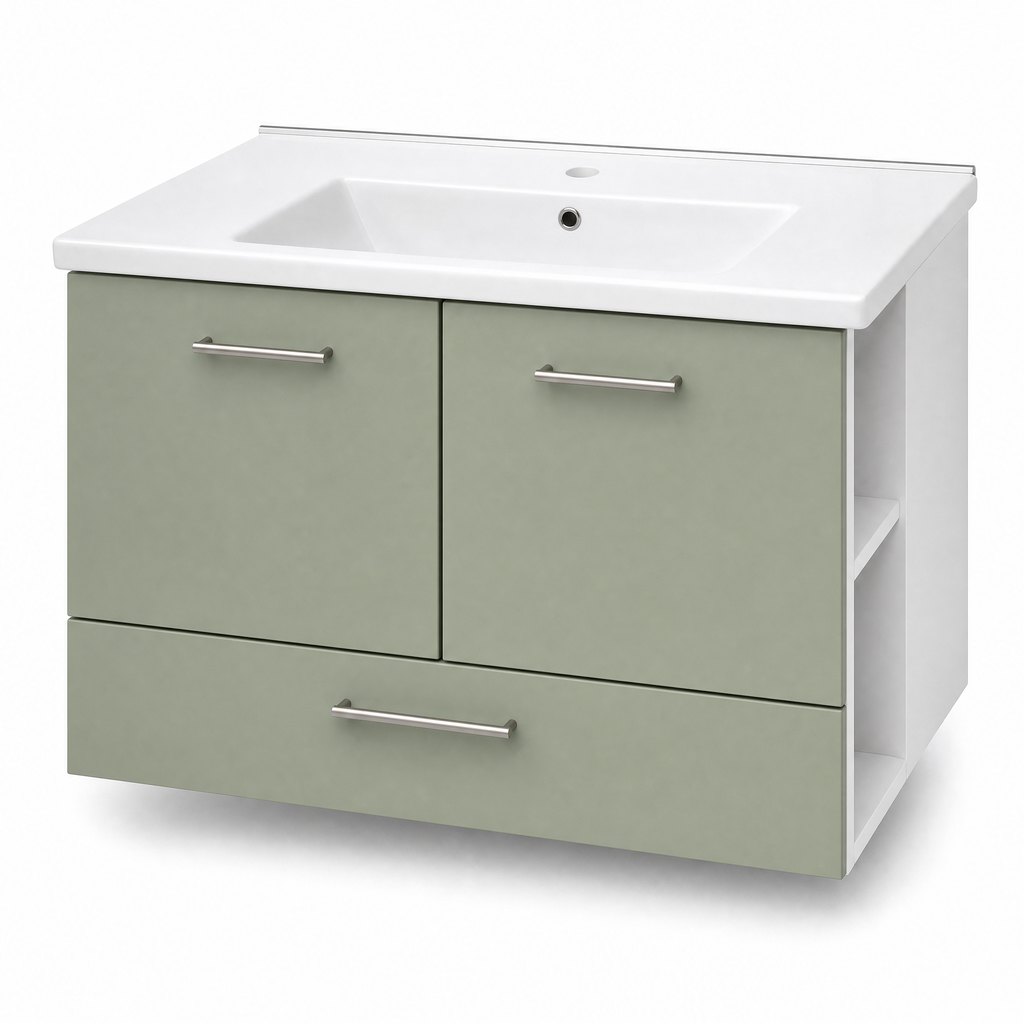
The number that decides whether a landed cost works is cubic meters per meter of run, not the ocean rate of the week. A 40HQ gives roughly 68 m³ of usable space, and assembled carcasses spend a large part of it on air. Flat-pack changes the arithmetic: a three-meter kitchen run in eight cartons at 0.58 m³ puts about 110 runs — around 330 linear meters — into a container, and an 800 mm wall-hung vanity packs to 0.075 m³ flat against 0.16 m³ assembled. That is the difference between a freight line that is 8% of landed cost and one that is 16%.
- Carton count, carton dimensions, total cubic meters and gross weight per set — not just the unit price
- Commodity code confirmed in writing by the importer's broker before the landed cost is priced
- Which GB port, and whether the booking allows a mixed container of kitchens, vanities and mirror cabinets
- Per-SKU packaging weights, so the EPR return can be filed without re-weighing cartons
- BS 6222-2 report reference, E1 board certificate with batch trace, and UKTR due-diligence statement
- For any lit product: WEEE producer details, RoHS declaration and the driver supplier named
Questions Buyers Ask
Does a cabinet shipped to the UK need UKCA or CE marking?
Is BS 6222-2 mandatory, or only when a customer asks?
Who is responsible for packaging EPR — the factory or the importer?
How much does flat-pack actually save on freight?

Want the Numbers for Your Own Program?
Send your model list, sizes and destination port — we reply within 24 hours with FOB pricing, MOQ and lead time.