Importing Cabinets into Germany in 2026: LUCID Registration, GS Mark and the Panel File
A working file for buyers placing flat-pack vanities and kitchens on the German market — which registration sits with you, which certificate is voluntary, which test report is tied to the construction, and how the container arithmetic decides the landed cost.
12 November 2026 · DE market · Fame Industry Co., Ltd.
The Four Documents That Decide a German First Order
A first order to Germany rarely stalls on price. It stalls on the paper that has to exist before the goods can legally be placed on the market, and on the question of who holds each piece of it. The file is short: a packaging registration, a system participation contract, a board declaration with the emission class behind it, and a test report for the assembled unit.
The split of responsibility is the part that surprises first-time importers. Your factory can supply declarations, test reports and carton artwork. It cannot register in your name, and it is not the party the German authorities will contact. If you buy FOB or CIF and clear the goods yourself, the obligations that sit on the entity placing the goods on the German market are yours, and they belong in your landed cost per unit, not in a footnote.
The practical rule we give buyers: ask for every document in the same format, keyed to the model code that appears on the packing list. When a container is held, the argument is never about whether a certificate exists — it is about whether it covers the model in the carton.
- LUCID registration number under the Verpackungsgesetz, plus the system participation confirmation for the packaging you ship
- Board declaration naming the EN 312 grade, the thickness and the formaldehyde class with its test method
- Hardware sheet with hinge and runner standards and load ratings, matching what is actually fitted
- EN 14749:2016+A1:2022 test report for the assembled unit, with the test house named
LUCID Registration: Whose Name Goes on the Register
The Verpackungsgesetz made registration in the LUCID register mandatory, and since 1 July 2022 that register — operated by the Stiftung Zentrale Stelle Verpackungsregister (ZSVR) — is the reference point every German buyer checks before placing an order. Registration is not the same as recycling participation: LUCID is the register, while the licence to put packaging on the market comes from a contract with a system operator.
For a Chinese factory shipping flat-pack cartons to a German distributor, the registration normally sits with the party that first places the filled packaging on the German market. That is usually the importer, and it is why a German buyer will ask for your LUCID number in the same email as the price request — and why they will not place the order if you cannot produce it. Distributors are barred from handling packaging that comes from a producer who is not registered, so an unregistered supplier becomes an unorderable supplier.
What the factory can do is make compliance cheap. We print the LUCID number, the material identification and the sorting instruction directly into the carton artwork. A printed marking costs nothing per unit; a labelling step in the importer's warehouse costs labour on every carton and creates a version-control problem the moment a decor changes.
Two details worth writing into the specification. First, registration covers a company and a packaging stream, not a product, so a new decor does not need a new number. Second, declarations to the system operator are generally based on declared put-on-market weights, which is why the packaging declaration has to be accurate rather than rounded — the carton weight list is the source document, not an afterthought.
The 2026 Formaldehyde Limit and What E1 Still Means
E1 is an emission class, not a board quality grade, and the two are confused in quotation sheets constantly. E1 is measured by the chamber method in EN 717-1 and has long been the European baseline for interior boards. A supplier writing "E1 board" without naming the method is giving you half of what your customer will ask about.
The regulatory floor is also moving. Commission Regulation (EU) 2023/1464 amends REACH Annex XVII to restrict formaldehyde emissions from articles, with a limit of 0.062 mg/m3 for furniture and wood-based articles, applying from 6 August 2026. For a cabinet program that means the declaration has to be backed by a test report on the actual board, measured by the chamber method — not by a generic statement that the board is E1.
EN 312 is where the mechanical grade lives, and it matters more in a kitchen than in a bathroom vanity. P2 designates non-load-bearing interior fitment board, which is what most cabinet carcasses in a dry room are. P3 designates load-bearing board for interior use in dry conditions, and it is the grade we specify for kitchen carcasses because a 600 mm sink base carrying a stone worktop and a full drawer stack is a load case, not a shelf.
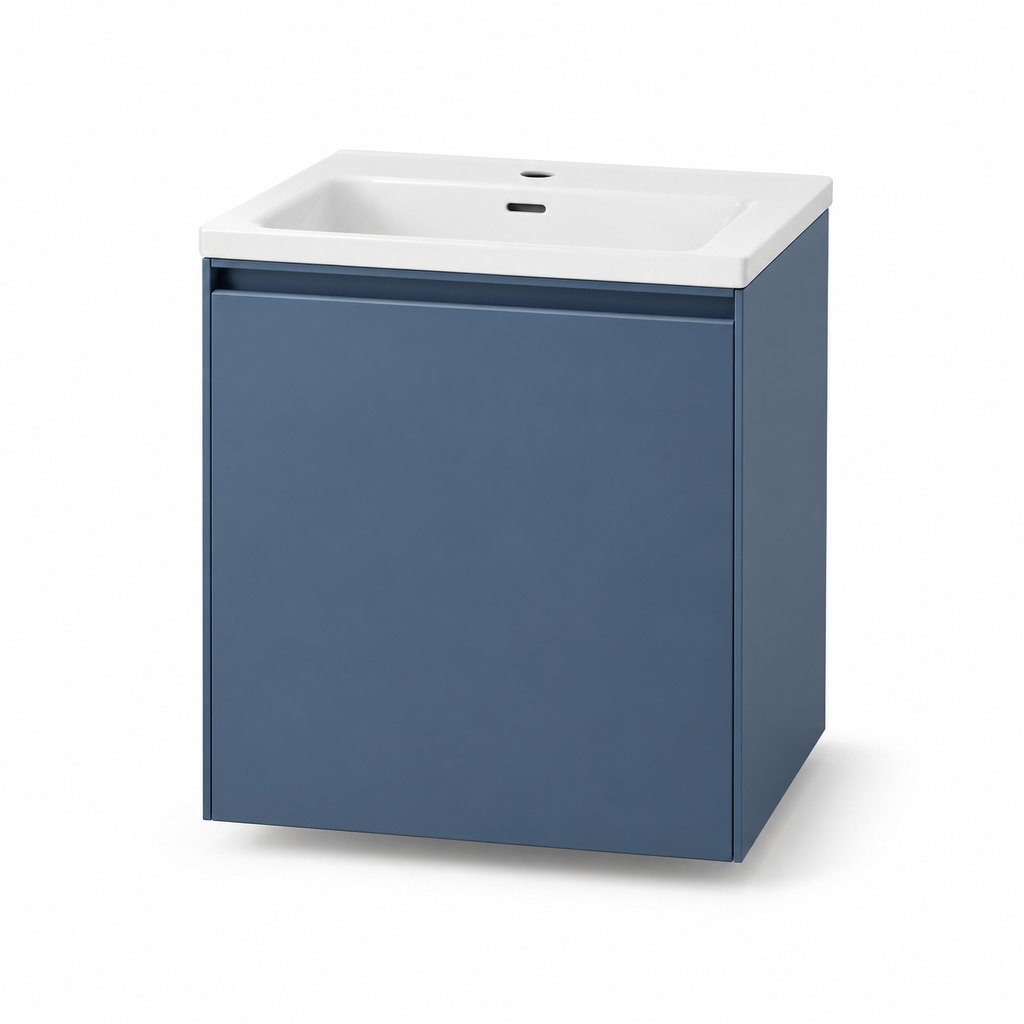
For bathrooms the argument shifts from load to moisture. Particleboard in a shower room will swell at an unsealed edge whatever class it carries, which is why wet-room vanities in our program use aluminum carcasses instead of board. If a project insists on board in a bathroom, specify sealed edges, a moisture-resistant grade, and a layout that keeps the panel out of direct spray.
GS Mark: What It Covers, and What It Does Not
The GS mark — Geprüfte Sicherheit — is the one product-safety mark in Europe with a statutory basis. It is regulated in the Produktsicherheitsgesetz (ProdSG), section 5, and it is voluntary: the manufacturer decides whether to apply. What it buys you is a third-party statement that the finished article meets the safety requirements of the ProdSG, issued by a testing body recognised for that scope.
Three practical points decide whether a GS certificate is worth having on a cabinet program. The first is scope: the certificate names a model or a construction, so a buyer should check that the scope actually covers the unit being shipped rather than a sister model. The second is that GS certification involves a factory inspection and is maintained through surveillance, which is a different exercise from a one-off type test. The third is that GS is not a substitute for CE marking where CE applies; furniture generally falls outside the directives that require CE, which is exactly why GS is the mark German buyers ask about.
Where GS earns its cost is in contract and tender work — housing associations, hotel programs and public procurement, where the specifier wants a mark rather than a test report they have to interpret. For a dealer selling through its own channel, an EN 14749 report plus a board declaration usually covers the question being asked.
The honest limitation: GS adds lead time and cost per model, and it has to be renewed. We quote it as a separate line with a timeline, rather than bundling it into a unit price and hoping the buyer does not ask what is inside.
EN 14749 Reports and the Flat-Pack Question
EN 14749:2016+A1:2022 is the European standard for kitchen and bathroom storage units, domestic storage furniture and kitchen worktops. It covers safety requirements and test methods for the carcass, the fittings and the worktop interface, and it is the report a German buyer asks for when the kitchen goes into a rental portfolio or a program where an insurer is involved.
Flat-pack does not exempt a product from the standard, but it changes the test object. What gets tested is the unit assembled from the carton contents with the supplied fittings and instructions. That is why the assembly instructions belong in the technical file: if the tested sample was built with one cam-and-dowel pattern and the production carton ships a different one, the report no longer describes what you sell.
The failure points are predictable. A wall unit tested with a full shelf load, a drawer runner at its rated load pulled to full extension, and a tall larder door on hinges that were never adjusted after assembly. All three are specification decisions, and all three are cheap to fix before production and expensive after a container has landed.
One point that saves money on reorders: an EN 14749 report is tied to a construction, not to a decor. Changing the foil color leaves the report standing. Changing the carcass thickness, the cam pattern or the hinge series needs a new test or an extension naming the new configuration. Plan decor changes for the same window as a production run, not in the middle of one.
Container Maths and What Sits Inside an FOB Price
For light furniture, ocean freight is charged on volume, so the number that decides whether a program works is the cost per cubic meter of the thing you ship. Two suppliers can quote the same vanity at the same unit price and land at very different costs because one packs 240 pieces in a 40HQ and the other packs 180.
Take our AL600 vanity. One piece is 0.258 m3 in a single carton, so with roughly 62 m3 of usable space a 40HQ takes 240 pieces. If the carton grows by 30 mm in each direction because a supplier adds extra foam, the volume rises by about a seventh and you lose thirty pieces per container without any change to the price list.
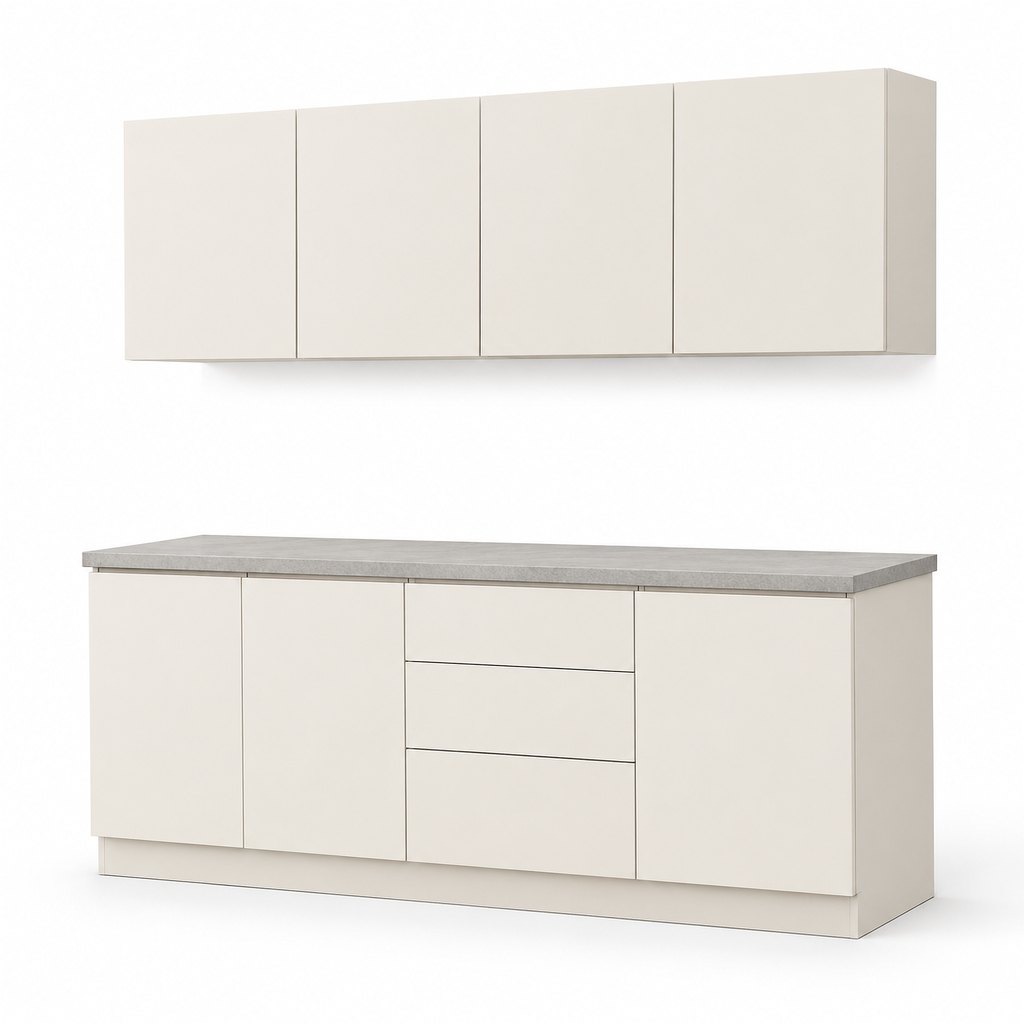
Kitchens work the other way: buyers think in linear meters, containers load in runs. Our KC24 run is 1.42 m3 across nine flat cartons, so a 40HQ takes 45 runs, which is 108 linear meters of standard 600 mm base. Quoting per linear meter and loading per run means the same container can be priced two ways, and the gap between them is where margin lives.
Rules we use when building a loading plan: compute volume from the carton outer dimensions including any pallet overhang, never from the product dimensions; keep one carton size per model where possible so the plan is reproducible; and confirm the plan against the actual module list before booking, because a tall larder changes the carton count even when the linear meters stay the same.
Under Incoterms 2020, FOB ends when the goods are on board at the named port, so the buyer carries ocean freight, insurance and the German leg. CIF extends the seller's obligation to the named destination port but still leaves import clearance, duty, import VAT and inland delivery with the buyer — a point that catches first-time importers who read CIF as delivered. Because the freight line is volume-driven, two CIF quotes are only comparable when the loading plan is identical, so ask for carton count and total cubic meters attached; a CIF price without a CBM figure cannot be checked, and it cannot be renegotiated fairly when rates move.
Duty depends on classification. Wooden kitchen furniture sits in heading 9403.40, other wooden furniture in 9403.60, metal furniture in 9403.20, ceramic sinks in 6910.10 and framed mirrors in 7009.92 — but the binding answer comes from your customs broker with the product in hand, especially for mixed-material units where an aluminum carcass carries a ceramic top.
The last line people forget is the German leg and the packaging decision. From Hamburg or Bremerhaven inland, haulage is charged on pallets and unloading time; a carton program that ships flat instead of on pallets saves container volume and costs handling hours at the other end. Decide which of the two you are optimising before you approve the packing method, because the answer changes the carton specification.
- Cost per cubic meter = FOB per unit divided by cubic meters per unit — the only figure that compares packing efficiency
- Loading quantity = usable container volume divided by carton volume, then reduced for stacking loss
- Cost per linear meter = FOB per run divided by run length, with worktops and appliances excluded
- Every FOB or CIF quote compared with carton count and total CBM attached, otherwise the comparison is not a comparison
A Realistic Eight-Week Path from Specification to Delivery
A first container to Germany takes about eight weeks from specification freeze to delivery, and the critical path runs through documents and artwork, not production. A mixed 40HQ is typically 30 to 35 days in production; approval, carton artwork and booking fill the rest.
Weeks one and two are specification and samples: finish approval against a physical color card, module list, and the board-versus-aluminum decision for wet areas. Weeks three and four are documents and artwork: board declaration with the emission class, the EN 14749 report scope, carton print with the LUCID number and sorting instruction, and confirmation that the packing list matches the tested construction. Weeks five to seven are production and inspection. Week eight is booking, loading and the documents that travel with the container.
The step most often skipped is the one that costs the most: checking that what will be produced is what was tested. Comparing the technical file against the production drawing takes an afternoon, and it is the difference between a clean arrival and a re-test on your own account.
On a repeat order the eight weeks compress to five or six, because the documents are already yours and only the loading plan needs rechecking. That is the point at which a cabinet program becomes predictable enough to quote to your own customers with a delivery date attached.
Questions Buyers Ask
Who registers in LUCID, the Chinese factory or the German importer?
Does the 2026 formaldehyde limit replace the E1 class?
Is a GS mark legally required to sell cabinets in Germany?
Can one EN 14749 report cover several decors?
Want the Numbers for Your Own Program?
Send your model list, sizes and destination port — we reply within 24 hours with FOB pricing, MOQ and lead time.