France Cabinet Imports 2026: EN 14749, REACH, EPR, Freight
France is the European market where a container of cabinets is judged twice: once by the importer's landed cost sheet, and once by a dossier the buyer's quality team can actually read. Four of those obligations changed inside the last two years, and three of them land on the importer rather than on the factory. This is the order a French distributor asks the questions in.
4 November 2026 · FR market · Fame Industry Co., Ltd.
One container, three tariff lines, one invoice that has to match
French customs classification splits a mixed cabinet container the same way the rest of the EU does. Kitchen units sit in CN 9403 40 as wooden furniture of a kind used in kitchens. A bathroom vanity is CN 9403 60, other wooden furniture. A ceramic basin top leaves chapter 94 entirely and lands in chapter 69 as ceramic sanitary ware. If the container also carries a lit mirror, that is a luminaire with its own electrical obligations rather than a piece of furniture.
The practical consequence is not the duty rate, it is the entry. A commercial invoice with one averaged description and one unit price for a mixed container is the classic route to a reclassification at the port, and a reclassification arrives after the goods are on the quay with storage running. Two or three lines, each with its own description, code and unit price, is also how a French distributor wants to buy: cabinet programs are quoted and re-sold separately from ceramic and from lighting.
- 9403 40 — wooden furniture of a kind used in kitchens: base, wall and tall units
- 9403 60 — other wooden furniture: bathroom vanities, mirror cabinets
- 6910 — ceramic sinks and washbasins, including a one-piece basin top
- 9405 — luminaires: where a lit mirror stops being furniture and becomes an electrical product
EN 14749 is the standard a French tender actually names
There is no CE marking for kitchen or bathroom furniture as such. CE applies to products covered by specific directives, which is why the LED mirror in the same container needs attention and the cabinet beside it does not. What French buyers, project specifiers and quality teams name instead is EN 14749, the European standard for domestic and kitchen storage units and kitchen worktops, which sets safety requirements and test methods rather than a design.
The current reference in circulation is EN 14749:2016 with amendment A1:2022, and its scope covers kitchen and bathroom storage units, domestic storage furniture and their components, including units fixed to the building. That last point matters for a flat-pack program: a wall-hung vanity and a tall kitchen pantry are both in scope, and the tests address the loaded unit, the door and drawer cycles, and the stability of the assembly rather than the finish.
A test report is only useful if it names the model, the configuration and the loading used. A report issued against a different carcass thickness, a different hinge or a different plinth height is a report about another product. When a French customer asks for EN 14749 evidence, the question to send back to the factory is not "do you have the certificate" but "which models, which hardware, which test house, which date".
- Scope: kitchen and bathroom storage units, domestic storage furniture, components, wall-fixed units
- Reference in circulation: EN 14749:2016 + A1:2022
- What the report must name: model, carcass thickness, hardware set, plinth, test house, date
- What it does not cover: surface finish durability, formaldehyde emission, electrical safety of a lit mirror
Formaldehyde: E1 board is not the same claim as the 2026 limit
Commission Regulation (EU) 2023/1464 added entry 77 to Annex XVII of REACH, and for furniture and wood-based articles the restriction applies after 6 August 2026 at 0.062 mg/m3, measured by the chamber method set out in Appendix 14 of that Annex. That is an emission limit for the finished article in a test chamber, not a board class.
This is where a lot of supplier paperwork stops being sufficient. E1 describes a board, and it has been the working reference in the trade for years. The restriction describes what the assembled cabinet releases, which depends on the board, the quantity of board per cubic meter of the article, the edge banding, the back panel and the adhesive. A carcass can be built from E1 board and still need a chamber test to show it meets the article limit, because the two are measured differently.
For a French program the useful question is therefore about documentation per production batch: the board supplier's declaration, the formaldehyde class, and a chamber test report on a representative assembled module. If the answer is only a board certificate, the file is one test short of what an importer needs when a buyer's quality team or a market surveillance authority asks.
- Legal instrument: Regulation (EU) 2023/1464, new entry 77 of REACH Annex XVII
- Limit for furniture and wood-based articles: 0.062 mg/m3, after 6 August 2026
- Method: chamber method, Appendix 14 paragraph 1 of Annex XVII
- Documentation to hold: board declaration + batch record + chamber test on an assembled module
GPSR put a name and an address on the product
The General Product Safety Regulation, Regulation (EU) 2023/988, has applied since 13 December 2024. For furniture it changed something quietly practical: a product placed on the EU market needs an identified economic operator established in the EU who can be contacted about safety, and the product needs traceability information that lets a batch be identified and, if necessary, withdrawn.
For an importer this is a labeling and filing task, not a design task. The importer is that economic operator. The label on the carton and on the product needs the importer's name and contact address, a model or batch reference, and enough information to link the unit back to the shipment. A factory logo and an order number on the carton is not the same thing as a traceability record, and the gap is usually discovered during a recall exercise rather than before one.
- Instrument: Regulation (EU) 2023/988, applicable since 13 December 2024
- Who: the EU-established importer is the responsible economic operator
- On the product and carton: importer name, postal and electronic contact, model or batch reference
- In the file: a record linking batch to shipment, so a single module can be traced without opening the container list
Packaging became a declared object in January 2026
France has had extended producer responsibility for household packaging for decades. What changed on 1 January 2026 is the professional packaging stream: cartons, stretch film, edge protection and pallets used in business-to-business flows now sit in their own EPR filière, with registration through an eco-organisme and an annual declaration of tonnage by material.
For a cabinet importer the arithmetic is not the point; the point is that the carton list already exists. A flat-pack program ships with per-carton dimensions, net and gross weight and the material of each component, because that is what freight and insurance need. The same list, aggregated by material, is the declaration. The companies that struggle are the ones whose only record of packaging is a photograph of a pallet.
Registration also produces an identifier used on declarations and, in the household stream, the sorting information printed on the packaging. The practical recommendation is to decide who declares before the first container lands: the importer as the party placing the packaging on the French market, or a supplier arrangement where the tonnage is declared upstream. Doing it in the wrong order means reconstructing a year of packaging data from shipping documents later.
- Household packaging EPR: long-standing, with sorting information on pack
- Professional packaging EPR: started 1 January 2026, B2B cartons, film and pallets
- Registration: through an eco-organisme, with an identifier used on declarations
- Data source you already have: the per-carton packing list, aggregated by material and weight
Since 1 September 2026 the PDF is not an invoice
The French e-invoicing reform entered into force on 1 September 2026. Receiving electronic invoices became an obligation for businesses established in France, and issuing follows the size calendar, with large companies and mid-caps in the first wave and smaller entities later. The invoice has to travel through an approved platform in a structured format, with the tax data reported alongside it.
For an exporter this is a document-format question with a commercial consequence. A proforma in PDF and a commercial invoice in PDF are fine for the export side, but once the French importer re-invoices the goods domestically, the domestic invoice is a structured document. If the importer's system can only ingest a PDF, someone re-keys every line, and the re-keying is where a tariff code or a unit price drifts away from the customs entry.
The cheap fix belongs in the RFQ: ask for the invoice data as a structured export, line by line, with code, description, quantity, unit price and carton reference. A factory that can send that file makes the importer's domestic invoicing a mapping job rather than a data-entry job, and the same file reconciles against the entry.
- In force: 1 September 2026 for receiving; issuing phased by company size
- What travels: a structured electronic invoice through an approved platform, with tax data reported
- What to request from the factory: line-level invoice data export, not only a PDF
- Why: the domestic re-invoice and the customs entry have to describe the same lines
Container maths: 68 m3, not 76
A 40HQ is about 76 m3 nominal and roughly 68 m3 usable once pallets, stowage loss and the fact that cartons do not fill the last 30 cm are allowed for. Every loading figure worth quoting is built from the usable number, and the difference between the two is where optimistic quotations are born.
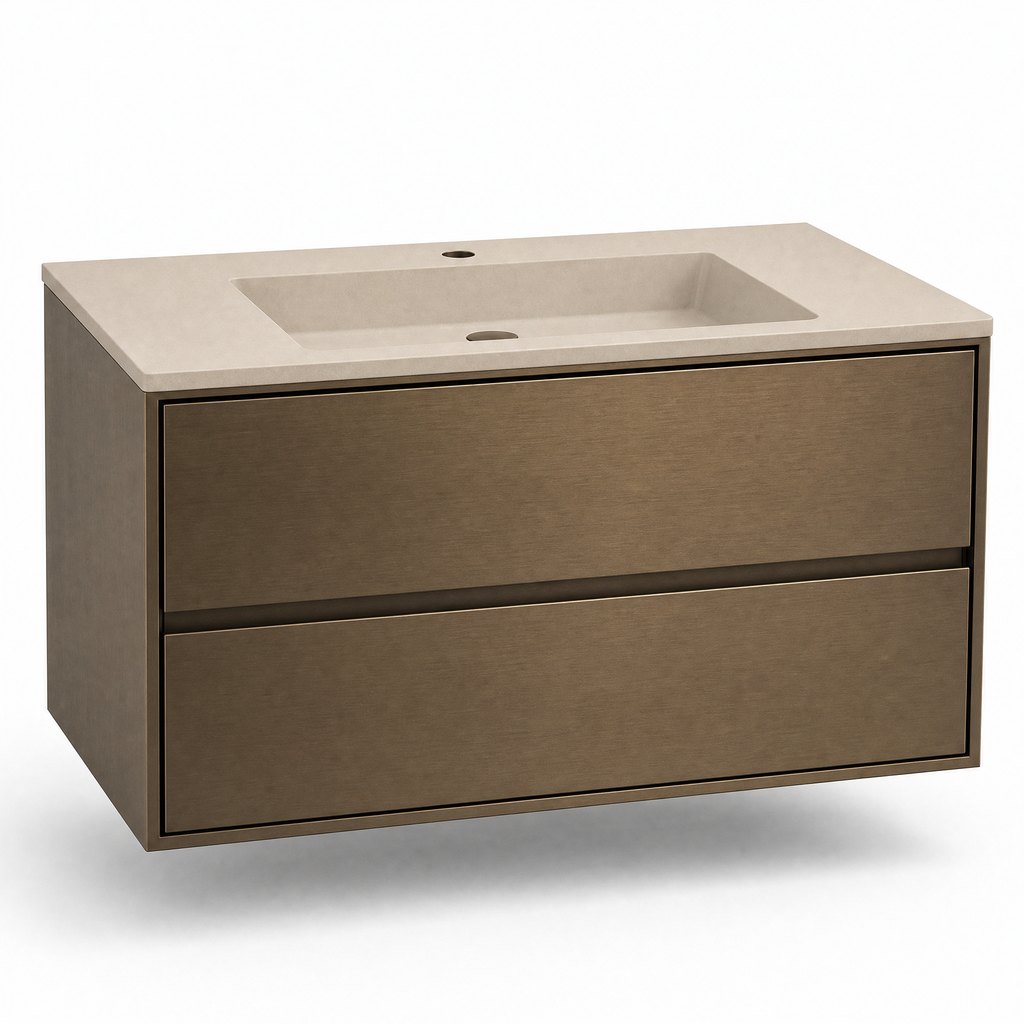
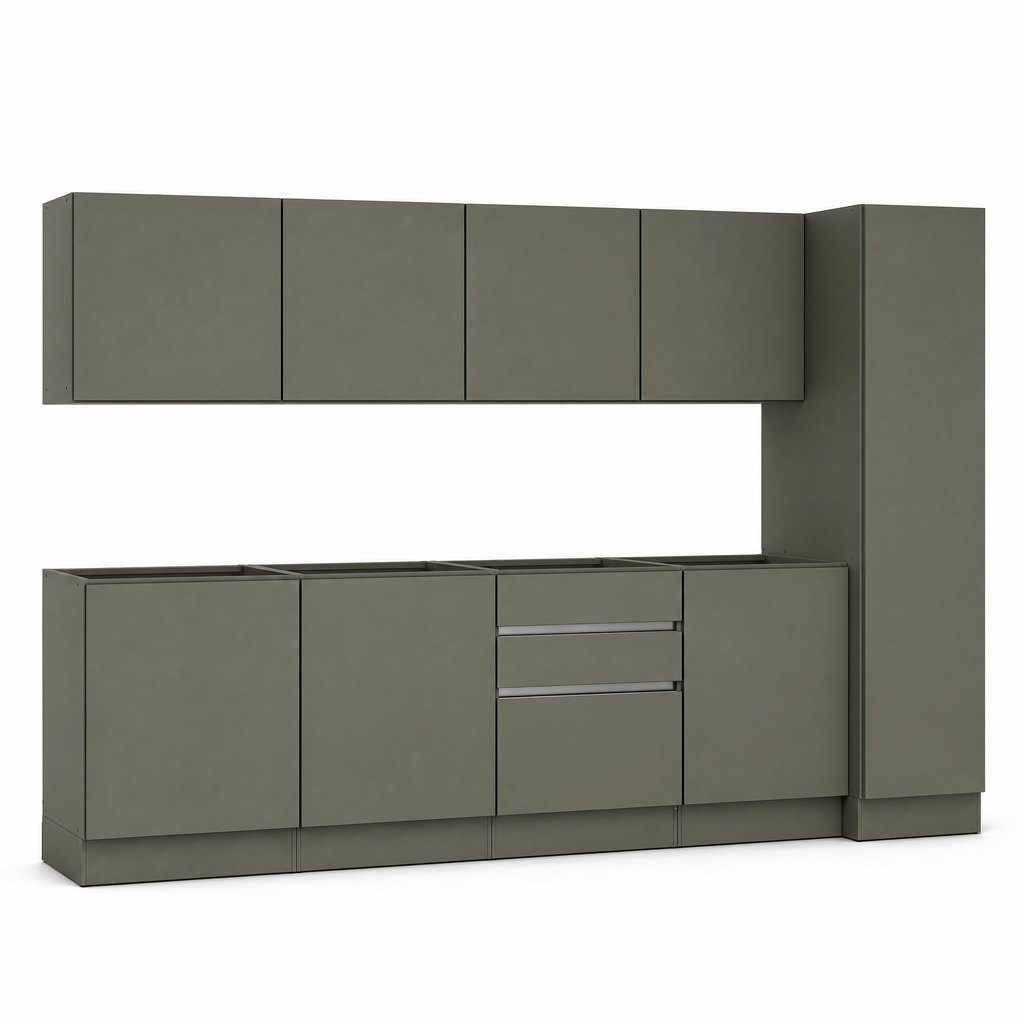
The two shapes behave differently. A wall-hung vanity with a molded solid surface top packs to 0.155 m3 in two cartons at 33 kg gross — 0.100 m3 for the knocked-down aluminum carcass, 0.055 m3 for the top — which puts about 430 sets in a 40HQ, against roughly 220 for the same vanity shipped assembled at about 0.30 m3. A ten-meter flat-pack kitchen run packs to 1.65 m3 in 14 cartons at 210 kg gross, so a container carries about 400 linear meters of cabinetry.
Mixed orders are where cube gets wasted. Vanity cartons stack well; basin tops and assembled mirror cabinets do not, because they cannot take load above about 1.8 m. The rule that keeps a mixed container honest is to load kitchens as the base of the stow and put the awkward cartons on top, then check the loading plan against the carton list rather than against the total cube.
- 40HQ: about 76 m3 nominal, about 68 m3 usable
- Wall-hung vanity with solid surface top: 0.155 m3, 33 kg gross, about 430 sets per 40HQ
- Ten-meter flat-pack kitchen run: 1.65 m3, 14 cartons, 210 kg gross, about 400 linear meters per 40HQ
- Mixed loads: kitchens as the base, fragile cartons on top, plan checked against the carton list
Questions Buyers Ask
Do kitchen cabinets need a CE mark to be sold in France?
Is E1 board enough to satisfy the formaldehyde rules from August 2026?
Who is the producer for French packaging EPR when the cartons are made in China?
Can cabinets and a ceramic basin top go on one invoice line?
Want the Numbers for Your Own Program?
Send your model list, sizes and destination port — we reply within 24 hours with FOB pricing, MOQ and lead time.