Chile Cabinet Imports: FTA, Ley REP, SEC, Freight
Chile is the one Latin American market where a Chinese cabinet program can land at zero duty and still fail on paperwork. The tariff depends on a certificate, the carton is a regulated product in its own right, and any lit mirror is an electrical product before it is furniture. Here is the order a Chilean importer actually asks the questions in.
2 November 2026 · CL market · Fame Industry Co., Ltd.
The import file travels with the importer, not the factory
When a container of vanities or flat-pack kitchens berths at San Antonio or Valparaíso, the party that answers for it is the Chilean importer of record with a RUT, acting through an agente de aduanas who files the Declaración de Ingreso. The factory issues the commercial invoice, the packing list, the bill of lading and — where a preference is claimed — the certificate of origin. Everything else in the file, and every consequence of it being wrong, sits on the importer.
The practical effect on a factory quotation is that the compliance pack is part of the product. A quote that arrives with a board certificate, the electrical file for a lit model and a packaging weight table is easier for a Chilean buyer to defend internally than one that arrives with a price and a photograph, and the difference shows up months before the container is booked.
The China-Chile FTA is worth six points of CIF
The Tratado de Libre Comercio between Chile and China has been in force since 1 October 2006, and the furniture and glass lines that carry this program have been at zero ad valorem under it for years. The general rate that applies when no preference is claimed is 6% of the CIF value. Value added tax of 19% is then calculated on CIF plus duty, so a preference does not only remove the duty line, it also shrinks the base the VAT is charged on.
The arithmetic is worth putting in front of a buyer, because it is the cheapest margin in the deal. On a CIF of USD 40,000 the duty is USD 2,400 at the general rate and zero with a valid origin certificate; the VAT is USD 7,600 on the preferred entry and USD 8,056 on the non-preferred one. The saving is USD 2,856 on one container, against a certificate that costs a stamp. What decides whether the saving is real is classification: the entry has to name the correct Chilean eight-digit code for what is in the box, and it is the importer's broker, not the factory, who confirms that code. Never treat a 0% line as automatic — treat it as a document that has to be right.
- Certificate of origin issued for the shipment, matching the invoice quantity, the description and the consignee
- Six-digit heading stated on the invoice so the broker can map it to the Chilean tariff without guessing
- Classification expectations for this program: 9403.40 for wooden kitchen units, 9403.60 for other wooden furniture such as a vanity carcase, 9403.20 for aluminum furniture, 7009.92 for framed glass mirrors, 6910.10 for ceramic sinks
- Duty and VAT calculated on CIF, not FOB, so the freight line has to be in the landed-cost sheet from the first quote
Ley REP: the carton is a regulated product in its own right
Chile regulates packaging under Ley 20.920, the framework law for waste management and extended producer responsibility, implemented for envases y embalajes by Decreto Supremo 12/2020 — the decree whose collection and recovery targets have been running since 16 September 2023. Under that regime the obligated party is not the factory that made the carton; in packaging it is whoever introduces the packaged consumer good into the Chilean market. For imported cabinetry that is normally the importer or the distributor that places its own label on the goods.
What this changes in a purchase order is small but concrete. The importer has to register and declare the quantities it puts on the market through the RETC, and join an individual or collective management system. Declaring tonnes of packaging requires knowing the packaging weight per SKU by material, which is a number the factory already has and rarely puts in a quotation. A packaging table — carton weight, EPS or pulp protection, pallet weight, plastic bag weight, per model — turns a compliance task into a data request that gets answered in an afternoon.
- Packaging weight per model split by material: corrugated board, moulded pulp or EPS, LDPE bag, timber pallet, strapping
- Carton dimensions and gross weight per set, which also drive the freight calculation
- Confirmation of whether the buyer's label goes on the carton, because that is what moves the packaging obligation onto them
- For a distributor running several suppliers: one packaging data sheet format across all of them, so the annual declaration is assembled from one table instead of five PDFs
SEC: the certification sits on the lamp, not on the cabinet
Chile's Superintendencia de Electricidad y Combustibles maintains a list of electrical products subject to mandatory certification, and luminaires are on it. A plain mirror cabinet is furniture. The moment an LED strip and a driver go inside it, the lit product needs SEC certification, a certificate that names the model and the protocol it was tested to, and the sello SEC carrying a folio number that a buyer or an inspector can look up.
Two details trip up first shipments. The first is that the certificate belongs to the model, not the brand, so a driver substitution in production invalidates the file even if the cabinet is unchanged — quote the driver and keep the model number stable. The second is the installation environment: Chile runs 220 V at 50 Hz on type L and type C outlets, and a bathroom luminaire has to be rated for the zone it sits in, which in practice means an IP44 enclosure for anything within reach of the basin. For a buyer, the useful question to the factory is not whether it is certified but which model numbers appear on the certificate and how long the file stays valid.
Board, edges, and the bathroom with no extraction
Most Chilean apartment bathrooms in the size band this program serves have no mechanical extraction — a window, or nothing. That single fact decides the board specification more than any standard does. Eighteen millimeter HMR particleboard with 1 mm ABS edges on doors and 0.5 mm on carcase panels is the specification that survives it, and the E1 class declared with a batch reference from the mill is what a retail buyer will ask for on paper.
The failure mode to design out is the cut edge. A basin cut-out, a hinge cup and a service hole are all places where the panel core is exposed, and a factory that seals them on the line is a factory that does not get a swelling claim in year two. On the kitchen side, an 8 mm HDF back panel sitting in a groove rather than stapled to the rear does the same job structurally: it holds the carcase square after a container has been stacked four high through a Pacific crossing.
- 18 mm HMR carcase, E1 declared with a batch reference from the panel mill
- 1 mm ABS on door edges, 0.5 mm on carcase, with cut-outs and hinge cups sealed on the line
- 8 mm HDF back in a groove, not stapled, for carcase squareness
- Super-matte melamine faces at around 105 degree gloss, which hides handling marks in a rental unit
Fixing into Chilean walls, and what an installer needs
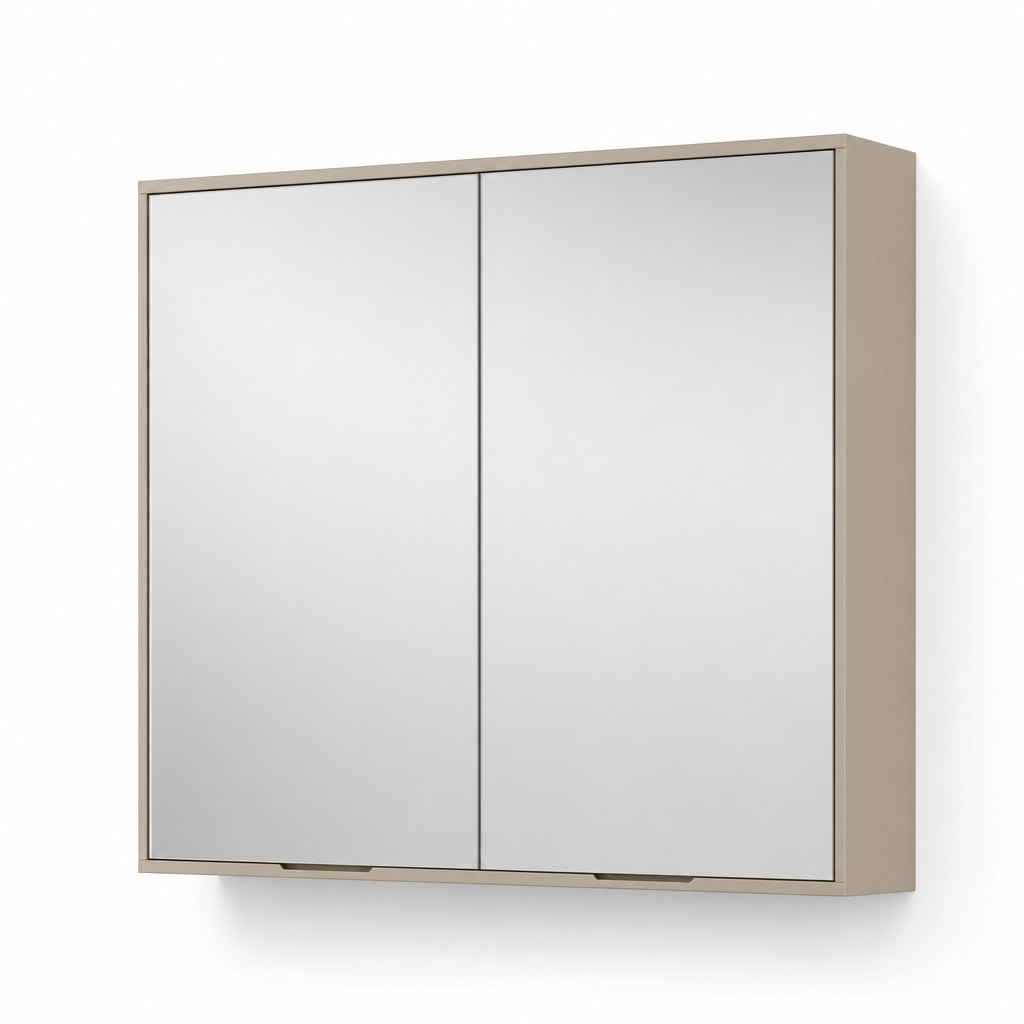
Chilean residential construction is dominated by reinforced concrete and masonry, which is good news for wall-hung furniture and bad news for anyone who has only packed plasterboard fixings. A 700 mm aluminum mirror cabinet at 21 kg and a 900 mm vanity at 18 kg are light loads for a slab or a brick wall, but they are marginal for drywall over metal stud, and the standard fixing has to be specified per substrate in the installation sheet rather than left to the installer.
Chile is a seismic country, and the failure mode that matters in a shake is the unit leaving the wall, not the frame failing. A French cleat through-bolted into masonry with a secondary top strap is the detail that gets accepted; four plugs into a cement render over block is the detail that gets called back. If the retail customer asks for a stability test on the units, the reference is EN 14749 for domestic kitchen and bathroom storage — name it in the RFQ and let the factory confirm which build was tested.
Cubic meters per meter of run, and what to put in the RFQ
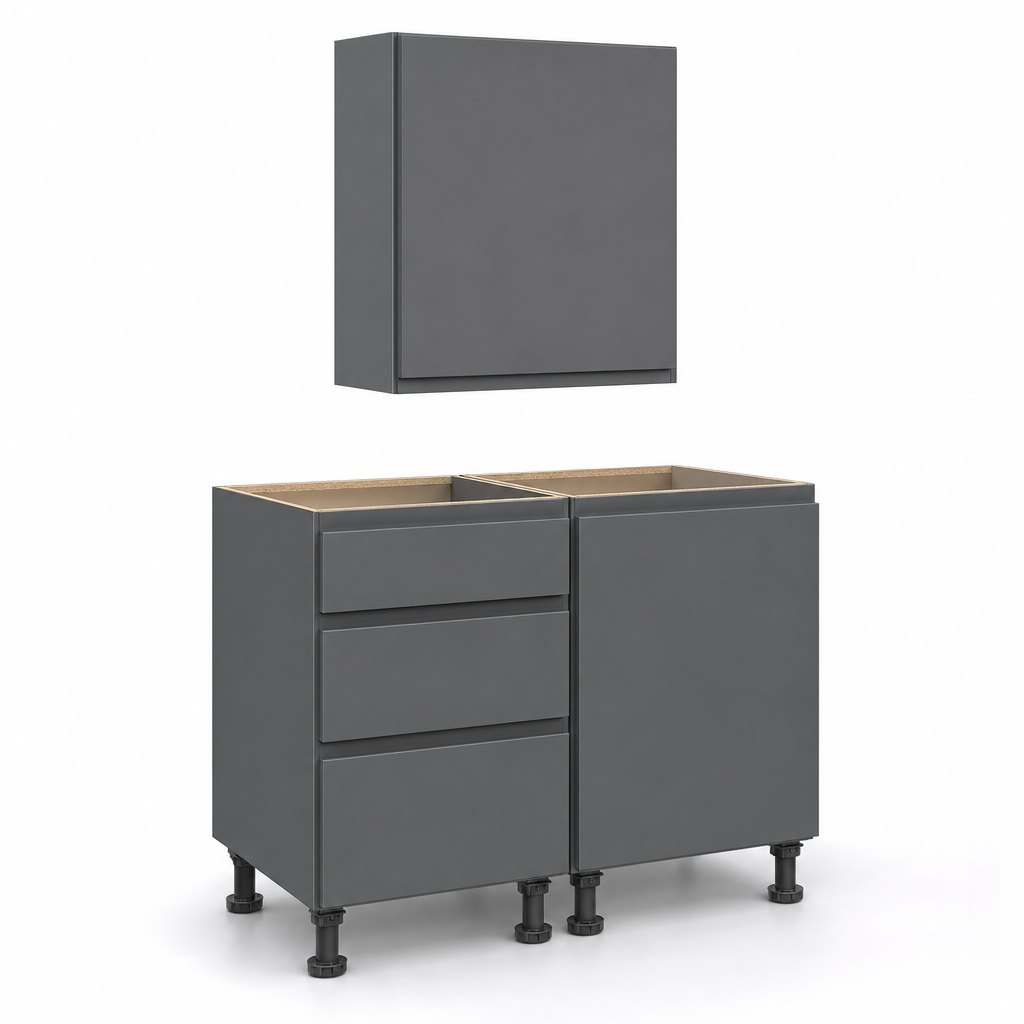
A 40HQ gives roughly 68 m3 of usable space, and cabinetry is cube-limited long before it is weight-limited. Flat-pack changes the arithmetic more than any freight negotiation: a three meter kitchen run in this program leaves as eight cartons at 0.52 m3, which puts about 125 runs — roughly 375 linear meters — into a container, and an assembled alternative at twice the volume halves that. A 900 mm vanity packs to 0.09 m3 and a 700 mm mirror cabinet to 0.055 m3, so a mixed container of kitchens, vanities and mirror cabinets is filled by carton count, not by piece count.
A Chilean RFQ that gets a usable answer in one round has the same seven lines every time, and none of them is a price. They are the specification, the evidence, the packaging, the ports and the volume — the price falls out of those. A supplier who receives them can quote a program; a supplier who receives a target price and a rendering can only guess at which board, which carcase and which hardware the number refers to.
- Market and channel: retail flat-pack, project homes or commercial fit-out — the three carry different hardware and edge expectations
- Board: HMR or interior grade, thickness, formaldehyde class, and whether the mill certificate travels with the shipment
- Model or module list with widths, carcase height and base depth, plus the worktop thickness you build to
- Evidence required: origin certificate support, board certificate with batch reference, and the SEC file for any lit model
- Packing: carton count, cubic meters and gross weight per set, plus packaging weights by material for the Ley REP declaration
- Volume: linear meters or pieces per order and per year, and whether mixed containers of kitchens, vanities and mirrors are allowed
- Destination port — San Antonio or Valparaíso — and the Incoterm, so the freight line is quoted against your route rather than a generic one
Questions Buyers Ask
Does the China-Chile free trade agreement mean cabinets enter Chile at zero duty?
Who is the obligated party under Ley REP when the cabinets are imported?
What does an LED mirror or lit mirror cabinet need for SEC in Chile?
How much does flat-pack actually save on freight into Chile?
Want the Numbers for Your Own Program?
Send your model list, sizes and destination port — we reply within 24 hours with FOB pricing, MOQ and lead time.