Brazil: The Warranty Clock Behind a Compact Kitchen Program
A compact-kitchen program is sold on price per metre and settled on after-sales. Between the purchase order and the first consumer complaint sits a legal warranty that starts at retail, not at shipment, and a tax file that starts at classification, not at the freight quote. This is the sequence a Brazilian distributor works through before the second container is ordered.
17 November 2026 · BR market · Fame Industry Co., Ltd.
The unit being fitted decides the run, not the catalogue
Compact apartments and refurbished older buildings are where a kitchen program actually moves in Brazil, and the constraint in those units is wall length, not taste. A 3,000 mm run quoted from a European catalogue arrives at a 2,400 mm wall, and the fitter resolves it with a saw: panels get cut on site, doors get chipped at the cut edge, and the cut edge is unsealed in a room that is about to be used for cooking.
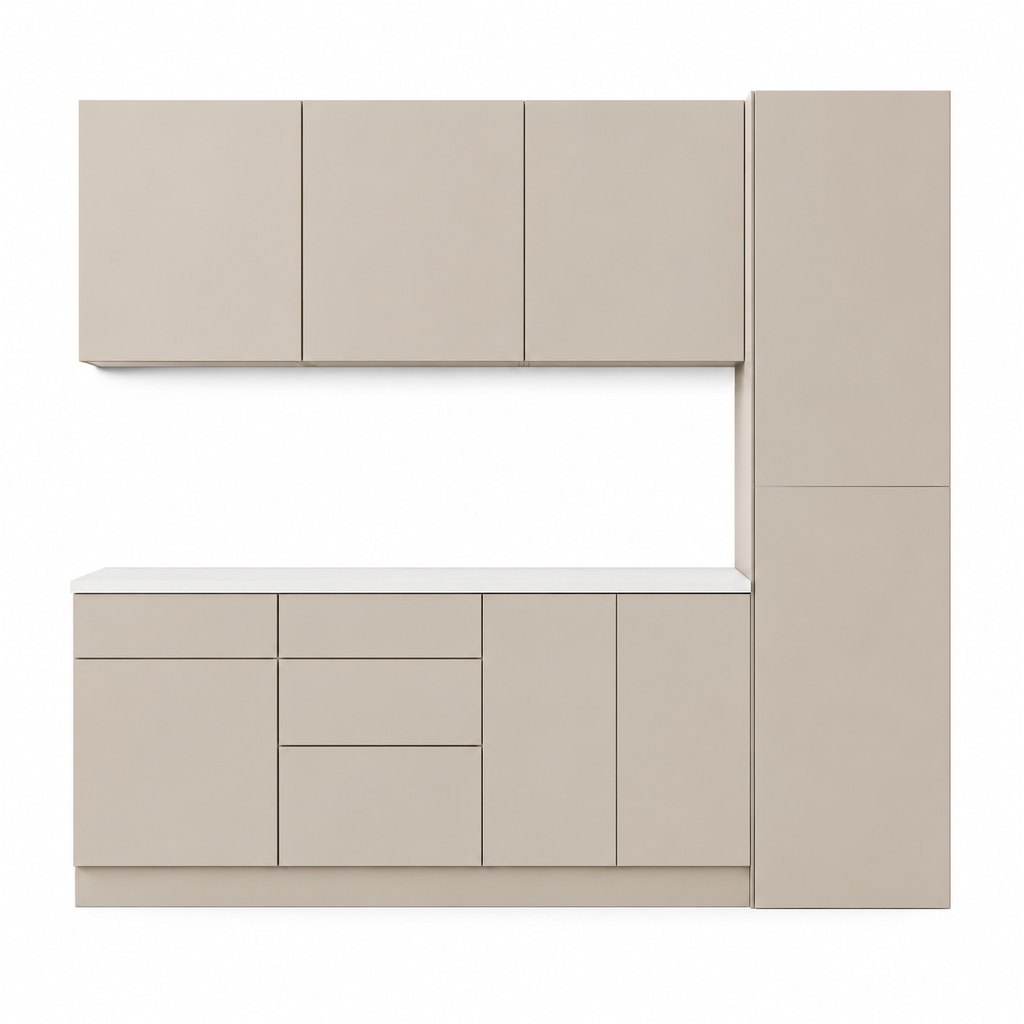
A 2,400 mm one-wall run removes that decision. Three 600 mm bases, three 600 mm wall units, one 600 mm tall larder and two 50 mm scribe fillers reach both end walls with the fillers taking up the tolerance. The cost argument is equally direct: 0.62 m3 per run against roughly 0.74 m3 for a 3 m run means the same container carries more finished kitchens, and the cost per metre of installed kitchen falls without touching the hardware specification.
- Quote the run in millimetres and name the filler width - tolerance is what the fitter argues about
- Keep one carcass system and one drilling pattern across run lengths, so the distributor carries one hardware set
- Never let the site cut a panel: a sealed factory edge and a saw cut are two different products in a wet room
Board, edge and plinth: the humidity specification
Two labels get used interchangeably in RFQs and they measure different things. E1 is a formaldehyde emission class, evidenced by a chamber test such as EN 717-2. A moisture-resistant grade is a board property. A kitchen in a Brazilian coastal city needs both stated, separately, on the quote, because a supplier who answers 'E1' has told you nothing about what happens when a wet cloth sits on a cut edge.
The practical specification is short: melamine on both faces, a sealed back edge, 1 mm ABS on every exposed edge, and a plinth that lifts the base off a floor that gets washed. A 0.4 mm edge tape is the first thing to lift in a steam-heavy kitchen, and once water reaches the core the panel swells and does not recover. None of this is expensive at the factory; all of it is expensive to fix after installation.
- Board grade and emission class as two lines on the quote, with the test method named
- 1 mm ABS edging on exposed edges, hot-melt glued and radiused, not 0.4 mm tape
- Sealed back edge and a plinth or adjustable feet keeping the carcass off the floor
- No solid wood in the pack, which also keeps the shipment clear of wood-packaging treatment
The ninety-day clock: what the consumer code actually obliges
Brazil's consumer code, the CDC (Lei 8.078/1990), sets a legal warranty independent of anything the supplier writes on a card. For durable goods - and furniture is a durable good - the consumer has ninety days from delivery to claim an apparent defect, and the same ninety days from the moment a hidden defect becomes evident. Thirty days applies to non-durable goods, which is why a supplier quoting '30 days' for a kitchen has usually copied the wrong line.
That clock starts at retail sale to the consumer, not at the factory gate and not at container discharge. A distributor importing on a 45-day crossing with a 30-day stock turn is already several months into a liability that the factory warranty does not necessarily cover. The commercial consequence is that the after-sales position has to be designed into the first order: who holds the parts, who authorises a replacement, and what evidence is required from the retailer before a claim is accepted.
- Ninety days for durable goods under art. 26, counted from delivery or from the emergence of a hidden defect
- Thirty days for non-durable goods - not the rule for cabinetry
- The supplier has thirty days to remedy a defect under art. 18 before the consumer may demand replacement or refund
- Put the parts-holding party, the authorisation path and the photographic evidence requirement into the supply agreement
Thirty days to repair means the part has to be in the country
Art. 18 gives the supplier thirty days to fix the product. Thirty days is roughly the ocean transit from Ningbo to Santos before customs clearance, so a program that relies on air-freighting a hinge from China will miss the deadline on the first claim and lose the argument on the second. The parts have to land with the goods.
The arithmetic is small against a container. Two percent of hinges and runners, one spare door front per twenty runs, one spare shelf per ten tall larders, plus a bag of cam locks and dowels, is a rounding error on the invoice and the difference between a same-week repair and a consumer complaint that escalates. The detail that gets missed is the invoice line: parts declared as samples attract a different treatment at entry, so list them as commercial goods with their own value and description.
- Two percent of hinges and runners per container
- One door or drawer front per twenty runs; one shelf per ten tall larders
- Parts invoiced as goods, not samples, with a material code each
- Agree who in Brazil holds stock - distributor, assembler or a third-party spare-parts warehouse
The entry file: from classification to ICMS
Wooden kitchen cabinets sit under NCM 9403.40.00, with bathroom furniture usually under 9403.60.00 - two lines, two files, one container. The applied Brazilian rate for 9403.40.00 is published in the current TIPI at 16.2 percent II with 3.25 percent IPI, against an 18 percent Mercosur common external tariff, but rates move by decree and by exception list, so the number that matters is the one your despachante confirma on the day of registration.
On top of II and IPI, PIS-Importacao at 2.1 percent and COFINS-Importacao at 9.65 percent apply to the customs value, AFRMM at 8 percent applies to the ocean freight under Law 14.301/2022, and ICMS is calculated por dentro on a base that includes the taxes already charged, at the rate set by the state of the importer. The Siscomex fee is charged per declaration plus each added item, on a sliding scale. Registration now runs through DUIMP, which means the importer needs RADAR authorisation in place and any required anuencia licence obtained before the vessel loads, not after it berths.
- Two NCM lines per mixed container: 9403.40.00 for kitchen, 9403.60.00 for bathroom furniture - confirm both with your broker
- PIS 2.1 percent and COFINS 9.65 percent on the customs value; AFRMM 8 percent on ocean freight
- ICMS por dentro, state rate, base grossed up with the other taxes - check the state before you price the shelf
- RADAR and DUIMP ready, and any anuencia resolved before loading
Cube, not tonnage: what a 40HQ of compact kitchens holds
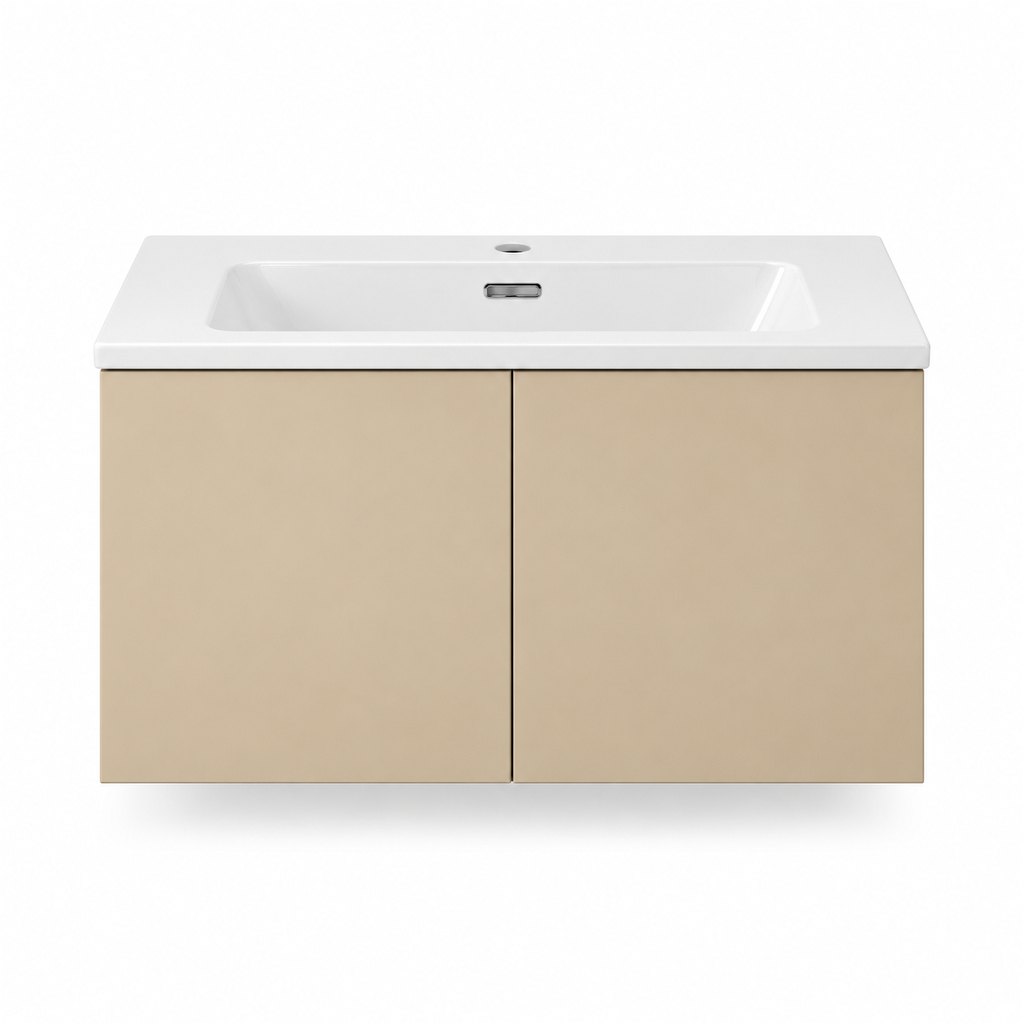
Board goods fill on volume. A 2,400 mm run at 0.62 m3 and 96 kg gross, and a 750 mm ceramic-top vanity at 0.133 m3 and 34 kg gross, both land near 155 kg per cubic metre. A 40HQ fills at about 68 m3 of usable cube, which is roughly 10 to 11 tonnes against a payload above 26 tonnes. Nothing in this shipment is weight-limited, so the planning variable is allocation, not payload.
A defensible first container for a distributor testing both categories is 60 kitchen runs and 220 vanities: 37.2 m3 plus 29.3 m3 is about 66.5 m3 and 13.5 tonnes. What that mix is not is an excuse to load china underneath board goods. The vanity tops travel upright at the door end with nothing bearing on the glaze, the kitchen cartons go behind them, and the container carries desiccant because condensation over a long crossing does more damage to board goods than a bump does.
- 68 m3 usable cube per 40HQ; 28 m3 per 20GP
- Single-SKU loads: 108 kitchen runs, or 508 ceramic-top vanities
- Mixed: 60 runs plus 220 vanities fills about 66.5 m3 at roughly 13.5 tonnes
- China tops upright at the door end, board goods behind, desiccant in the container, loading photos with the documents
Sequencing the launch: sample, file, parts, then container
The order that avoids the expensive mistakes is short. Sample one run and one vanity, and test what a Brazilian retailer will test: assemble the run and check the door line, run water over the vanity top edge and look for wicking at the cut, and photograph the label and the packing list against the invoice. Then lock the specification - board grade, edge thickness, drilling pattern, carton plan - because every change after approval re-opens the carton engineering.
Only then order the container, with the parts line included, the NCM classification confirmed in writing by the despachante, and the assembly drawing and warranty text in Portuguese inside the carton. The Portuguese insert is a retail problem rather than a customs one, which is exactly why it gets forgotten and then found by the first consumer who cannot read the fitting instructions.
- Sample before the PO, and test the edges rather than the showroom face
- Classification confirmed in writing before the deposit
- Parts line and Portuguese instructions bundled with the first container
- Second container ordered against sell-through, not against the freight saving
Questions Buyers Ask
How long is the legal warranty on a kitchen cabinet sold in Brazil?
If a hinge fails, how quickly does it have to be fixed?
What is the import classification for a flat-pack kitchen and the vanity that ships with it?
Does flat-packed board furniture need any special treatment for entry?
Want the Numbers for Your Own Program?
Send your model list, sizes and destination port — we reply within 24 hours with FOB pricing, MOQ and lead time.