Australian Cabinet Imports: WaterMark, Board Class and ISPM 15
An Australian importer does not buy a cabinet, it buys a package that has to clear biosecurity, satisfy a certifier and match a builder's set-out. Each of those three sits under a different rule, and each rule produces its own document.
15 November 2026 · AU market · Fame Industry Co., Ltd.
Three documents decide an Australian cabinet import, and price is not one of them
A kitchen or vanity container arriving in Sydney, Melbourne or Brisbane is checked three ways, and none of the checks is about the price per unit. The plumbing products inside the box fall under the Plumbing Code of Australia. The panels the carcass is cut from fall under the AS/NZS 1859 series for reconstituted wood panels. The timber used to pack the cartons falls under Australian biosecurity rules.
Buyers who treat those as paperwork to solve at clearance end up with a container on the wharf and a project handover date that has already moved. The cheap habit is to make the quotation carry one line per obligation, with a document name against each, so the file is assembled before the order rather than after the arrival notice.
The three questions to answer at quotation stage are simple: which plumbing products are in the box, which board class is the carcass, and what is the packaging made of and how was it treated.
- Plumbing products: WaterMark certification, model by model
- Panels: board class and test report to the AS/NZS 1859 series
- Packaging: ISPM 15 treatment, mark and a packing declaration
- Commercial: classification, ChAFTA certificate of origin, GST on importation
WaterMark follows the basin, the waste and the tap, never the carcass
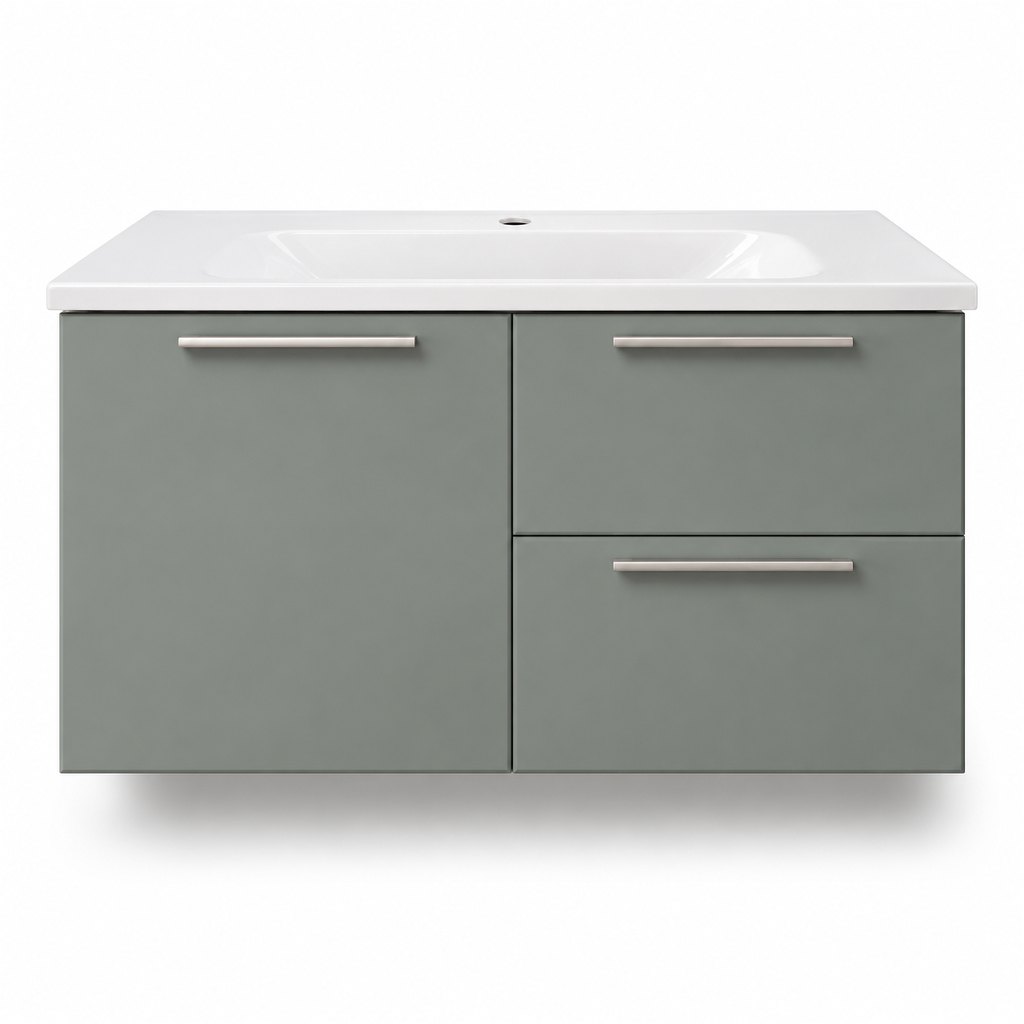
This is where a vanity container goes wrong. The carcass, the doors, the hinges and the handles are furniture and sit outside the plumbing regime entirely. A basin, a waste outlet, a trap or a mixer is a plumbing product, and the Plumbing Code of Australia requires critical plumbing and drainage products to be WaterMark certified before they can legally be installed.
So the compliance question is not whether the vanity is approved. It is whether the basin and the mixer in carton 2 are certified, whether the certificate covers the model and finish actually shipped, and whose name is on the licence. A chrome mixer and its brushed nickel sibling are separate models and can sit under different certificate entries.
Most merchants and importers solve this by buying cabinet only and pairing it with a basin and tap range they already stock and already list, because the local supplier already holds the licence and the paperwork. That removes a certification question from the container and keeps the bathroom package consistent across a project. When a basin does ship, put the WaterMark licence number on the packing list line rather than in a separate email.
- Cabinet, top surround, hinges: furniture, outside the WaterMark scheme
- Basin, waste, trap, mixer: plumbing products, WaterMark certification required
- Check the certificate by model and finish, not by brand
- Cabinet-only supply keeps the licence with the party that already holds it
E1 is the floor, E0 is the specification
In Australia the panel question is answered by class and by standard, and quoting a class is what a certifier can check. The AS/NZS 1859 series covers reconstituted wood panels, with 1859.1 for particleboard and 1859.2 for decorative overlaid panels. Under it, E1 is the baseline legal grade for interior panels at a formaldehyde emission of 1.5 mg/L on the desiccator method, and E0 is the tighter industry class at 0.5 mg/L.
Both are real, and both are acceptable on most projects; what is not acceptable is a specification that says only 'low formaldehyde' or 'moisture resistant'. A kitchen carcass is a large surface area in a small, warm, closed room, so the class belongs on the drawing, on the purchase order and in the file as a test report, not as an adjective in a brochure.
The same logic applies to moisture resistance. HMR board is the Australian default for carcasses because it is formulated for the humidity in a working kitchen. Thickness is the second half of that: 16 mm is the trade thickness hinges and runners are set up for, and 18 mm is common on fronts where the door carries the visual weight.
- AS/NZS 1859.1 for particleboard, AS/NZS 1859.2 for overlaid decorative panels
- E1: 1.5 mg/L desiccator, the baseline legal grade
- E0: 0.5 mg/L, the class most project specifications name
- Ask for the report against the panel, by class and by test house
ISPM 15 and the packaging question at the wharf
Cartons travel on pallets, in crates, or braced with dunnage, and that timber is a biosecurity risk regardless of what is inside the carton. Wood packaging must be treated and marked to ISPM 15, the international standard for phytosanitary measures on wood packaging material, and the shipment needs a packing declaration that states what timber packaging is present and how it was treated.
Australian biosecurity can inspect a container on arrival, and it can direct inspection to a facility with the right setup rather than at the first port. For wooden manufactured articles there is an additional supplier declaration requirement. None of this is unusual, and all of it is slower to fix after the vessel sails than before the booking is made.
There is a design decision buried in the rule as well. Cartons that are floor-loaded and braced with treated timber, or palletized on ISPM 15 pallets, are both workable; a mixed load where nobody recorded which pallet came from which yard is the version that stalls. Put the treatment mark, the pallet count and the declaration reference on the booking, and file the declaration next to the invoice.
- ISPM 15 treatment and legible mark on every timber pallet, crate and dunnage piece
- Packing declaration stating timber packaging and treatment method
- Supplier declaration where wooden manufactured articles are in scope
- Inspection can be directed on arrival, so schedule the buffer into the project
ChAFTA, GST and the customs value line
Duty and tax are two different lines on the same entry, and confusing them is a common way to lose margin. Under ChAFTA, in force since 2015, most manufactured goods of Chinese origin are scheduled to enter Australia free of duty, but the rate is claimed with a Certificate of Origin issued for the goods and the consignment, not assumed because the factory is in China.
The classification itself follows the article's construction, not the product name. A wooden carcass kitchen cabinet, an aluminum vanity cabinet and a ceramic basin do not sit in the same heading, and the invoice description has to match the code. Confirm the code with a licensed customs broker before the invoice is raised, because re-classifying after arrival means the container waits.
GST is payable on importation at 10 percent, on the customs value plus duty plus the international transport and insurance that got the goods to Australia. For a GST-registered importer it is a cash flow item rather than a cost, but it still lands before the goods are sold, which is why landed cost models for a container should carry it as a timing line.
- ChAFTA: duty-free entry claimed with a Certificate of Origin, not assumed
- Classification by construction and material, confirmed with a broker pre-invoice
- GST at 10 percent on customs value plus duty plus international transport
- Invoice description must match the code and the packing list
Cube, flat-pack and the cost per installed meter
A 40HQ holds roughly 76 m3 internally and loads to about 62-68 m3 of cartons depending on how well the pack tessellates. That ratio is the whole argument for flat-pack in a market as far from Ningbo as Australia: a carton that measures 780 x 620 x 150 mm stacks, a built cabinet does not, and the difference shows up as packs per container rather than as a unit price.
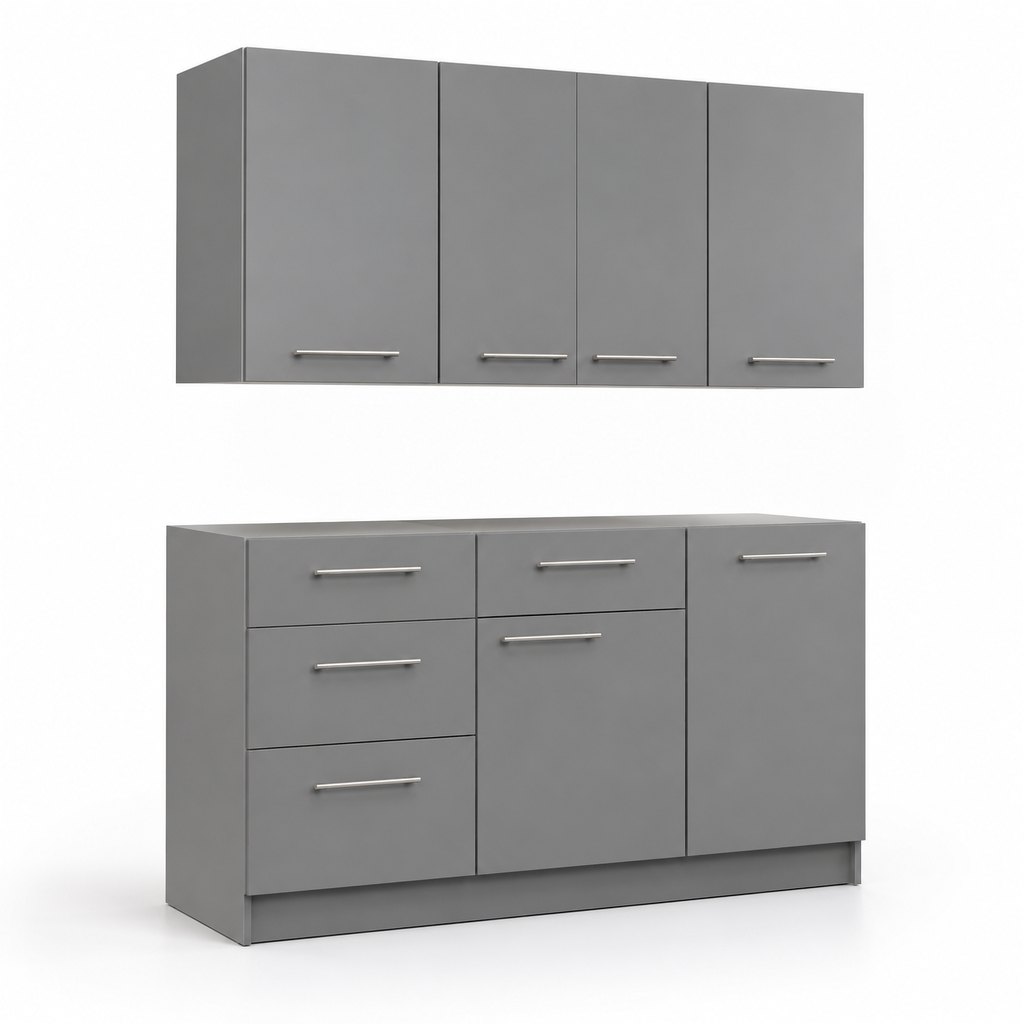
Take a realistic pack: eighteen units of 600 and 450 mm cabinets, fourteen cartons, 0.72 m3 and 182 kg. At 62 m3 usable that is 86 packs per 40HQ, or 1,548 units, on a single model. Change one carton dimension by 30 mm and the pack count moves; keep the carton table measured rather than nominal and the container arithmetic stays honest.
Assembly time belongs in the same comparison. A cam-and-dowel carcass with pre-fitted cams and pre-drilled hinge plates takes about ten minutes per base unit for someone who has built one before, which is a predictable labor line. The unpredictable line is a carcass that arrives out of square because the back panel was stapled rather than rebated into a groove.
- Measured carton table, cubic meters per pack, packs per 40HQ at 62 m3 usable
- Benchtop out of the pack: templated and fitted locally after leveling
- Assembly time quoted per unit, not per kitchen
- Weight per carton checked against manual handling limits on site
What to put on the purchase order
The purchase order is the only document that travels with the money, so it is the right place to pin the obligations down. Six lines cover almost everything a certifier, a broker or a site manager will ask for later, and each line is a document reference rather than a promise.
Keep the file in the order the container is cleared: the panel report and the hardware sheets support the product claim, the packing declaration and timber mark support biosecurity, and the certificate of origin and the classification support the entry. When one of them is missing at the wharf, it is almost always the packing declaration or the origin certificate, because both are treated as administrative until the day they are not.
- Board class and standard, with the test report named against the panel
- WaterMark licence numbers for any basin, waste or mixer in the box
- Measured carton dimensions, cubic meters per pack, packs per container
- ISPM 15 treatment and packing declaration reference
- Certificate of origin and the agreed commodity code
- Spares policy: hinges, runners and a touch-up pen per container
Questions Buyers Ask
Does a bathroom vanity cabinet need WaterMark certification in Australia?
Is E1 board legal in Australia, or must it be E0?
Does flat-pack furniture need ISPM 15 treatment?
How is duty calculated on a kitchen cabinet container from China?
Want the Numbers for Your Own Program?
Send your model list, sizes and destination port — we reply within 24 hours with FOB pricing, MOQ and lead time.