Importing Flat-Pack Cabinetry into Australia: Board Class, Duty and the Carton Plan
Australia is a metric market with its own board standard, its own plumbing scheme and a duty rate that is either five percent or nothing depending on a certificate. This is the order an importer works in: the geometry the fitter sets out from, the board document the builder will ask for, the certification that belongs to the tap rather than the cabinet, the entry arithmetic, the packaging rules, and the cube that decides the landed cost.
8 November 2026 · AU market · Fame Industry Co., Ltd.
A 460 mm carcass and 903 mm to the bench
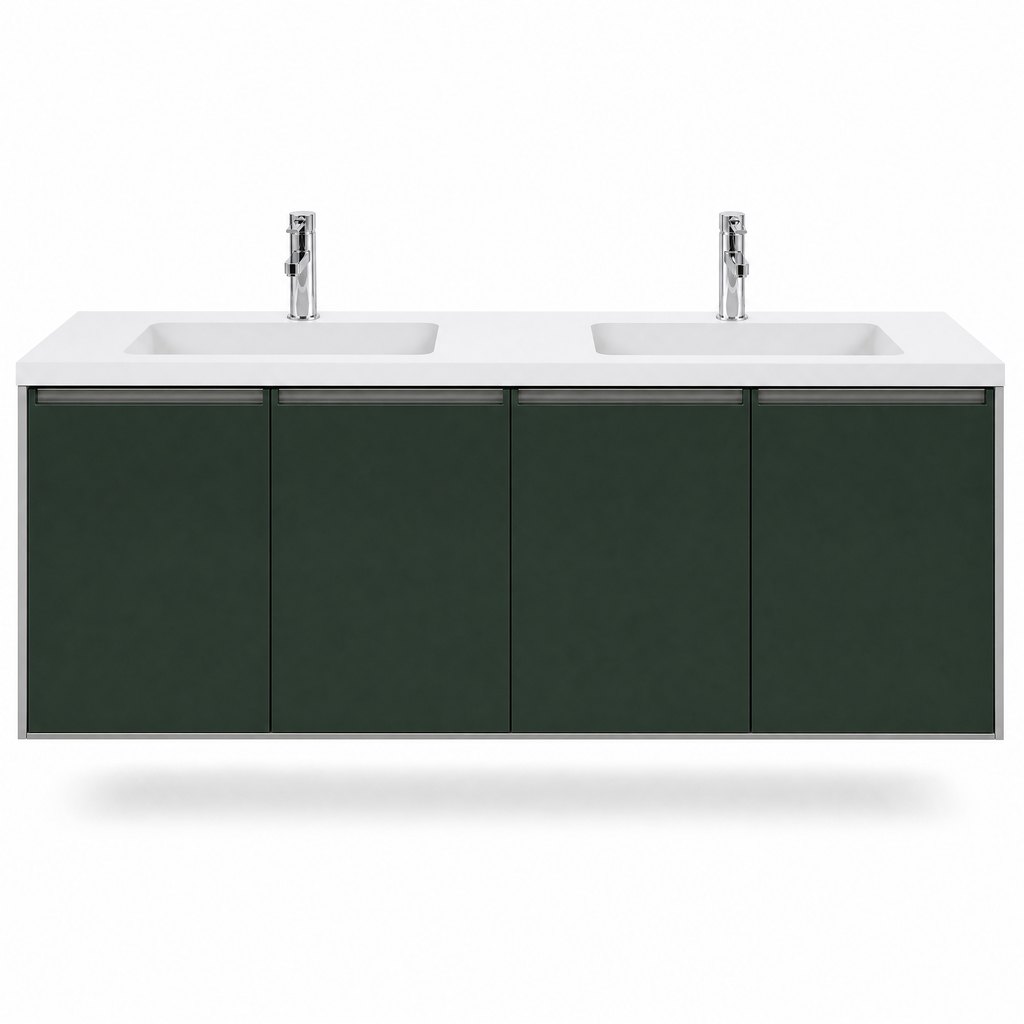
An Australian vanity is bought in a narrow set of widths, 600, 750, 900, 1200 and 1500 mm, and the depth is usually 460 mm because that is what clears a doorway swing and a shower screen in a bathroom that was framed before anyone drew a furniture plan. The carcass height that goes with it is around 520 mm wall-hung, or 850 mm floor-standing on a kickboard. A supplier quoting a 500 or 550 mm depth into this market is quoting a European module that will not drop into the alcove the builder has already lined.
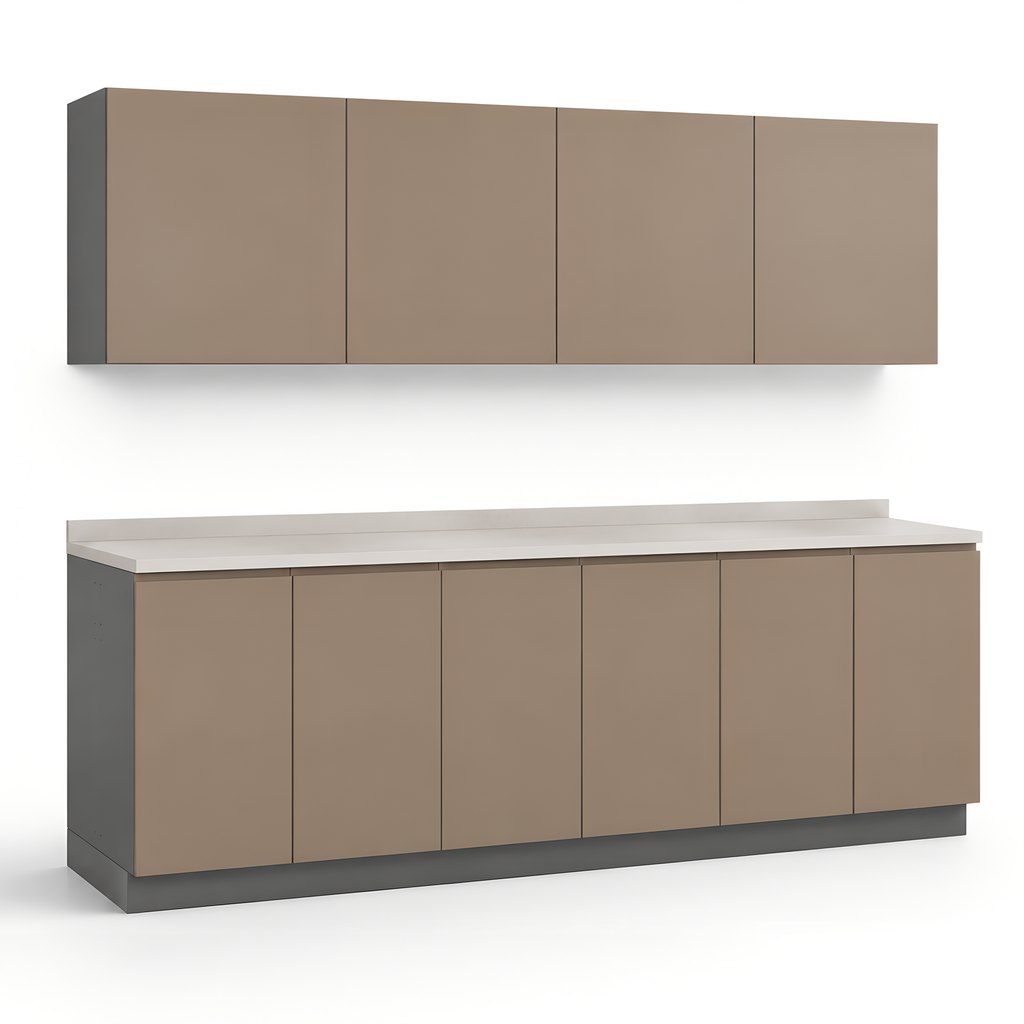
The kitchen numbers work the same way and are worth writing down, because they are the numbers every other decision hangs from. Base carcass 720 mm high and 560 mm deep, wall carcass 720 mm high and 350 mm deep, a 150 mm adjustable plinth, and a benchtop of 33 mm laminate or 20 mm stone. On laminate the finished bench is 903 mm; on 20 mm stone the same carcass lands at 890 mm. That is why the top thickness has to be fixed on the purchase order and not selected at the end of the job, and why a 600 mm carcass under a 600 mm benchtop is a mistake: the door face lands at 618 mm, the overhang goes negative, and every spill on the bench has a path down the front of the door.
- Vanity widths: 600, 750, 900, 1200, 1500 mm; depth 460 mm; wall-hung carcass about 520 mm high
- Kitchen base: 720 mm high x 560 mm deep; wall: 720 mm high x 350 mm deep; plinth 150 mm adjustable
- Bench height: 720 + 150 + 33 = 903 mm on laminate, 890 mm on 20 mm stone
- Door face at 560 + 18 = 578 mm, so 22 mm of overhang under a 600 mm benchtop
- Sink, hob and appliance voids are set from the finished height, so the top is chosen before the legs are set
Board class is a document, not a logo
Australian specifiers name AS/NZS 1859.1 for particleboard, and the part of it that decides whether a shipment is accepted is the formaldehyde declaration. Emission is measured by the desiccator method in AS/NZS 4266.16, and the result is expressed in milligrams per litre rather than in the chamber concentration used in Europe, so an E1 certificate written to EN 717-1 is not the same document and should not be offered as a substitute. What a builder or a certifier wants to see is a test report from a recognised laboratory, naming the panel mill and the class, matched to the board actually in the carcass.
The practical filter is simpler than the paperwork. Ask which mill made the board, ask for the report against that mill's production, and ask for the moisture-resistant grade where the panel is going under a sink or around a waste. A supplier who can describe the board as low emission but cannot name the test method has given a claim; a supplier who sends a report for a different mill's board has given a document that will not survive a query. On a container of flat-pack, the board is the single largest input by volume, so it is also where a cheaper quote is usually cheaper.
- Particleboard specification: AS/NZS 1859.1 — ask for the edition on the report
- Formaldehyde method: desiccator, AS/NZS 4266.16, result in mg/L, not the European chamber method
- Moisture-resistant board for carcasses under sinks, wastes and appliance voids
- Report should name the panel mill and the class, and match the board in the shipment
- Flat-pack shipments are mostly board by volume, so board substitution is where price gaps appear
WaterMark belongs to the tap, not the cabinet
A frequent misunderstanding on a first Australian order is that the whole vanity needs certification. It does not. WaterMark is a plumbing and drainage scheme, and the products that need it are the ones connected to a drinking water supply: tapware to AS/NZS 3718, and the mixers, hoses and outlets that go with it. A cabinet, a mirror or a set of hinges is furniture and carries no WaterMark obligation. The basin is a plumbing product but sits in the sanitaryware part of the scheme, which is why a basin supplied loose needs its own evidence while a cabinet does not.
The commercial consequence is that bundling a tap into a vanity offer moves the certification problem onto the importer. If the tap is WaterMark certified in the supplier's name and marked accordingly, the shipment is straightforward; if it is an uncertified mixer packed in the carton to make the offer look complete, the whole set becomes unsaleable through a plumbing merchant and, in most states, uninstallable by a licensed plumber. The clean structure is to ship the cabinet as furniture and let the tap be sourced locally against a WaterMark certificate, or to bundle only a tap that already holds one.
- Tapware connected to drinking water: WaterMark required, tested to AS/NZS 3718
- Cabinets, mirrors and hardware: furniture, no WaterMark obligation
- Certification sits with the product and the certificate holder, not with the carton it ships in
- An uncertified mixer bundled into a vanity set makes the set unsaleable through plumbing channels
- Simplest structure: cabinet as furniture, tap sourced against a WaterMark certificate
Five percent, or nothing, depending on a certificate
Wooden furniture of the kind used in kitchens and bathrooms is classified in heading 9403, and the most-favoured-nation rate on that heading is 5 percent of the customs value. Goods of Chinese origin with a valid Certificate of Origin under ChAFTA enter at free. The difference between those two outcomes is a document, not a negotiation, and the document has to be issued for the consignment and match the invoice description closely enough that an officer can trace it. A certificate that describes the goods differently from the commercial invoice is the most common reason a preference is refused at the counter.
On top of duty sits GST at 10 percent, calculated on the customs value plus the transport and insurance to the Australian port plus the duty itself. That is a cash-flow line as much as a cost line: a GST-registered importer claims the credit back, but the money is paid at entry. The Incoterm decides who is the importer of record. On FOB or CIF the Australian buyer is the declarant and needs an ABN and an EORI-equivalent entry through an accredited broker; on DDP the supplier becomes the importer, which in practice means an Australian business number and GST registration for the seller, and it is the arrangement that most often goes wrong on a first container.
- Heading 9403 for wooden furniture; MFN duty 5 percent of customs value
- ChAFTA: free with a valid Certificate of Origin issued for the consignment
- GST 10 percent on customs value + international transport and insurance + duty
- FOB or CIF leaves the entry with the Australian buyer; DDP pushes it onto the seller
- Invoice description and certificate description have to match, line for line
ISPM 15 stops at the crate
Wood packaging entering Australia has to meet ISPM 15, which means heat treatment or fumigation and the stamp on the timber. The rule applies to solid wood: pallets, crates, dunnage and bracing. It does not apply to processed board, so plywood cases, MDF crating and particleboard pallets are outside the scheme, and cartons are outside it entirely. That matters on a flat-pack cabinet shipment, where the product is board and the packaging is usually carton and pallet, and where a supplier who crates in solid timber for a one-off project creates a treatment requirement that did not exist for the previous twenty containers.
The compliance step is a packing declaration that states what the packaging is made of and whether it contains solid timber, backed by the ISPM 15 mark where it does. Australia runs its own certification scheme for treatment providers, so the mark has to be a genuine one rather than a stencil. The cost of getting this wrong is not a fine so much as a delay: a container held for inspection or re-treatment at the wharf costs more per day than the treatment itself, and it lands on the buyer's account under most Incoterms.
- ISPM 15 applies to solid timber packaging: pallets, crates, dunnage, bracing
- Processed board — plywood, MDF, particleboard — is outside the scheme, and cartons are too
- Packing declaration stating packaging material, backed by the ISPM 15 mark where applicable
- Australia certifies its own treatment providers, so the mark has to be verifiable
- The real cost of a miss is wharf delay and re-treatment, charged to the importer on most terms
The carton plan is the landed cost
Freight is bought by volume, so the number that decides the landed cost per unit is cubic meters per set, and it is the number a factory is least likely to volunteer. Two worked examples make the arithmetic concrete. A 1200 mm wall-hung vanity built as one carcass packs to about 0.280 m3 in three cartons, against roughly 0.32 m3 for two 600 mm units bolted together, because the second unit carries its own back panel, its own rail and its own carton void. A twelve-unit flat-pack kitchen packs to about 1.04 m3 in fifteen cartons, and the tallest panels at 2,050 mm are floor-loaded while the other fourteen palletize.
Then divide into a container honestly. A 40 foot high cube is about 76 m3 nominally, but stowage loss, carton voids and door-end blocking bring the planning figure to roughly 68 m3. At 0.280 m3 a set that is about 240 vanities; at 1.04 m3 a pack it is about 65 kitchens, and 65 times 1.04 is 67.6 m3, leaving under half a cubic meter of slack. Anyone quoting a loading quantity that cannot be reproduced from the carton list within a few percent is quoting a sales figure. The carton list is also the document the forwarder books against, so it is worth having before the order is confirmed rather than after.
- One 1200 mm carcass: 0.280 m3 in three cartons, against roughly 0.32 m3 for two 600 mm units
- One twelve-unit kitchen pack: 1.04 m3 in fifteen cartons, 138 kg gross
- 40HQ planning figure: about 68 m3 usable, not the 76 m3 nominal
- About 240 vanities or about 65 kitchen packs per 40HQ, reconcilable to within a few percent
- 2,050 mm tall-panel carton is floor-loaded; everything else palletizes on 1,200 x 800
Fixing to a wall that was never designed for the vanity
A loaded 1200 mm vanity with two solid-surface bowls is around 68 kg before anyone puts a towel in it, and the wall behind it in an Australian home is usually brick veneer: a single skin of brick, a cavity, and timber studs at 450 or 600 mm centers with plasterboard over them. The brick carries the weather, not the cabinet. The load has to reach the studs, so a hanging rail is positioned to span two of them and the fixing schedule says what to do when the studs fall between the bolt holes, which on a 1200 mm unit is common enough to plan for rather than discover.
Two things reduce callbacks more than any hardware upgrade. The first is a rail that spans the full width instead of two small brackets, because it turns four point loads into a line and lets the installer choose where to drill. The second is a written wall specification covering the three walls actually found in the market: brick veneer on studs, full masonry, and plasterboard on steel framing. Toggle anchors in plasterboard are not a fixing for a 68 kg wall-hung unit whatever their rating says, and a supplier who ships a cabinet without saying so is handing the problem to the plumber.
- Loaded weight around 68 kg for a 1200 mm double-bowl vanity
- Brick veneer: the brick is a skin, the studs at 450 or 600 mm centers take the load
- Full-width rail converts four point loads into a line and lets the installer choose the drill position
- Wall schedule should cover brick veneer on studs, full masonry, and plasterboard on steel frame
- Plasterboard toggles are not a fixing for a 68 kg wall-hung cabinet, regardless of the stated rating
Questions Buyers Ask
Do flat-pack cabinets need WaterMark to be sold in Australia?
Is an E1 certificate to EN 717-1 accepted in Australia?
What duty will I pay on a container of Chinese-made cabinets?
Do I need ISPM 15 for cartons?
Want the Numbers for Your Own Program?
Send your model list, sizes and destination port — we reply within 24 hours with FOB pricing, MOQ and lead time.