Australia Cabinet Imports: AS 4386, WaterMark, Freight
Australia is not a smaller version of the UK or US market. The cabinet standard is named differently, the plumbing rules sit on the tap rather than the carcass, biosecurity looks at the pallet, and the number that decides the landed cost is cubic meters per meter of run. Here is the order an Australian buyer actually asks the questions in.
1 November 2026 · AU market · Fame Industry Co., Ltd.
The importer carries the file, not the factory
When a container of vanities or flat-pack kitchens lands in Sydney or Melbourne, the party that has to answer for it is the Australian importer of record, not the factory in Zhejiang. That party accounts for 10% GST at import, holds the commercial invoice and packing list, answers a biosecurity question about packaging if one is raised, and — if it places its own label on the goods — takes on the seller obligations that come with that label. This is why a first enquiry from an Australian distributor rarely starts with a target price. It starts with the documents.
The practical consequence for a factory is that the compliance pack is part of the product. A quotation that arrives with a board certificate, a test report reference and a packaging data sheet is easier to defend internally than one that arrives with a price and a promise, and the difference shows up long before the container is booked.
AS 4386:2018 is the standard an Australian specifier will name
The current Australian reference for built-in cabinetry is AS 4386:2018, Cabinetry in the built-in environment — Commercial and domestic. It replaced the older domestic kitchen assembly standard, and the test methods that go with it sit in the AS/NZS 4387 series — separate methods for carcass strength, shelf and bottom surface loading, door and drawer operation, and worktop strength. A project specifier, a merchant builder or a cabinetmaker supplying a volume builder will name AS 4386 rather than a European standard, because that is the document their certifier and their insurer recognise.
What matters commercially is that the evidence is tied to a build, not to a brand. A report on a 720 mm carcase in 16 mm board says nothing about a 2100 mm tall unit in the same program unless the tall unit was in the tested sample, and a worktop report under a different part of the series does not cover the cabinets. A supplier who states which build was tested, and in which board, saves the buyer an argument they would otherwise have with their own quality manager.
- Ask for the AS 4386 test report reference and the date of the tested build, not a certificate of compliance in principle
- Confirm the carcase height, board thickness and door type that were tested — a 720 mm base unit is not the same structure as a 2100 mm tall unit
- Ask separately for worktop evidence if the program includes tops, since that is a different test in the AS/NZS 4387 series
- Put the door and drawer cycle count you require into the RFQ so the sample build is agreed before the MOQ run
Board: AS/NZS 1859.1, E1, and why HMR is a separate question
Reconstituted wood panels are specified in Australia against the AS/NZS 1859 series, with AS/NZS 1859.1:2017 covering particleboard. Formaldehyde emission is expressed as a class, and E1 is the class most trade programs work to. In practice the Australian buyer wants the panel producer's certificate with a batch reference that ties the delivered boards to the tested lot, because the class belongs to the mill, not to the cabinet factory — a factory buying from three mills has three files to keep straight and a due-diligence answer that changes with the decor.
Moisture resistance is a separate specification, and it is the one that decides failure in service. HMR — high moisture resistant — particleboard has a green-dyed core and a specified swelling performance, and it is the board most Australian flat-pack joinery is actually milled in, at 16 mm. A program built on an 18 mm interior board because that is what a European factory runs is a program importing its panels. For a bathroom, the specification that survives a room with no mechanical extraction is HMR with a sealed edge, and it costs less to specify at the order than to replace at year three.
- Board certificate with batch reference, per decor, from the mill that produced the panels
- Formaldehyde class stated explicitly — E1 unless the project asks for lower
- HMR core for bathroom carcasses, with the swelling figure stated rather than implied
- Edge banding thickness and adhesion method, which is the first thing to fail in a rental kitchen
WaterMark and WELS: the tap is regulated, the cabinet is not
This is the point where Australian enquiries most often go sideways. A vanity carcass or a kitchen cabinet is furniture and falls outside the plumbing regime. The tap does not. Tapware, outlets and the plumbing components of a basin or sink installation are covered by the WaterMark certification scheme administered through the ABCB, and a licensed plumber in Australia cannot legally install an uncertified product — which means a vanity shipped with a bundled, uncertified mixer is a vanity that stalls on site, no matter how good the cabinet is.
Water efficiency runs on a second scheme. WELS, operating to AS/NZS 6400:2016, requires registration and a star rating label for taps, showers, toilets, urinals, washing machines and dishwashers, and the label has to match the registered model. Both regimes work at model level, not at brand level, so the useful question to a factory is not whether it is certified but which model numbers are on the certificate — and whether the same model will still be on it in eighteen months, when a warranty claim lands.
Biosecurity looks at the pallet, not the carton
Australia's biosecurity requirements reach the packaging before they reach the product. Solid wood packaging — pallets, crates, dunnage, bearers — has to meet ISPM 15: heat treated or fumigated, and stamped with the IPPC mark showing the country code and the treatment code. Cartons, moulded pulp, and engineered panels such as plywood are outside that requirement. In a flat-pack kitchen shipment the pallet is usually the only regulated article in the container, and it is also the cheapest thing to get wrong: a re-treated or rejected pallet at the wharf costs more in delay than the pallet cost to begin with.
The factory-side answer is a packing spec rather than a certificate: which pallet, which treatment, which stamp, and where the stamp sits so an inspector can read it without breaking down the load. For a distributor taking mixed containers of kitchens, vanities and mirror cabinets, one packing spec across all three lines is worth more than three separate declarations.
Cubic meters per meter of run: the 40HQ arithmetic
Classification follows the material that gives the article its essential character: wooden kitchen furniture normally falls in 9403.40, other wooden furniture including bathroom vanities in 9403.60, metal furniture such as an aluminum cabinet in 9403.20, and ceramic sinks and washbasins in 6910.10. The duty rate on the entry depends on the classification and on whether a ChAFTA certificate of origin is presented, and it is the importer's broker who confirms both — the factory issues the origin documentation, it does not set the rate.
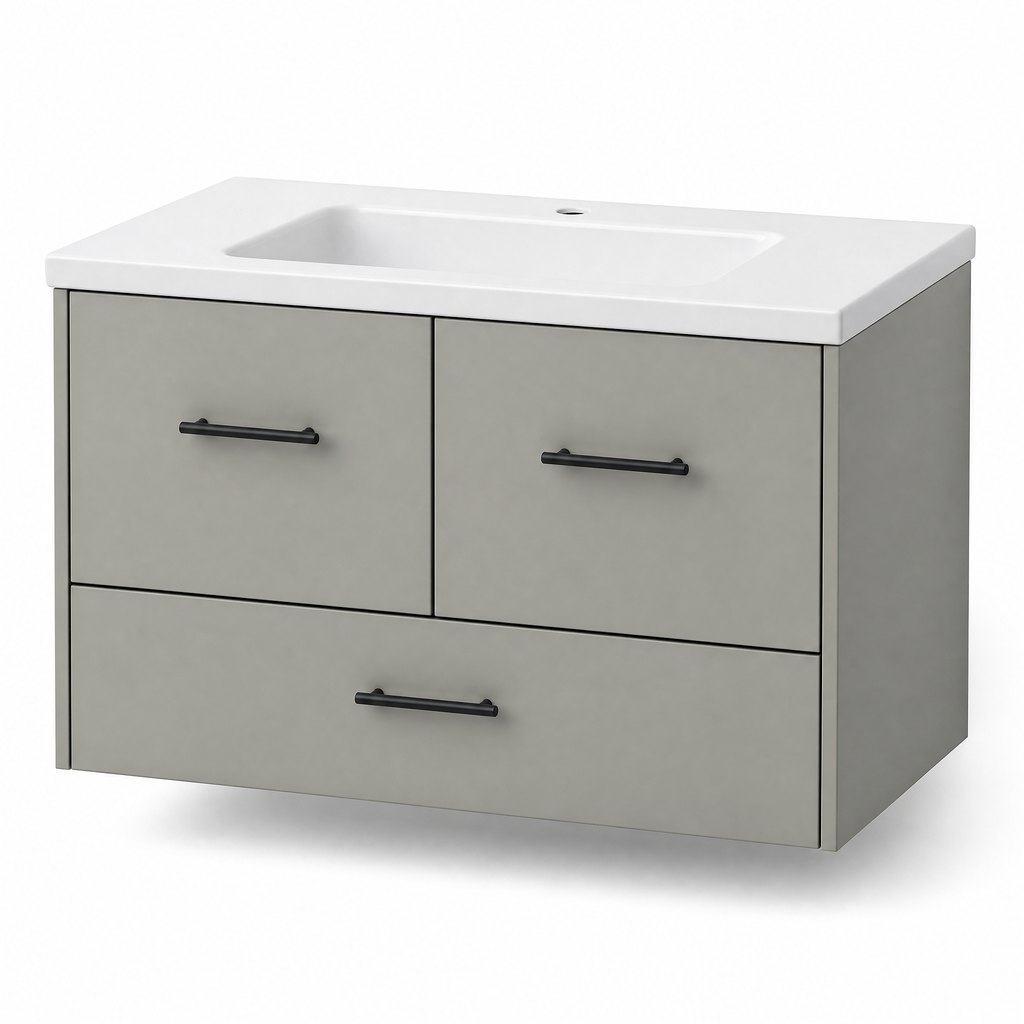
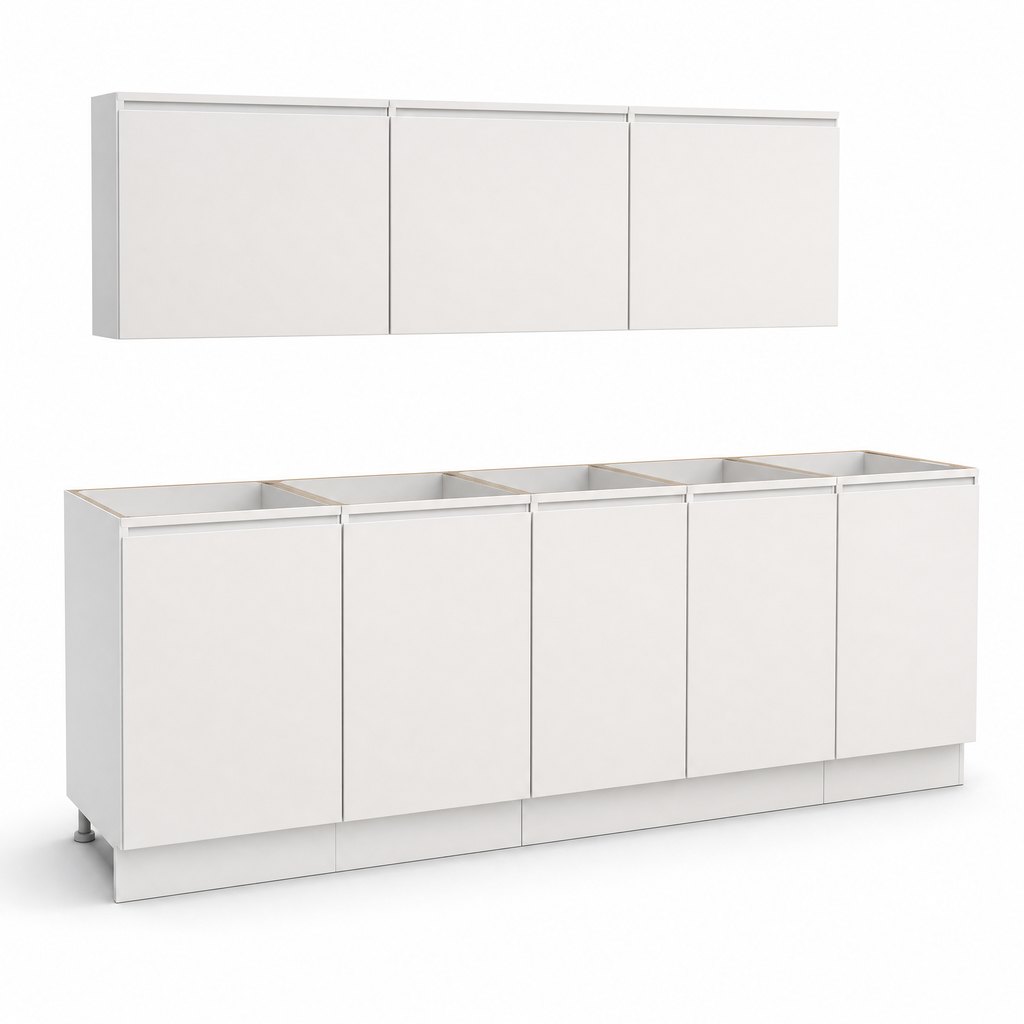
The number that decides whether a landed cost works is cubic meters per meter of run, not the ocean rate of the week. A 40HQ gives roughly 68 m³ of usable space, and assembled carcasses spend a large part of it on air. Flat-pack changes the arithmetic: a three-meter kitchen run in eight cartons at 0.52 m³ puts about 125 runs — around 375 linear meters — into a container, and a 900 mm wall-hung vanity packs to 0.09 m³ flat against 0.19 m³ assembled. That is the difference between a freight line that is a small share of landed cost and one that is twice that share, and it moves with the ocean rate rather than against it.
- Carton count, carton dimensions, total cubic meters and gross weight per set — not only the unit price
- Tariff classification confirmed in writing by the importer's broker before the landed cost is priced
- Which Australian port, and whether the booking allows a mixed container of kitchens, vanities and mirror cabinets
- Per-SKU packaging weights by material, so any packaging data obligation can be answered without re-weighing cartons
- AS 4386 report reference, AS/NZS 1859.1 board certificate with batch trace, and the HMR swelling figure
- For any lit product: the electrical compliance file and the driver supplier named, with a spare-part line
What to put in the RFQ
An Australian RFQ that gets a usable answer in one round has the same six or seven lines every time, and none of them is a price. They are the specification, the evidence, the packing, the ports and the volume — the price falls out of those. A supplier who receives them can quote a program; a supplier who receives a target price and a photo can only guess at which board, which carcase and which hardware the number refers to.
- Market and end use: project homes, retail flat-pack, or commercial fit-out — the three have different carcass and hardware expectations
- Board: HMR or interior grade, thickness, formaldehyde class, and whether the certificate has to travel with the shipment
- Module or model list with widths, plus the carcase height and base depth you build to
- Evidence required: AS 4386 report, board certificate, and for any lit item the electrical file
- Packing: flat-pack or assembled, pallet type, and confirmation of ISPM 15 treatment
- Volume: linear meters or pieces per order, and how many orders per year
- Destination port and Incoterm, so the freight line is quoted against your route rather than a generic one
Questions Buyers Ask
Does a bathroom vanity or kitchen cabinet need WaterMark certification in Australia?
Is AS 4386 mandatory, or only when a customer asks?
What formaldehyde class does Australia require for cabinet board?
How much does flat-pack actually save on freight into Australia?
Want the Numbers for Your Own Program?
Send your model list, sizes and destination port — we reply within 24 hours with FOB pricing, MOQ and lead time.