US Cabinet Imports: The Compliance File Before the Price
A US buyer rarely loses a supplier on price. The order is lost earlier — when the formaldehyde declaration, the plant-product declaration or the classification cannot be produced on request. Here is the file, in the order it gets asked for.
30 October 2026 · US market · Fame Industry Co., Ltd.
Why the American file is asked for earlier than the price
A US importer placing its own brand on bathroom or kitchen cabinetry carries the legal position of the manufacturer for product safety and environmental compliance. That single fact explains the sequence of a first email: the buyer wants to know whether documentation exists before it invests time in a drawing, a sample or a margin model.
The practical consequence for a factory is that the file is a qualification gate, not paperwork to be completed after the PO. A supplier that can send four documents in one reply is treated as low risk and moves to sampling. A supplier that answers price first and documents later usually does not hear back.
TSCA Title VI and CARB Phase 2: which one applies, and to what
TSCA Title VI (40 CFR Part 770) is the federal formaldehyde emission standard for composite wood products — hardwood plywood, medium-density fiberboard and particleboard — manufactured, imported, sold or supplied in the United States. CARB Phase 2, under California's airborne toxic control measure for composite wood (17 CCR §93120), is the state rule that the federal standard was built on. In practice a factory supplying the US market works to one emission level and keeps the paperwork for both.
Two details decide whether a container is clean. First, the certification belongs to the panel producer, not to the cabinet factory, and the panel producer's name and lot information must be traceable through the factory's records. Second, the scope is composite wood — an aluminum cabinet, a mirror cabinet and a ceramic basin are outside it, which is one reason aluminum and glass lines are simpler to import than a board-built vanity.
The Lacey Act declaration is about the wood, not the finish
The Lacey Act requires an import declaration for plants and plant products, filed on PPQ Form 505, naming species and country of harvest. Cabinets built from MDF or particleboard contain wood fibre and normally require a declaration covering the panel content; the fact that the surface is melamine or paint does not remove the obligation.
This is where a supply chain with one panel source is commercially better than one with three. A melamine carcass traces to a single board producer, with a single species and origin answer. A painted door program that adds an MDF door blank from a second mill doubles the declaration work and lengthens the importer's audit.
Classification decides the duty, and it is not always obvious
Cabinets for the bathroom and kitchen generally land under heading 9403, but the subheading follows the material that gives the article its essential character: 9403.20 for other metal furniture, 9403.60 for other wooden furniture. A ceramic-top vanity, a mirror cabinet with an aluminum body and an aluminum outdoor kitchen can therefore sit in different subheadings even though a dealer sells them side by side.
Classification is also where additional duties attach. Chapter 99 subheadings carry country-specific additional duties on many furniture and cabinet lines, and both the lists and the rates change by effective date. The rate that applies is the one in force on the entry date, so the importer's broker — not the factory — confirms the subheading and the Chapter 99 treatment before the PO is priced.
- Ask the factory for the bill of materials by component and material, not just a product name
- Have the broker confirm the 10-digit subheading in writing before pricing the landed cost
- Check Chapter 99 additional duties for the origin and the entry date, not from memory or an old quotation
- Keep the classification decision on file — a repeated entry is easier to defend than a re-argued one
ISF, bond and entry: the timeline that catches first-time importers
The Importer Security Filing — ISF 10+2 — must be filed with US Customs and Border Protection at least 24 hours before the cargo is loaded at the foreign port, which means the importer needs the factory's booking data, not just the invoice. Missing the window does not stop the ship; it exposes the importer to penalties and to a hold at destination.
Entry itself is filed on CBP Form 7501 by a licensed broker, and a continuous bond is normally in place before the first shipment. The documents the broker will ask the factory for are consistent across suppliers: commercial invoice with the correct consignee, packing list with carton dimensions and gross weight, bill of lading instructions, and the classification and origin data behind them.
Container math: why a per-meter quote is really a freight decision
For volume cabinetry the freight cost per unit is set more by packing density than by the ocean rate of the week. A 40HQ gives roughly 68 m³ of usable space, so the question a distributor should ask is not how many units fit, but how many cubic meters each configuration occupies and what that does to the landed cost per meter of run.
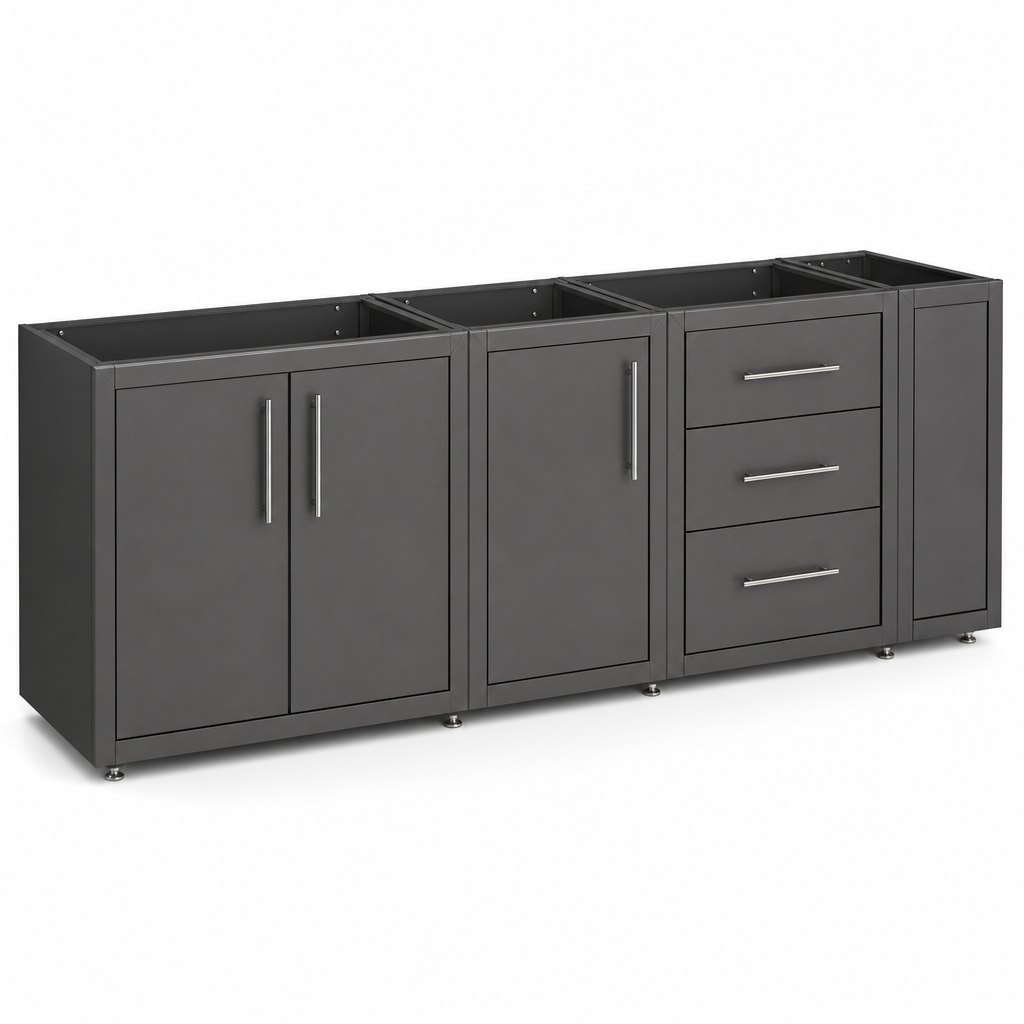
This is where flat-pack and hollow-section construction earn their place. An aluminum mirror cabinet packs one unit into 0.15 m³; a flat-pack outdoor kitchen packs a 3.0 m run into 0.62 m³ across five cartons. Assembled carcasses consume volume with air, and a container of air is a container of freight that nobody invoices for.
- Ask for carton count, carton dimensions and total cubic meters per set — not only gross weight
- Model landed cost per linear meter of run, not per cabinet box
- Mix dense items (mirror cabinets, basins) with bulky items (kitchen runs) to fill a container without hitting the weight limit
- Confirm whether the factory loads at Ningbo or Shanghai and whether the booking allows a mixed LCL for sample orders
What belongs in a quotation that a US buyer can sign
The quotation that closes fastest answers the compliance questions in the same document as the price, so the technical and commercial reviewers can sign off in parallel instead of taking turns. In our experience that structure shortens a program more than any discount on the unit price.
It also sets up the second order. A buyer who has already filed the declarations, the classification and the ISF data for a first container can repeat them by reference; the cost of compliance is front-loaded, and a supplier who makes the first file complete becomes the default for the next program.
- FOB price per unit at a named port, with packaging cost broken out rather than absorbed
- Carton count, volume and gross weight per set, so freight and consolidation can be modelled
- Board grade and panel producer with certificate reference — or a written statement that the product contains no composite wood
- Construction details that matter to the classification: carcass material, door substrate, top material
- Loading quantity per 20GP and 40HQ for the exact configuration quoted
- Lead time measured from deposit and from drawing approval, stated as two separate numbers
- Compliance statements a US buyer will ask for by name: TSCA Title VI / CARB Phase 2 for composite wood, Lacey Act plant content, and California Proposition 65 where the product is sold into California
- Performance reference for residential cabinetry, such as ANSI/KCMA A161.1, where the program is sold through kitchen and bath retail
Questions Buyers Ask
Does TSCA Title VI apply to aluminum cabinets and mirror cabinets?
Who files the ISF — the factory or the importer?
Is a vanity with a ceramic top classified as wooden or ceramic furniture?
Do we need a Lacey Act declaration for MDF and particleboard?

Want the Numbers for Your Own Program?
Send your model list, sizes and destination port — we reply within 24 hours with FOB pricing, MOQ and lead time.